Taxonomy & naming
The green-gold cory was described by the British ichthyologist Charles Tate Regan in 1912 as Corydoras melanotaenia, from material attributed to Colombia. For more than a century it has been bred and traded under that name, lumped together with the other shiny, deep-bodied members of the so-called 'aeneus group' of Corydoras Lacépède, 1803 — the enormous genus of South American armoured catfishes in the family Callichthyidae.
That genus had become unmanageable, with well over 170 species, and molecular work showed it was not a single natural lineage. In 2024 Dias, Tencatt and colleagues published a large revision of the subfamily Corydoradinae that split Corydoras into several genera, among them the resurrected Brochis and the resurrected Osteogaster. The bronze cory and its near relatives — including the green-gold cory — fall in Osteogaster, so under the current Catalog of Fishes classification the valid combination is Osteogaster melanotaenia (Regan, 1912). The change is recent and the aquarium world still overwhelmingly says 'Corydoras melanotaenia,' so we keep that as the heading while flagging the new genus. One footnote worth knowing: the original type-locality data ('Honda, Río Meta system') is internally contradictory — Honda sits on the Río Magdalena, not the Meta — and like several early Regan localities it should be read with caution.
Morphology
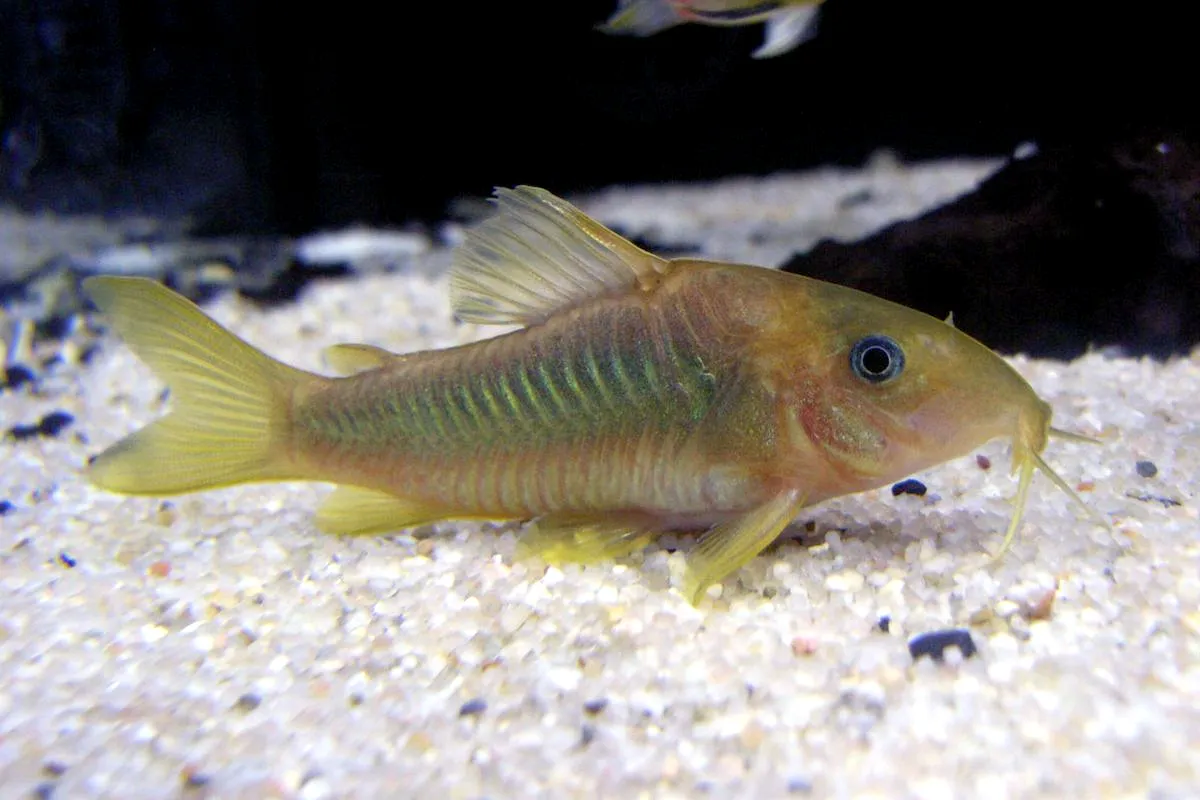
This is a small, comparatively slender cory, more elongate than the stockier bronze, reaching roughly 2–2.5 in in total length; females grow a little larger and noticeably rounder than males. The body plan is pure Corydoras: in place of scales, two overlapping rows of bony plates (scutes) run the length of each flank and meet in a ridge along the back, the head is a hard, blunt helmet, and three pairs of short barbels fringe the downturned mouth.
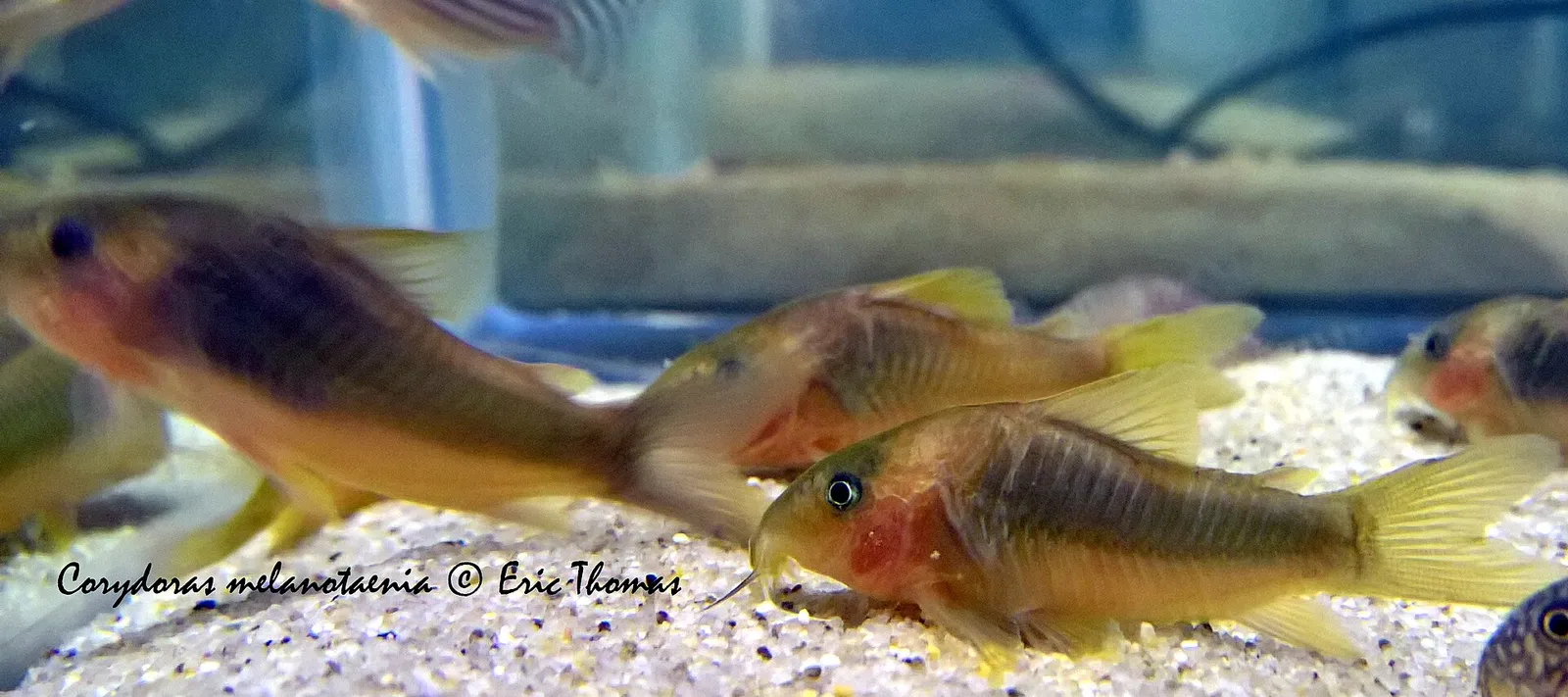
What sets it apart is colour. The ground is a pinkish-tan overlaid with a bright, iridescent green-to-gold sheen along the side — brighter and more golden than the bronze cory's flush — and the species takes its name from a darker band running along the upper flank and the dusky, blackish crown and dorsal ridge, the 'black-top' of one of its trade names. The dorsal, pectoral and adipose fins each carry a stiff, mildly venomous spine, the standard cory defence; in this species the soft fins often carry a warm yellow-gold tint that adds to its appeal.
Habitat
Corydoras melanotaenia is a Colombian endemic of the upper Orinoco/Meta drainages on the eastern (llanos) side of the Andes. It is a fish of the quieter shallows — small forest streams and creeks, the margins of larger rivers, flooded forest and exposed sand banks — typically over soft sand with leaf litter and submerged wood.
These are warm but not hot waters, and the species is reported from a moderate envelope: temperatures around 68–79 °F, a slightly acidic to neutral pH (roughly 6.0–7.2) and soft to moderately hard water. The relatively cool, well-oxygenated end of that range matters in captivity, where the fish does better below the tropical-hot temperatures often given to community tanks. Like all corys it is a facultative air-breather, periodically darting to the surface to gulp air and absorb oxygen through a vascularised hindgut — an adaptation that lets it ride out the warm, oxygen-poor conditions of shrinking dry-season pools.
Feeding
The green-gold cory is a benthic omnivore and detritivore that works the bottom continuously, burying snout and barbels in sand to taste out small invertebrates, insect larvae, worms, micro-crustaceans, fallen seeds and the organic film of detritus, then expelling cleaned sand through the gills. It is an opportunist rather than a specialist, which is a large part of its hardiness. In the aquarium it readily takes good-quality sinking pellets and tablets as the staple, supplemented with frozen or live daphnia, brine shrimp and bloodworm; as with any cory it should never be left to scavenge only what its tankmates drop, and a varied, regularly delivered diet keeps it in condition.
Mating
Like all Corydoras, the green-gold cory is an egg-laying shoaler with no pair bond and the family's distinctive courtship. When a female is ripe she cleans a site — a leaf, a stone, the aquarium glass — and the group becomes active; a male takes up the classic 'T-position', lying at right angles to her head, and she appears to take his milt into her mouth. Sperm is thought to pass rapidly through her gut to fertilise the few eggs she clasps in a basket formed by her pelvic fins, which she then carries to the cleaned surface and presses into place. The sequence repeats, a few eggs at a time, until the clutch — adhesive, sticky eggs in modest numbers — is scattered over the chosen spots.
Breeding
The green-gold cory breeds along standard cory lines but is regarded as a little less prolific and less automatic than the bronze. A productive group skews to more males than females (around two males per female), and spawning is typically triggered by a cool, large water change that mimics the onset of the rainy season, dropping the temperature several degrees. The adhesive eggs are laid in small batches on the glass and on plants and receive no parental care — the adults will eat them, so breeders move either the eggs or the parents. Eggs hatch in roughly three to five days depending on temperature; the fry, once the yolk sac is absorbed, take microworm, baby brine shrimp and powdered foods, and grow steadily. There are hints that the species may be a seasonal spawner, which can make it less reliable than the bronze cory in a home tank.
In the aquarium
The green-gold cory makes an excellent, slightly less-common community fish, and most of its needs are the familiar cory needs. First, it is a shoaling species and is genuinely stressed alone or in pairs — keep six or more and they reward you with constant, confident foraging. A group is comfortable in a tank of around 23.5 in / 20 US gal or more, where bottom area matters more than height.
Second, substrate is not décor: provide soft sand or very smooth, rounded fine gravel, because corys feed by sifting and sharp or coarse gravel erodes and infects their barbels, leaving the blunt, stubby faces that betray poor husbandry. Keep the bottom clean. Where this species differs slightly from the warm-water crowd is temperature — it appreciates the cooler end of the tropical range (around 72–77 °F) and is a good companion for other subtropical-leaning fish rather than for heat-loving species. It is utterly peaceful and suits tetras, rasboras, dwarf cichlids and other calm community fish, never anything large enough to bully it. The usual two cautions apply: the fin spines can snag in a net, so a cup is safer, and a badly stressed cory can release a skin toxin that, in the small volume of a bag or bucket, can wipe out the whole group — so transport with care.
Conservation
Corydoras melanotaenia is assessed by the IUCN as Least Concern. It is reasonably widespread within its Colombian range, tolerant of the shallow, variable habitats it favours, and most fish in the trade are commercially bred rather than wild-caught, so direct collection pressure is light. That status does not make it immune to the broad pressures on northern South American freshwaters — deforestation, agriculture, run-off and damming all degrade the marginal shallows it depends on — but as a species it is not currently considered at risk. As with the rest of the 'aeneus group', the recent move into Osteogaster is the more active question hanging over it: a tidying of names rather than any change in its standing in the wild.