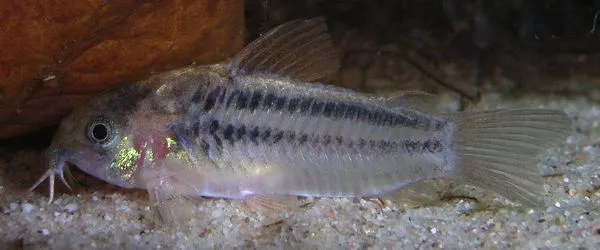
Taxonomy & naming
Corydoras nanus was described in 1967 by the Dutch ichthyologists Han Nijssen and Isaäc Isbrücker, the pair responsible for naming a large share of the corys of the Guianas and northern South America. The type material came from the Suriname river system, and the epithet nanus is Latin for 'dwarf', for its small size. It belongs to the family Callichthyidae and subfamily Corydoradinae.
The oversized genus Corydoras Lacépède, 1803 was long recognised as artificial, and in 2024 Dias, Tencatt and colleagues published a major revision splitting it among several genera (including Brochis, Hoplisoma, Osteogaster and Gastrodermus). Under that scheme the little corydoras becomes Gastrodermus nanus — the combination now used by FishBase and listed as valid in the Catalog of Fishes. The change is recent and the hobby still says 'Corydoras nanus,' so we keep that heading while noting the current placement in Gastrodermus.
Morphology
True to its name, this is a small cory — FishBase gives a maximum of about 2 in standard length — with the short rounded snout and compact body of the lineage. Like all Corydoradinae it is armoured rather than scaled: two overlapping rows of bony plates run down each flank and meet along the back, the head forms a hard bony casque, and three pairs of barbels fringe the downturned mouth.
Its colour pattern is the muted brown-and-pale scheme typical of small Guianan corys, with darker markings along the body; because so few specimens have ever been examined, in-life colour and pattern are not richly documented. The dorsal, pectoral and adipose fins each carry the family's stiff leading spine. Females grow larger and broader than males, as in corys generally, most easily seen from above.
Habitat
Corydoras nanus is a fish of the coastal drainages of the Guianas: FishBase records it from the Suriname and Maroni river basins in Suriname and the Iracoubo basin in French Guiana. These are blackwater and clearwater coastal rivers draining the Guiana Shield to the Atlantic — a distinct biogeographic setting from the Amazon proper.
It is a genuinely rare and little-collected species; FishBase notes that only about ten specimens have ever been taken. Two of those came from a creek with moderate current, half a metre to three metres wide and shallow (8–19.5 in deep), with a sandy to sandy-muddy bottom and rather dim, shaded light — a small, soft-water forest stream. FishBase gives an environmental envelope of pH about 6.0–8.0, hardness from soft to fairly hard (dH 2–25), depths of 0–10 ft and warm tropical temperatures around 72–79 °F. As with the rest of the genus it is a facultative air-breather, gulping surface air and absorbing oxygen through a vascularised hindgut.
Feeding
No dedicated diet study exists for this rarely collected species, but Corydoras nanus is a typical small benthic cory — an omnivore and detritivore of the stream bed. It sifts soft sandy substrate with its barbels and downturned mouth, taking small invertebrates, insect larvae, micro-crustaceans, fallen organic matter and detritus, venting cleaned sand through the gills. In the aquarium small corys of this type readily take finely sized sinking foods — micro-pellets, granules and crushed flake — along with live or frozen bloodworm, Daphnia, grindal worm and brine shrimp; with so small a mouth, appropriately small food matters.
Mating
Corys share a distinctive, well-studied courtship that this species can be assumed to follow. They are egg-laying shoalers with no pair bond. A ripe female cleans a surface and the group becomes active; a male takes up the classic 'T-position', at right angles to her head, and she appears to take his milt into her mouth. Sperm is thought to pass rapidly through her gut to fertilise the few eggs she cradles in a basket formed by her pelvic fins, which she then presses onto the cleaned site. The sequence repeats, a few eggs at a time, until the clutch is laid — in this species reportedly mostly on plant leaves.
Breeding
Despite its rarity in the wild, Corydoras nanus has been spawned in captivity, and FishBase records that eggs are deposited mostly on plant leaves and that a female may produce up to about 600 eggs. That fits the family pattern: adhesive eggs laid in small batches, here favouring broad plant surfaces, with no parental care — the adults will eat the eggs, so a breeder removes either eggs or parents. Spawning in related corys is typically triggered by a cool, large water change mimicking the rains. By analogy the eggs would hatch in roughly three to five days and the fry take microworm, baby brine shrimp and powdered foods; the high egg count noted on FishBase suggests a productive species once settled and conditioned.
In the aquarium
Corydoras nanus is only sporadically available — FishBase lists it as traded for the aquarium, but its rarity in the wild keeps it uncommon and it reaches few hobbyists. As a small, peaceful shoaling cory its needs are the familiar ones, with size as the main qualifier: keep it in a group of six or more, never singly, in a tank with plenty of bottom area, and pair it with small, gentle tankmates that will not out-compete or harass so little a fish. Substrate should be soft sand, because corys feed by sifting and sharp grit erodes and infects their barbels; the dim, shaded, soft-water forest-creek conditions of its home suggest planting, wood and subdued lighting will help it settle. Provide clean, warm (about 72–79 °F), well-oxygenated, well-filtered water with gentle current and regular changes, across a broad soft-to-moderate pH and hardness window. It is entirely peaceful and belongs in a quiet community of small characins, rasboras and dwarf cichlids.
Conservation
The IUCN Red List assessed Corydoras nanus as Least Concern in 2020. Although it is rarely collected and known from few specimens, it ranges across several coastal Guianan drainages (the Suriname, Maroni and Iracoubo basins), much of it in relatively intact forest country, and it faces no concentrated threat; the small aquarium trade in the species is not a significant pressure. Broader regional pressures on Guianan freshwaters — gold mining and the mercury and sedimentation that accompany it, deforestation and pollution — do degrade some of its habitat, but as a species it is presently judged to be of low conservation concern.