Taxonomy & naming
The pygmy cory was described by Gerhard Knaack in 1966 from the Río Madeira drainage in Brazil. It was placed in Corydoras Lacépède, 1803 — the vast genus of South American armoured catfishes in the family Callichthyidae — and has been bred, traded and written about as Corydoras pygmaeus ever since.
That genus had become unwieldy, with well over 170 species and molecular evidence that it was not a single natural lineage. In 2024 Dias, Tencatt and colleagues published a large phylogenomic revision (Zoological Journal of the Linnean Society) that split Corydoras into several genera, several of them resurrected: Brochis, Hoplisoma, Osteogaster and Gastrodermus among them. Under that scheme the pygmy cory becomes Gastrodermus pygmaeus, sitting in the small-bodied 'elegans' lineage alongside fish such as G. hastatus and G. elegans. The change is recent and not yet universally applied — the hobby still overwhelmingly says 'Corydoras pygmaeus' — so we keep that as the heading while flagging the current Catalog of Fishes combination. It should not be confused with two other dwarf corys often sold alongside it, the deeper-bodied C. hastatus and the checker-patterned C. habrosus.
Morphology
This is a true dwarf: males mature at around 1 in standard length and the largest fish reach roughly 1 in in total length, making it one of the smallest catfishes kept in the hobby. The body is the typical Corydoras shape in miniature — armoured with two rows of overlapping bony plates rather than scales, a blunt helmeted head, a downturned mouth fringed with sensory barbels — but it is noticeably more slender and torpedo-like than the stocky bottom-corys, an outline that suits its mid-water habits.
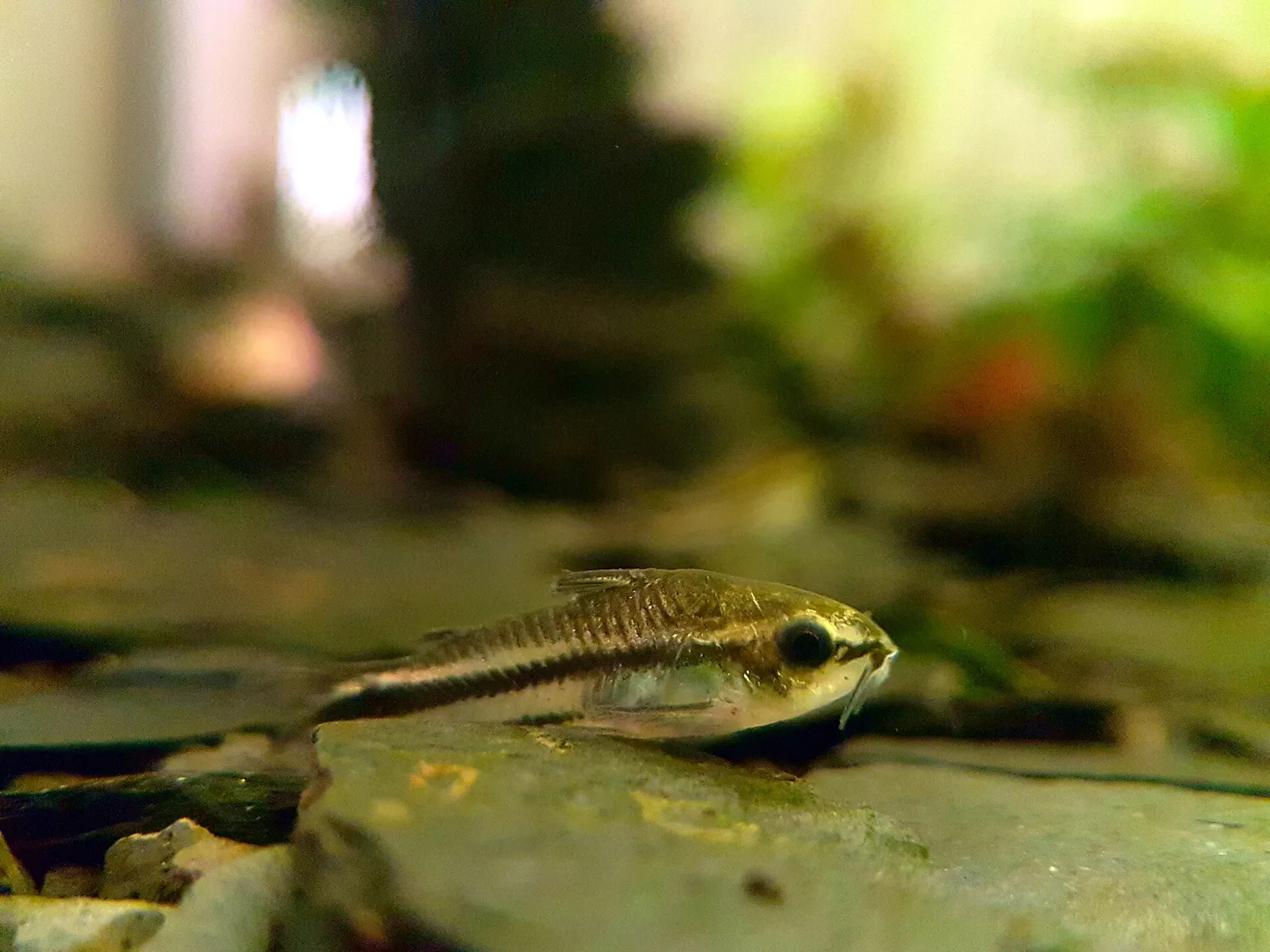
The ground colour is a translucent silvery-grey. The defining mark is a single dark horizontal stripe that runs from the snout, through the eye, the full length of the flank and into the base of the tail, usually with a second, fainter line below it and a pale belly. The fins are clear. As in all Corydoras, the dorsal, pectoral and adipose fins carry a stiff leading spine. Because the fish is so small and lightly built, the sexes are best told apart from above: mature females are distinctly broader and rounder than the slimmer, smaller males, especially when carrying eggs.
Habitat
Corydoras pygmaeus is recorded from the Río Madeira basin in the western Amazon of Brazil (with the broader range reaching into adjacent Amazonian drainages). It is a fish of quiet, shallow water — small tributaries, creeks, backwaters, floodplain pools and inundated forest margins — where it shelters among submerged grasses, fine roots, leaf litter and overhanging vegetation rather than open sand flats.
These are warm, soft, often shaded blackwater and clearwater habitats. Aquarium-relevant figures from FishBase put it at roughly 72–79 °F, a pH band from about 6.0 to 8.0 (it favours the softer, more acidic end) and soft to moderately hard water (around 2–25 dH). Like other corys it is a facultative air-breather, darting to the surface to gulp air and absorb oxygen through a vascularised hindgut — a useful adaptation in the warm, oxygen-poor pools it inhabits during the dry season.
Feeding
The pygmy cory is a micro-omnivore. In the wild it takes tiny invertebrates, crustaceans, insect larvae and organic detritus, foraging both in the sediment and, unusually for a cory, from biofilm on plants and surfaces up in the water column. Its mouth is minute, which is the practical constraint in captivity: it needs correspondingly small foods. It does well on finely crushed sinking foods, microworm, sifted Daphnia and freshly hatched brine shrimp (Artemia nauplii), and these small live and frozen items bring out its best condition and colour. It is too small to compete with larger, faster tankmates at feeding time, so a keeper has to make sure food actually reaches it.
Mating
Like other Corydoras, the pygmy cory is an egg-laying shoaler with no pair bond and the family's distinctive T-position courtship. When a female is ready the group becomes active and a male aligns himself at right angles to her head, the pair briefly locking in the classic 'T'. Milt is released and is thought to pass quickly to fertilise the very small batch of eggs the female clasps in a basket formed by her pelvic fins — in this tiny species only two to four eggs at a time. She then carries them to a cleaned surface, a plant leaf, fine root or the aquarium glass, and presses them into place. The sequence repeats over a spawning session until something on the order of a hundred eggs have been laid in ones and twos.
Breeding
Pygmy corys breed readily in a mature, well-fed group, and spawning is typically triggered by a cool, large water change that imitates the rainy season. The adhesive eggs are scattered singly or in tiny clutches across plants and hardware and receive no parental care — indeed the adults will eat them, so breeders either remove the eggs or move the parents. Incubation runs about three to five days depending on temperature. The newly free-swimming fry are exceptionally small and need the finest first foods — infusoria or a liquid fry food at first, then microworm and baby brine shrimp as they grow. Clean, stable water and frequent small feeds are the keys to raising them; given that, they grow steadily and the species is now produced in good numbers by hobbyists.
In the aquarium
The pygmy cory's charm is its mid-water habit: where most corys hug the bottom, a pygmy shoal hangs and drifts at all levels of the tank, settling on plant leaves and darting up into the current together. That behaviour only emerges in numbers. This is an emphatically social species and is stressed, dull and inactive when kept in twos or threes — keep eight or more, and ten-plus is better, to see them behave naturally and shoal with confidence.
Because they are so small, a group is comfortable in a modest tank — something around 45 × 12 in / 10 US gal or more suits a school — but the setup matters. Provide soft sand or very fine, smooth substrate (sharp gravel damages the barbels of all corys), plenty of planting, fine-leaved cover and some shade, which makes these naturally shy fish bold. Water should be warm but not hot (about 72–79 °F), gently filtered and clean, soft and slightly acidic to neutral. Tankmates must be small and peaceful — pygmy corys are perfect with small rasboras, pencilfish, dwarf tetras, Boraras and shrimp, and should never be housed with anything large enough to eat or harass them. As with all corys, net them in a cup rather than a mesh net, since the fin spines tangle easily.
Conservation
Corydoras pygmaeus has not been formally assessed on the IUCN Red List, so it carries no official conservation status. Practically, it is a widespread fish of the Amazonian lowlands, much of it now captive-bred for the trade, which eases pressure on wild stocks. The pressures it does face are the general ones on western Amazonian freshwaters — deforestation, agricultural run-off, and the damming and degradation of the small floodplain creeks and inundated margins it depends on — rather than any species-specific threat. The taxonomic reshuffle into Gastrodermus does not change its outlook, but the absence of a formal assessment is itself a reminder of how little of the megadiverse Amazon catfish fauna has been evaluated.