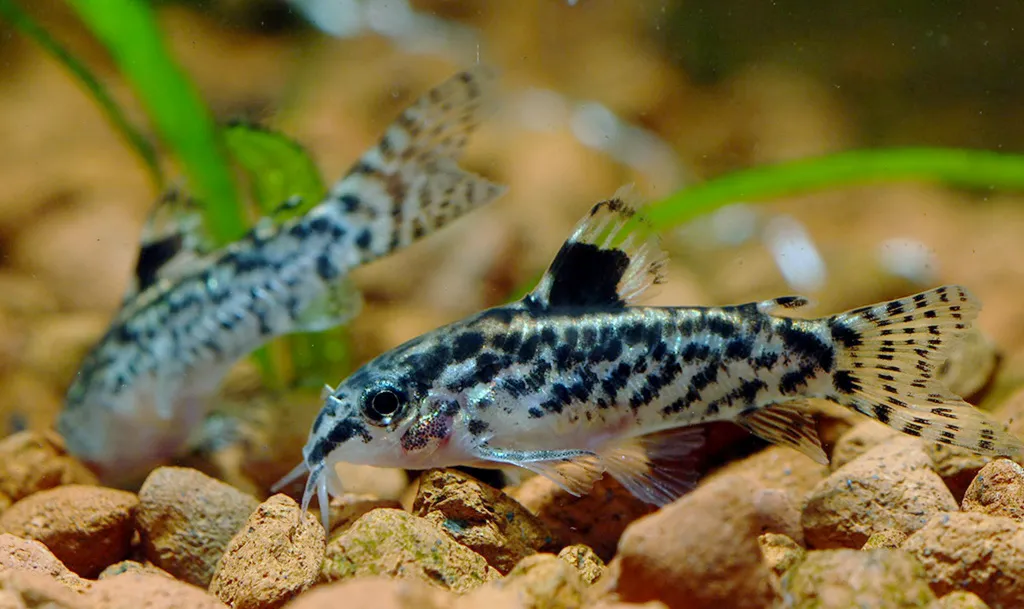
Taxonomy & naming
Stanley Weitzman and Han Nijssen described this fish in 1970, in the Dutch journal Beaufortia, as Corydoras pauciradiatus, from the Rio Araguaia near Aruanã in Goiás State, Brazil. It was moved into Aspidoras not long after, and through most of its time in the hobby and the literature it has stood as Gastrodermus pauciradiatus (Weitzman & Nijssen, 1970), which is the name under which it is traded, photographed and bred — and the name we keep here.
Aspidoras itself was erected by Ihering in 1907 for a cluster of small callichthyid catfishes from eastern and central Brazil that look like miniature Corydoras but differ in the skull: Aspidoras has a paired (divided, two-window) cranial fontanelle where Corydoras has a single one. That sounds like a technicality, but it marks a genuinely separate lineage of dwarf 'corys.' The taxonomy of this particular species has since been unsettled. The large 2024 revision of the Corydoradinae by Dias, Tencatt and colleagues, which broke the old Corydoras apart into several genera, transferred pauciradiatus to the resurrected genus Gastrodermus — so that Eschmeyer's Catalog of Fishes and FishBase now give the valid combination as Gastrodermus pauciradiatus. That arrangement is new and far from settled in everyday use: the GBIF backbone still carries it as Gastrodermus pauciradiatus, and the aquarium world universally says 'Aspidoras' (or simply 'false cory'). We therefore keep Gastrodermus pauciradiatus as the heading while flagging both the historic Corydoras origin and the new Gastrodermus combination. There is also a curious biogeographic footnote: Weitzman and Balph (1979) reported the species — or a very similar form — far away in the Rio Negro, raising questions about its true range that have never been fully resolved.
This fish was long listed as Aspidoras pauciradiatus; Eschmeyer's Catalog of Fishes places the species in Gastrodermus, and the current combination Gastrodermus pauciradiatus is followed here.
Morphology
This is one of the smallest of the cory-type catfishes, a genuine dwarf. Sources put the maximum standard length at roughly 1–1.5 in; Planet Catfish records a type-based figure near 1 in. The body plan is pure callichthyid in miniature — two rows of overlapping bony scutes along each flank, a small armoured head, and three pairs of short barbels around the downturned mouth — scaled down to a fish that sits comfortably in the palm of a hand.
The colour pattern is what distinguishes it at a glance: a pale, translucent straw-to-pinkish ground heavily peppered and marbled with fine dark blotches, usually with a darker mark on the dorsal fin and a scattering of spots along the back and sides, giving the 'filigree' look. The diagnostic character, though, is in the fin count that names the fish — pauciradiatus, 'few-rayed' — referring to its six soft dorsal-fin rays, against seven in the other Aspidoras species. Combined with the paired skull fontanelle of the genus and its distinctive mottling, that ray count makes it identifiable even among very similar dwarf catfishes. The sexes differ only subtly: females grow a little larger and noticeably rounder and broader-bodied, best seen from above, while mature males tend to have more pointed fin tips.
Habitat
The type locality is the Rio Araguaia near Aruanã, in Goiás, central Brazil, and the species is generally regarded as restricted to the upper Araguaia basin — part of the larger Tocantins–Araguaia system that drains north into the lower Amazon. Planet Catfish maps it across the Araguaia, Tocantins and lower-Amazon drainages, and the much later Rio Negro record of Weitzman and Balph (1979) hints that its distribution may be wider or more complicated than the type series suggested.
These are warm tropical lowland waters, and unlike its cool-water coastal relatives this little catfish wants ordinary tropical conditions. The figures in the aquarium literature cluster around a temperature of roughly 72–81 °F, a slightly acidic to neutral pH of about 6.0–7.0, and soft to moderately hard water (very roughly up to around 12 dH). It is a shallow-water, bottom-associated fish of quieter margins over sand and fine substrate. Like all callichthyids it can take a gulp of air at the surface and absorb oxygen through its hindgut, but it is otherwise an unremarkable, undemanding tropical dwarf in its requirements.
Feeding
Aspidoras species are foraging benthic omnivores, and the false cory is no exception. In the wild it works the bottom for tiny invertebrates, larvae and organic detritus, sifting fine substrate through its barbels. In the aquarium it readily accepts most small sinking dried foods — micro-pellets, granules and crushed tablets — and relishes small live and frozen items such as bloodworm (chironomid larvae), Daphnia, Tubifex and grindal worm, which are also used to condition a group for spawning. Because it is so small, it needs food that actually reaches the bottom and is fine enough to handle; it should never be left to subsist on scraps from larger tankmates or expected to 'clean' the tank, and a varied diet is what keeps it in spawning condition.
Mating
Reproduction follows the standard corydoradine template. The false cory is an egg-scattering shoal spawner with no pair bond and the familiar 'T-position' courtship, in which a male aligns himself at right angles to the female's head and she takes up his milt while clasping a small batch of eggs in the basket of her pelvic fins. She carries each batch to a cleaned surface — a leaf, a stone, the glass — and presses the sticky eggs into place before the sequence repeats. As with its larger cousins, spawning groups are best kept with more than one male so that the competition between them helps trigger the females, and the whole performance is driven by the group rather than by any settled pairing.
Breeding
Breeding the false cory is much like breeding any small Corydoras, with the usual dwarf-cory caveats about scale and water quality. A well-conditioned group is encouraged to spawn by a large water change with notably cooler water, ideally timed to a drop in barometric pressure, mimicking the rainy-season cues of its native streams. The adhesive eggs are laid a few at a time and scattered over plants, décor and glass; there is no parental care and the adults will eat their own eggs, so the breeder removes the eggs or the parents. The eggs hatch within a few days, and the very small fry need correspondingly small first foods — infusoria and powdered fry food at first, graduating to microworm and newly hatched brine shrimp. It is bred by dedicated hobbyists but is nowhere near as commonly or commercially propagated as the mainstream corys, and stable, mature, scrupulously clean water is the recurring condition for success with such a small fish.
In the aquarium
The false cory is a peaceful, gregarious nano-aquarium fish that should be kept in a group — at least four to six, and happier in more — and it is genuinely stressed kept alone or in pairs. Because it is so small it suits a planted nano or community tank; a base footprint of around 60 x 12 in is ample, and what matters is bottom area and security rather than volume. Give it a substrate of fine, soft sand (smooth rounded gravel is a poor second), kept very clean, because like every cory it digs and sifts and is prone to barbel erosion over sharp or dirty substrate. Plenty of planting, wood and shade lets it forage with confidence. The single most important husbandry point is water stability: this is not a fish for a new, biologically immature tank, and it wants clean, stable, gently filtered tropical water. As tankmates choose other small, calm, warm-water community fish — pygmy corys, small tetras and rasboras, dwarf shrimp — and avoid anything large or boisterous enough to outcompete or intimidate a 1 in catfish. The standard cory cautions apply in miniature: the small fin spines still catch in nets, so a cup is kinder, and a badly stressed fish can release skin toxins that are dangerous in the confined volume of a transport bag.
Conservation
Gastrodermus pauciradiatus has not been formally assessed by the IUCN — Planet Catfish lists its Red List category as Not Evaluated — so there is no global threat status to report. As a small, range-restricted fish of the upper Araguaia, its fortunes are tied to the health of the Tocantins–Araguaia basin, a system under growing pressure from agricultural expansion, deforestation of the surrounding Cerrado, and a wave of dam construction that fragments and alters the river. None of that has been quantified for this particular species, and the trade in it is modest and increasingly supplied by captive breeding rather than wild collection. The honest summary is that its conservation status is simply unknown: it is a localised dwarf in a heavily developed basin, which is reason for attention rather than alarm, but the data to say more do not yet exist.