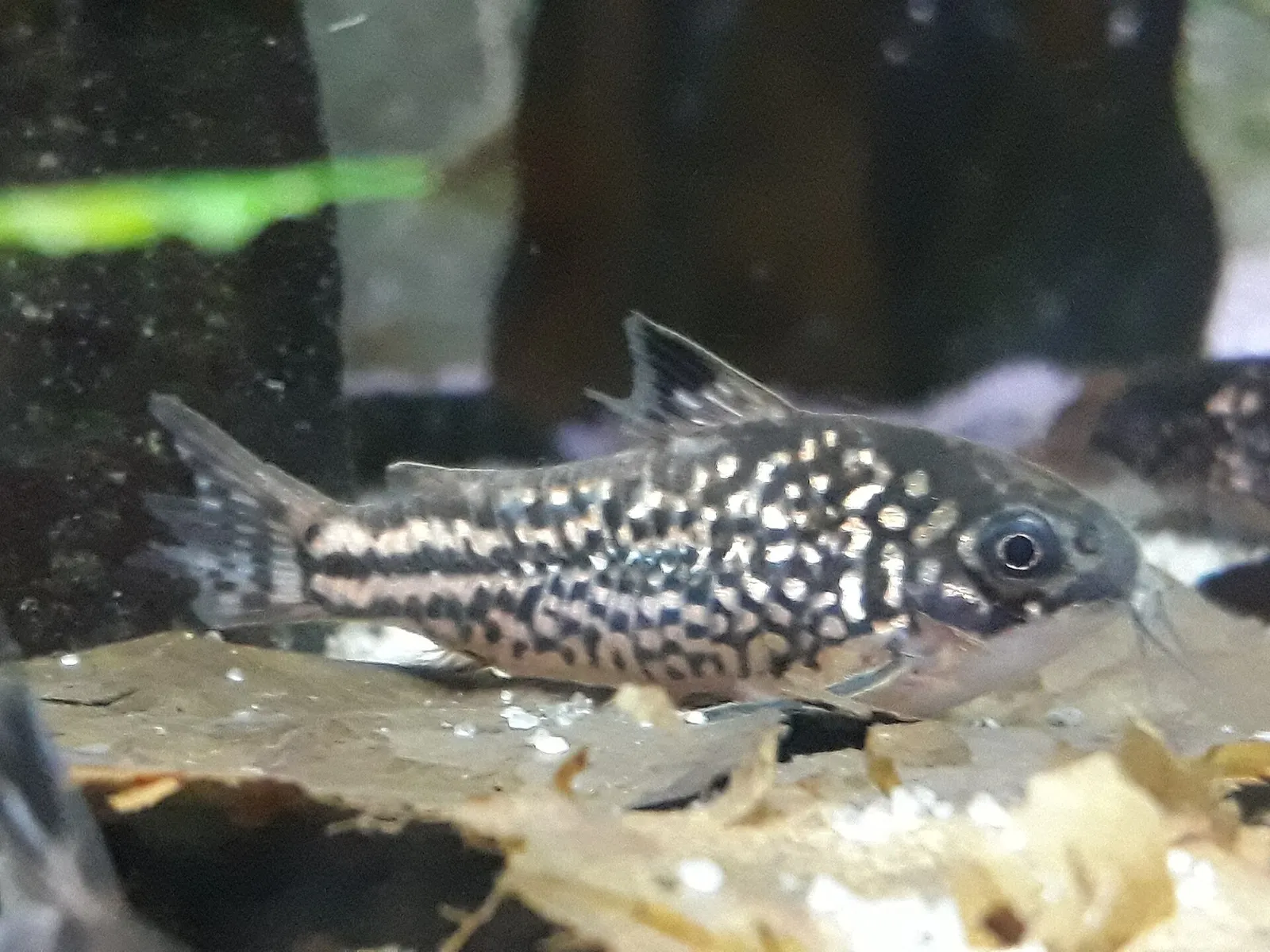
Taxonomy & naming
Corydoras napoensis was described in 1986 by the Dutch ichthyologists Han Nijssen and Isaäc Isbrücker, the pair responsible for naming a large share of the South American armoured catfishes during the 1960s–80s. The species epithet is geographic: the type material came from the Río Napo system on the Ecuador–Peru frontier, and the name simply means 'of the Napo'. The fish sits in the family Callichthyidae, subfamily Corydoradinae, and for nearly four decades carried the long-familiar combination Corydoras napoensis.
The genus Corydoras had become one of the largest in all of fishes — well over 170 species — and molecular work showed it was not a single natural lineage. In 2024 Dias, Tencatt and colleagues published a comprehensive phylogeny and revised classification of the Corydoradinae (DOI 10.1093/zoolinnean/zlae053) that broke the old genus into several, among them Brochis, Hoplisoma, Osteogaster and the resurrected Gastrodermus. Under that scheme the Napo cory becomes Gastrodermus napoensis — the combination FishBase and Eschmeyer's Catalog of Fishes now carry. The change is recent and far from universally adopted in the hobby, so we keep 'Corydoras' as the display heading while recording the current combination honestly. In the aquarium trade C. napoensis is one of several superficially similar small corys often lumped as the 'elegans group' (with C. elegans, C. bilineatus and C. nanus), and it is regularly confused with them on import lists.
Morphology
This is a small, fairly slender cory, reaching only about 1.5 in standard length (roughly 2 in total) — at the diminutive end of the genus. The body is the usual Corydoras package: a short, blunt snout, a hard helmet of a head, a downturned mouth ringed by three pairs of sensory barbels, and two overlapping rows of bony plates (scutes) replacing scales along each flank. The dorsal, pectoral and adipose fins each bear a stiff leading spine.
The ground colour is a mottled gold-to-greyish brown, finely peppered with dark pigment, with an irregular darker band running lengthwise along the side. The single most useful field mark is sexual and seasonal: courting males develop a prominent black blotch in the upper part of the dorsal fin, while females show a more or less clear dorsal, at most a faint smudge. That dorsal blotch, together with the small size and the mottled flank, separates napoensis from the broadly similar C. elegans and its relatives, though the distinction can be subtle in non-breeding fish.
Habitat
Corydoras napoensis is a fish of the western Amazon headwaters. It is recorded from the Río Napo and Río Aguarico in eastern Ecuador and adjacent Peru (Loreto), and from the Río Nanay near Iquitos, with records extending into the Río Amazonas and Río Atacuari reaches of the Colombia–Peru border region. This is white- and clear-water country fed off the eastern slopes of the Andes.
It lives in the quieter margins — small tributaries, forest creeks, areas of seasonally flooded forest (igapó/várzea edge) and sand banks — over soft sand and leaf litter rather than in fast main-channel current. The water is warm and on the soft, gently acidic to neutral side: temperatures around 72–79 °F, pH roughly 6.0–7.4 and low to moderate hardness. Like all corys it is a facultative air-breather, periodically darting to the surface to gulp air and absorb oxygen through a vascularised hindgut, which lets it cope with the warm, oxygen-poor shallows it favours. It shoals, and is reported to occur alongside the similar C. elegans.
Feeding
The Napo cory is a benthic omnivore and forager. In the wild it works the bottom continuously, burying snout and barbels in sand and litter to taste out small invertebrates, insect larvae, micro-crustaceans, worms and fallen organic matter, sieving the substrate and passing cleaned grains out through the gills. It is an opportunist rather than a specialist. In the aquarium it readily takes good-quality sinking pellets and tablets as a staple, supplemented with live and frozen foods such as bloodworm, daphnia and brine shrimp; it should not be expected to subsist on leftovers from tankmates above.
Mating
Like other Corydoras, the Napo cory is an egg-laying shoaler with no pair bond and the genus's distinctive 'T-position' courtship. When a female ripens, the group becomes active and she cleans a spawning site — a leaf, a stone, a stem or the aquarium glass. A male aligns himself at right angles to her head, forming the classic T, and she takes a small clutch of eggs into a basket formed by her clamped pelvic fins while milt is released; sperm is thought to pass rapidly along her body (or through the gut) to fertilise the eggs she then carries to the cleaned surface and presses into place. The displaying male's darkened dorsal fin is part of this courtship signalling. The sequence repeats a few eggs at a time.
Breeding
Captive breeding of C. napoensis follows the standard small-cory recipe but is less routinely reported than for the workhorse species, and much of what is written is extrapolated from close relatives. Conditioning on a varied diet and then a cool, large water change that mimics rainy-season inflow is the usual trigger. A group skewed toward more males than females (often suggested at around 2:1) spawns more reliably. The adhesive eggs are deposited in small batches onto cleaned surfaces and receive no parental care — the adults will eat them, so breeders move either the eggs or the parents. Eggs hatch in roughly three to five days depending on temperature, and the fry, once the yolk sac is absorbed, take microworm, baby brine shrimp and powdered fry foods. Honest note: published, repeatable spawning accounts specific to napoensis are thin compared with common corys, and individual results vary.
In the aquarium
The Napo cory is an undemanding but genuinely social fish, and the single most important husbandry point is to keep it in a proper shoal — six or more, ideally more — because isolated corys are stressed and inactive. A group is comfortable in a modest tank with plenty of floor area; footprint matters more than height.
Substrate is not decoration: provide soft sand or very smooth, rounded fine gravel, because corys feed by sifting and sharp or coarse gravel abrades and infects their barbels, leaving the blunted, eroded faces that mark poor husbandry. Keep the bottom clean. Water should be warm but not hot (about 72–79 °F), soft to moderately hard and gently acidic to neutral (pH ~6.0–7.4), well-filtered and well-oxygenated with a little current; subdued light and cover (wood, leaf litter, planting) suit this forest-margin fish. It is entirely peaceful and pairs well with small, calm community fish — tetras, pencilfish, dwarf cichlids and similar — never with anything large enough to bully it. Two standard cory cautions apply: the fin spines snag in nets (use a cup), and a badly stressed cory can release skin toxins that, in the small volume of a bag or bucket, may kill a whole group, so transport with care.
Conservation
Corydoras napoensis is assessed by the IUCN as Least Concern. It has a reasonably wide distribution across the western Amazon headwaters of Ecuador, Peru and the border zone with Colombia, occupies common marginal habitats, and faces no identified species-specific threat. As with all Amazonian fishes it is exposed to the broad regional pressures of deforestation, agriculture, mining-related water quality decline and habitat alteration that degrade the shallow forest streams it favours, but none of this currently endangers the species. Collection for the aquarium trade is small-scale relative to the commercially mass-bred corys.