Taxonomy & naming
Heros severus was named by the Austrian ichthyologist Johann Jakob Heckel in 1840, in the second volume of the Annalen des Wiener Museums der Naturgeschichte, where it also became the type species of the new genus Heros. The type locality is Marabitanas on the Rio Negro, near the Brazil–Venezuela frontier, and the species rests on a single specimen — the unique holotype NMW 17638 in the Naturhistorisches Museum, Vienna, which Staeck & Schindler re-examined and figured in 2015. Through much of the twentieth century the fish was folded, like most heroine cichlids, into the catch-all genus Cichlasoma (as Cichlasoma severum); Regan (1905) treated Heros as merely a section of Cichlasoma. Sven O. Kullander resurrected Heros as a valid genus in 1983–86 and, in his 1986 redescription of Heros appendiculatus, fixed severus as a slender-bodied species with a distinct caudal spot and distinct vertical bars, distributed in the upper Rio Negro and upper Rio Orinoco. The genus today holds a small cluster of South-American severums — among them Heros efasciatus, Heros notatus, Heros spurius and the recently described Heros liberifer — and severus is the name-bearer for all of them. The most important taxonomic episode in its modern history is one of mistaken identity: a mouthbrooding Heros exported from the Orinoco from the 1980s was widely assumed to be Heros severus, an assumption Stawikowski questioned in 1994 once its delayed-mouthbrooding habit became known. Staeck & Schindler (2015) resolved the matter by describing that Orinoco fish as a new species, Heros liberifer, syntopic with the true severus and separable from it by a distinct caudal spot, a bright red iris, narrower lips, and an unshortened fourth vertical bar. The valid name Heros severus is upheld in the Catalog of Fishes (Cichlidae: Cichlinae).
Morphology
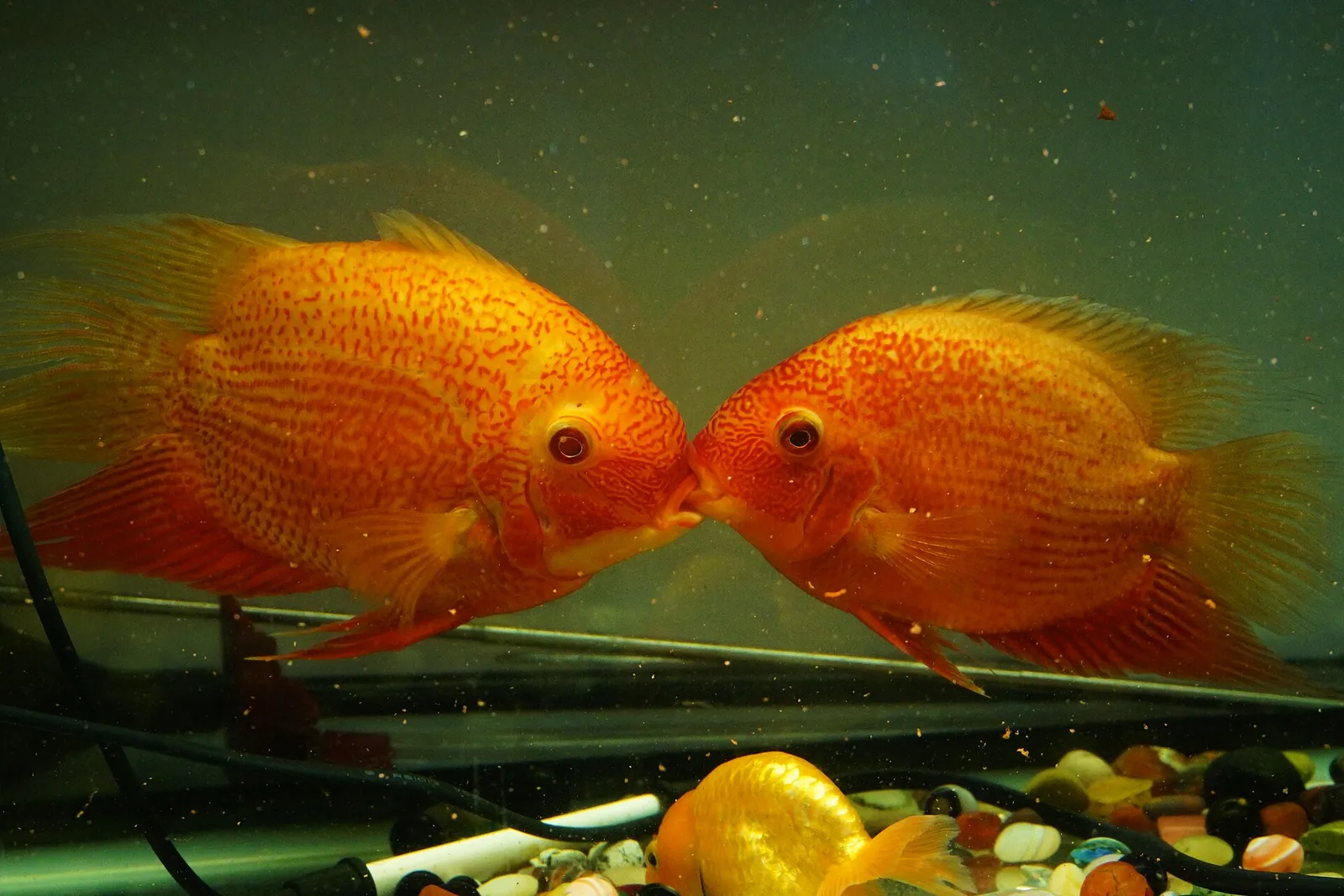
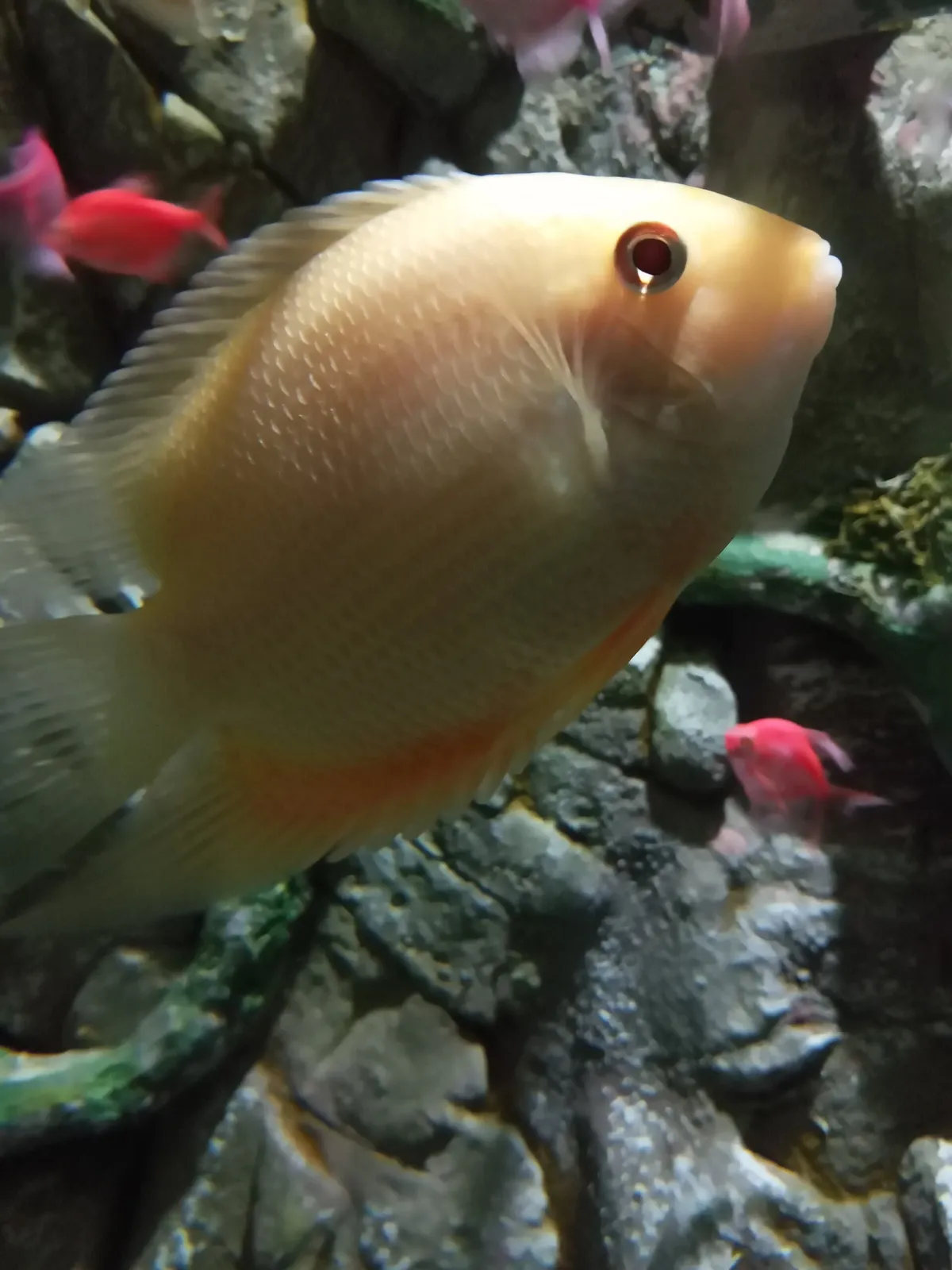
Heros severus is a tall, strongly compressed, almost disc-shaped cichlid built on the classic severum plan — a high back, a steep forehead and a small mouth set on a deep, laterally flattened body. FishBase lists a maximum of about 8 in standard length, with a common length near 5.5 in; aquarium and wild fish generally sit in the lower-to-middle of that span, and the holotype and topotypic material run to roughly 6.5 in SL. The ground colour of an adult is a warm green to olive, the chest and shoulders flushing bright red and the head overlaid with fine red spots and vermiculations against the green — a pattern that intensifies in dominant, breeding males. The single most reliable field mark, noted by both Kullander and the hobby literature, is the vertical barring: severus carries a series of dark bars down the flank, of which the third-from-the-rear (Kullander's bar 4) is conspicuously shortened, not running the full depth of the body, while the holotype also shows the first two bars fused into the absence of a discrete caudal-peduncle spot. This shortened bar and the fine red head-stippling separate it at a glance from the syntopic, undescribed-to-2015 fish (now Heros liberifer), which keeps a complete fourth bar, a sharp caudal spot and a red iris. Sexual dimorphism is modest and develops with maturity: males grow somewhat larger, carry the heaviest red on the head and chest and develop more produced soft dorsal and anal fin tips, while ripe females are rounder-bellied; juveniles are a plainer barred grey-brown. As with all Heros, the species is easily confused with the mass-bred "green severum" of the trade, which is referable to Heros efasciatus rather than to true severus.
Habitat
True Heros severus has a genuinely restricted range for such a famous name: it is native to the upper Rio Negro basin of the Amazon system (in Brazil and across the Colombian and Venezuelan headwaters) and to the upper Orinoco drainage in Colombia and Venezuela, where Staeck & Schindler recorded it living side-by-side with Heros liberifer in tributary creeks of the lower Rio Autana and elsewhere. These are quintessential blackwater fish — the upper Negro and upper Orinoco carry some of the softest, most acidic and most nutrient-poor freshwater on Earth, stained tea-brown by dissolved tannins, very low in dissolved minerals and warm year-round. FishBase gives a pH range of about 5.0–6.5 and a hardness of roughly 0–6 dGH, with temperatures of about 73–84 °F; the syntopic liberifer was measured in water as extreme as pH 4.1–6.1 and conductivity of just 4–15 µS/cm, an indication of how mineral-starved the severus biotope can be. Field observers describe severums of various species in slow-to-moderate marginal water choked with sunken trees, roots, branches and leaf litter — structurally complex shoreline and flooded-forest habitat that offers cover from wolf fish (Hoplias) and peacock bass. While the species is most typical of blackwater, it also turns up in clearwater creeks, and the Heros genus as a whole tolerates a wide physicochemical envelope across the Amazonian water types. Reliable depth data are sparse; like its relatives it is a fish of shallow, structured marginal and floodplain water rather than the open channel, occupying roughly the upper 0–10 ft. An introduced population is established in Florida, U.S.A.
Feeding
Heros severus is a deep-bodied omnivore that grazes the structured shallows and the substrate rather than hunting in open water. FishBase places it at a trophic level near 2.9, consistent with a mixed diet weighted toward plant and detrital material, small invertebrates and aufwuchs taken from submerged wood, roots and leaf litter. Field accounts of Heros in the wild describe loose groups of six to twenty fish grazing over the bottom through the dry season, a generalist foraging style well suited to the leaf-littered, tannin-stained creeks the species inhabits. The small terminal mouth and tall, slow-moving body fit a browser-gatherer rather than a piscivore or a dedicated sand-sifter; in the community it works the marginal cover and soft sediment, leaving the open-water and sand-sifting niches to characins and eartheaters. In captivity this translates into an easy, opportunistic feeder that takes prepared foods readily but does best on a varied menu that includes vegetable matter alongside live and frozen invertebrates.
Mating
Like other severums, Heros severus is a comparatively peaceful, socially flexible cichlid that lives in loose aggregations outside the breeding season and pairs off only as conditions turn favourable. In the wild the trigger is the flood pulse: as the rainy season raises the rivers, fish move out into the inundated forest, where abundant food and new cover let pairs stake out territories. Pair formation is selective and choosy — keepers find that simply putting one male with one female rarely works, because the fish strongly prefer to choose their own partners from within a group, and a mismatched pair may never settle. Once a bond forms, both partners cooperate to clean and defend a chosen vertical surface and the surrounding territory. Severums and their relatives are, by cichlid standards, inoffensive fish for their size — plants may get nibbled if food is otherwise short, but they rarely inflict serious damage on tankmates or even on each other. Territoriality becomes a real issue only around spawning, and a guarding pair will drive off intruders from the immediate nest area; outside that window the courtship and site-preparation phase can still make an otherwise placid pair temporarily on edge, but the aggression is narrowly targeted rather than general.
Breeding
Heros severus is, distinctively for the genus, a delayed biparental (larvophile) mouthbrooder — a reproductive mode documented in detail in the Orinoco severums by Stawikowski (1994) and Stawikowski & Werner (1995) and carried by both true severus and its sibling Heros liberifer. Recognition of this habit is comparatively recent: for years the aquarium 'severum' was assumed to be an ordinary open-brooder, and it took targeted observation of Orinoco stock to confirm true mouthbrooding — helped along by the parallel confusion with Heros efasciatus, the farmed green severum, which is not a mouthbrooder at all. The pair begins like an ordinary substrate-spawner, depositing the eggs on a cleaned vertical or diagonally sloping surface such as a submerged log or root, the adhesive eggs hung directly on the wood; FishBase records clutches of up to about 200 eggs guarded by both parents. Where no suitably angled surface is available, pairs have also been seen to use a natural trough in bogwood or rock — the same alternative nursery site favoured by the related chocolate cichlid Hypselecara — depositing the eggs there instead of hanging them. The departure from the substrate-spawning norm comes at hatching: at around 81 °F the eggs hatch roughly forty hours after spawning, and at that point both parents take the larvae into their mouths and brood them orally, a behaviour otherwise essentially unknown among the substrate-spawning Heros. The fry attempt free-swimming three or four days later, after which the pair shifts to long-term biparental defence of a mobile shoal of young — both sexes sharing all brood-care duties — for a period that can last up to about six weeks (around three weeks in the liberifer observations). In the wild the young are raised in the shallow margins and guarded until they are large enough to disperse; wild Heros pairs may shepherd well over 500 fry against the many small predators that pick at them. The species is bred in aquaria, though true severus is far less common in the trade than the farmed "green severum" (Heros efasciatus) whose breeding is better known.
In the aquarium
True Heros severus is a connoisseur's fish rather than the supermarket severum: it was effectively absent from the hobby for much of its history and was only reintroduced to aquarists around 2014, since when wild-collected stock from the upper Negro and Orinoco has trickled onto specialist stock lists. Anyone buying a "severum" should understand that the overwhelming majority of fish sold under that name — and virtually all the green, gold, red and albino strains — are Heros efasciatus or farmed hybrids, not severus; the real thing is identified by its fine red head-stippling, red chest and the characteristically shortened third-from-rear bar.
In keeping terms it is a typical large, peaceful severum. Despite a gentle temperament these are tall, robust cichlids that reach 8 in or more in the wild (usually 8–10 in in a tank), so they need space: a single pair is best given a tank on the order of 120 US gallons or larger, and a group needs more. The decor that suits them mirrors their habitat — a fine sand substrate to reduce aggression, plus plenty of driftwood, branches and roots reaching toward the surface to break sightlines and provide the vertical spawning surfaces the pair will want. Subdued lighting and tannin-stained water show the fish at their best.
Water chemistry should respect their blackwater origins. Soft, warm, acidic-to-neutral water is ideal: temperatures around 79–84 °F, a pH in the 5.0–6.5 range, and low hardness (roughly 0–6 dGH). Warmth in the upper part of that band plus an abundance of food helps trigger spawning, echoing the flooded-forest conditions they breed in. Because they come from mineral-poor water, they appreciate clean, well-filtered conditions without strong current; gentle flow and generous water changes suit them.
Feeding is undemanding — they accept quality flake and pellet readily, but colour and condition are best on a varied diet that supplements dry food with live or frozen bloodworm, chopped earthworm and shrimp, and includes vegetable matter for an omnivore that grazes plant material in the wild. For tankmates, severums combine well with other peaceful, similarly sized Amazonians: eartheaters such as Geophagus and Satanoperca, angelfish, chocolate cichlids (Hypselecara), larger characins (silver dollars, the bigger Moenkhausia, pinktail chalceus, peaceful anostomids) and fair-sized, low-flow catfish. Avoid very small tetras, which a severum will eat, and boisterous, fin-nipping or hyper-aggressive cichlids that will bully a placid, slow-moving fish off its food. To breed them, start with a small group so the fish can self-select a pair, raise the temperature and feed heavily; once a pair has cleaned a vertical surface, the other fish are best removed for the brood's safety and the tankmates' protection.
Conservation
The IUCN Red List assesses Heros severus as Least Concern (assessed 19 November 2020 by R.G. Frederico, published 2023), noting that — despite little specific information on the species — its wide assessed range and the absence of any known threats currently affecting it warrant the lowest concern category; the population trend is listed as unknown. It carries no CITES or CMS listing and is harmless to humans. The species is taken for the ornamental aquarium trade, but true severus is exported only in small numbers from a remote part of its range and is not a fisheries staple in the way the widespread Heros efasciatus is, so collection pressure on it is light. Two caveats are worth flagging for accuracy. First, the conservation assessment and several databases apply the name Heros severus to a broader Orinoco–Amazon range (and additional countries such as Bolivia and Peru) than the strict upper-Negro/upper-Orinoco distribution that the taxonomic literature assigns to true severus — a legacy of the long confusion between severus and the fish now called Heros liberifer — so range-based assessments should be read with that ambiguity in mind. Second, the blackwater headwaters that severus depends on, while currently little disturbed, are part of the broader Amazon and Orinoco systems facing accelerating pressure from deforestation, mining and altered flood regimes; none of this is documented as a present danger to this particular cichlid, but it is the backdrop against which a narrow-range blackwater specialist's long-term security should be judged.