Taxonomy & naming
Australoheros facetus carries one of the most distinguished collection histories of any cichlid: the type material was gathered by Charles Darwin himself during the voyage of HMS Beagle. Darwin netted the fish at Maldonado on the north shore of the Río de la Plata in Uruguay between April and July 1833 — the terra typica is now identified as the Laguna del Diario (about 34°54′S, 55°00′W) — and the Reverend Leonard Jenyns formally described it as Chromis facetus in 1842 in 'The Zoology of the Voyage of H.M.S. Beagle.' The syntype survives in the University Museum of Zoology, Cambridge, catalogued under Darwin's own field number 660. For most of the twentieth century the species was shuffled through the catch-all genus Cichlasoma; Sven Kullander's 1983 restriction of Cichlasoma to a small Amazonian core left facetus and its relatives as the orphaned "'Cichlasoma'-facetum group." Oldřich Říčan and Kullander resolved that orphanhood in 2006, erecting the genus Australoheros (Journal of Zoological Systematics and Evolutionary Research 44: 136–152) on combined morphological and mitochondrial evidence and designating facetus as the type species. The genus name fuses Latin australis, 'southern,' with Heros, the nominotypic genus of the tribe Heroini, and the group sits in the Neotropical subfamily Cichlinae (Cichlasomatinae of older usage). What followed was a taxonomic explosion: Říčan & Kullander's 2008 Zootaxa treatment of the Uruguay and Paraná drainages, and Říčan and colleagues' later coastal-river revisions, splintered what had long been regarded as a single wide-ranging "facetum" into a dozen-plus narrow-range species. Australoheros facetus itself was correspondingly narrowed, anchored to the lower La Plata and the Maldonado type region, so much of the older aquarium and scientific literature that uses the name "facetum" in fact refers to a complex of species rather than to this one fish.
Morphology
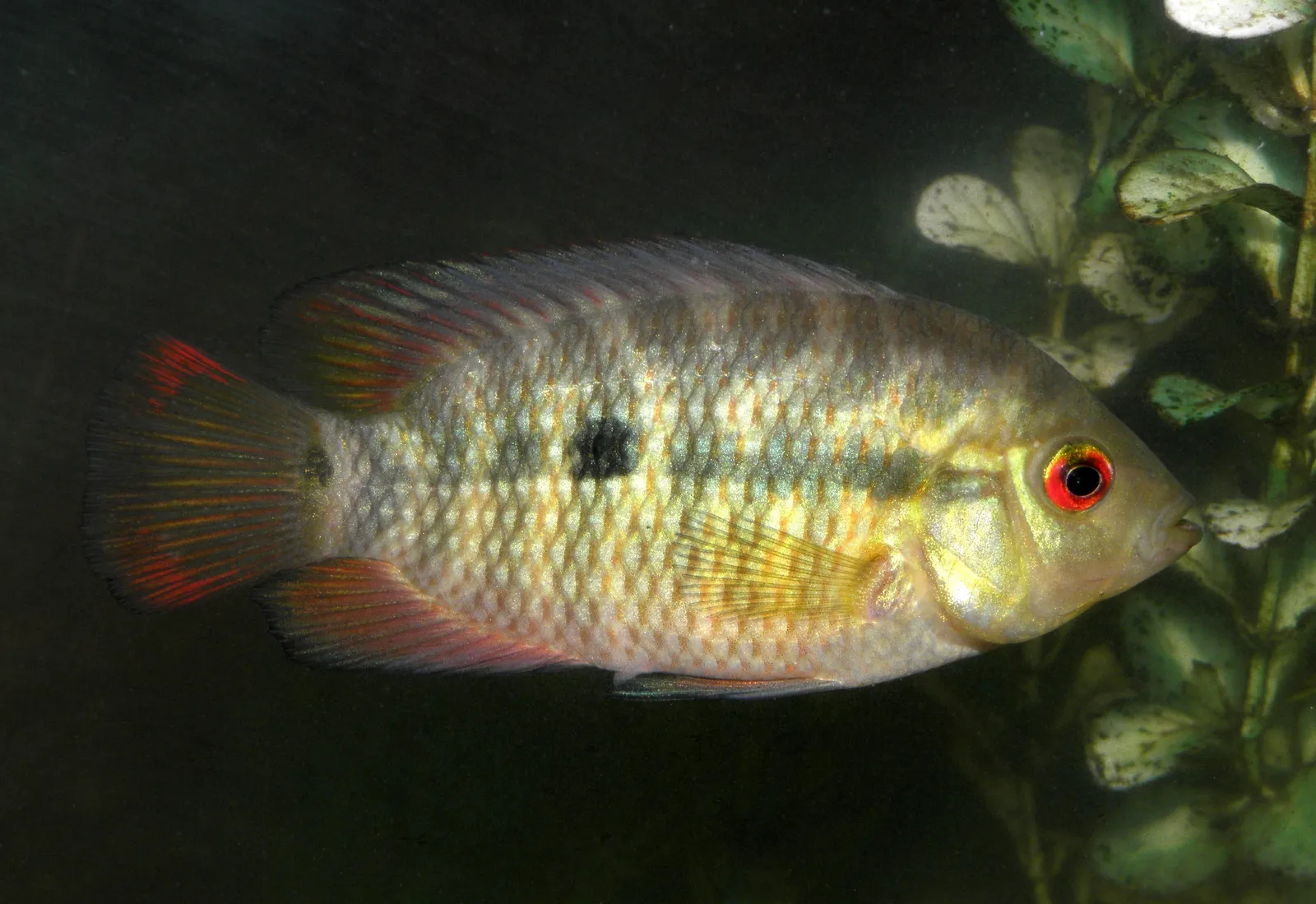
This is a deep-bodied, laterally compressed, robust cichlid of moderate size. FishBase gives a maximum of 7.5 in standard length, with fish reportedly reaching about 10 in SL and living up to roughly ten years; the historic aquarium literature cited five- to six-inch (5–6 in) adults as typical. The ground colour is famously protean — brassy yellow through olive-green to near-black — overlaid with a series of dark vertical bars and, on each flank, a prominent dark blotch. The genus-diagnostic feature, visible in courting and brooding fish, is the way the dorsal portion of the abdominal (vertical) bars is interrupted by a horizontal break between the operculum and the caudal peduncle, so the bars appear cut in two; breeding adults also develop a black blotch in the soft dorsal fin. Australoheros facetus is distinguished from many congeners by consistently carrying four abdominal bars, whereas several relatives show them in only about half of individuals. Sexual dimorphism is real but undramatic: males grow larger and develop more produced, pointed dorsal- and anal-fin tips, while ripe females are rounder and fuller in the belly; breeding females typically darken intensely. The 'chameleon' name is not hyperbole — the fish can flip from a washed-out gold to a brooding charcoal within minutes depending on mood, dominance and breeding state, which is precisely the trait that earned it the Brazilian name acará-camaleão and made it a curiosity in the early hobby.
Habitat
Australoheros facetus is a fish of the temperate-to-subtropical lowlands of southeastern South America. Its native range covers the lower Río de la Plata basin — the lower Paraná and Uruguay rivers and the Plata estuary — together with the Atlantic coastal drainages of Uruguay, Rio Grande do Sul in southern Brazil, and Buenos Aires province in Argentina; Paraguay is also included in the basin-wide range. (Much of the literature extending "facetum" deep into Paraguay and farther north now refers to other Australoheros species split off since 2006, so the strict modern range is concentrated in the south.) Within that range it is, in FishBase's words, "common in creeks, rivers, swamps and lakes," a benthopelagic generalist that does well in slow, vegetated, often silty or muddy lowland waters rather than fast clear rivers. Reported aquarium-relevant chemistry is near-neutral and soft to moderately hard: FishBase lists a preferred temperature band of 77–86 °F and pH around 6.5–7.0, with field and hobby reports spanning roughly pH 6.4–7.5 and hardness to about 13 °dGH. Because it lives in shallow streams, marshes and lake margins rather than deep open water, its occupied depth is essentially the shallow shoreline band — on the order of 0–10 ft — and FishBase publishes no discrete depth range for the species (the value here is the documented shallow-habitat band, not a measured maximum). The trait that sets this fish apart ecologically is its cold tolerance: laboratory critical-thermal trials on Iberian populations recorded a critical thermal minimum as low as about 40 °F (in 54 °F-acclimated fish) and a maximum near 102 °F, an exceptionally wide envelope that lets it overwinter in waters that seasonally approach freezing — a key reason it ranks among the most frost-enduring of all cichlids and has thrived as an introduced species in Mediterranean Iberia.
Feeding
Australoheros facetus is an opportunistic omnivore that forages by day low in the water column and over the bottom; FishBase places it at a trophic level near 3.3. Its diet mixes detritus and plant material with small aquatic animals — aquatic insect larvae, crustaceans, worms and other invertebrates — and it will take small fish when the chance arises. The 'chanchita' (little pig) epithet is earned at the substrate: the fish roots and digs in soft sediment, grubbing for buried invertebrates much as its larger relatives do. This dietary flexibility is more than a footnote. Studies of the species' invasion of Mediterranean-type streams in southern Portugal single out its broad, plastic feeding ecology — the readiness to switch among detritus, plants, invertebrates and fish as availability shifts — as a central reason it establishes and spreads so successfully outside its native range. In its home waters it functions as a mid-level generalist predator and detritivore of vegetated lowland habitats.
Mating
Outside of breeding, chanchitas live in loose aggregations and are comparatively peaceful toward conspecifics, though they bully smaller tankmates. Reproduction reorganizes that social order: pairs form, claim a territory and become markedly aggressive, defending the spawning site against all comers. Work on a Portuguese population describing the species' social organization and endocrine profiles documents a clear dominance structure tied to reproductive state, with breeding fish adopting the dark, high-contrast 'chameleon' livery as a social and reproductive signal. Courtship runs on the standard substrate-cichlid template — mutual displays, lateral presentation, jaw-locking tests of strength, and joint cleaning of a chosen spawning surface — culminating in a monogamous pair bond that both partners maintain through the spawning and brood-care cycle. Temperature is the principal trigger: in both its native range and in introduced European rivers, spawning is keyed to the warm season, with reproduction commencing as water climbs above roughly 82–86 °F.
Breeding
Australoheros facetus is a biparental, open-substrate spawner — the classic, easily bred 'beginner's' cichlid behaviour that made it a hobby staple a century ago. The pair cleans a flat hard surface (a stone, slab, root or, in the tank, a piece of slate) and the female deposits an adhesive sheet of eggs that the male fertilizes; reported clutches run into the hundreds of eggs (genus-typical and consistent with other mid-sized open-substrate heroines, the exact count varying with female size). Both parents then mount an intense, well-divided guard: they fan the eggs to oxygenate them and pick off fungused ova, and after the eggs hatch they shuttle the wriggling larvae among a series of shallow pits excavated in soft substrate, moving the brood from pit to pit to stay ahead of threats. Once the fry are free-swimming — after a few days — the pair leads and herds the school, and the young can take newly hatched brine shrimp and finely crushed flake almost at once. A dedicated study of parental roles in the chameleon cichlid found that both sexes contribute to defence and brood care with the female weighted toward direct egg- and fry-tending and the male toward perimeter territorial defence, the labour-division pattern typical of substrate-brooding cichlids. The combination of strong, reliable biparental care, a generalist diet and aggressive territoriality is exactly the package that underwrites the species' reproductive success as an invader abroad.
In the aquarium
Australoheros facetus has one of the longest unbroken aquarium careers of any cichlid. It arrived in Germany in the early 1890s — the Vereinigte Zierfischzüchtereien reports it as a fixture by 1895 — making it among the first cichlids ever kept in Europe, pre-dating nearly every other New World species in the hobby by decades. That longevity is earned. The fish is genuinely forgiving of beginner mistakes: it eats practically anything, tolerates a wide range of water conditions, spawns willingly, and does not require a heater in a temperate room. None of that makes it a trivially easy species, but it means errors in feeding or temperature rarely prove fatal, which is a considerable kindness to new keepers.
A single pair needs at minimum a 120-litre (about 4 ft / 47 in) tank; more is better, particularly when a breeding pair turns territorial and the male needs room to roam the perimeter while the female broods. Water chemistry should track the species' subtropical origin: pH 6.5–7.0, total hardness below 13 °dGH (soft to moderately hard), and temperature in the 75–82 °F range. One of Australoheros facetus's genuinely unusual qualities is cold tolerance — field populations survive down toward 50–54 °F, laboratory CTmin trials record fish withstanding approximately 40 °F — so in a temperate household this species can often be kept unheated through winter, running in the low 20s without complaint. This is not a recommendation to let the water crash into the low teens, but it does mean a brief room-temperature dip that would stress most cichlids barely registers for the chanchita. Do match the pH and hardness: while the fish adapts to neutral or slightly alkaline tap water (pH to about 7.5), very hard alkaline conditions are outside its natural chemistry and become noticeable over time.
Decor should reflect its lowland, densely vegetated home waters. A fine-grained or mixed gravel-sand substrate satisfies its rooting behaviour and makes pit-digging easy; expect the fish to move substrate freely and to dislodge plants without roots anchored in pots or heavy stones. Provide flat spawning surfaces — slate slabs, smooth flat stones, or a half-buried terracotta slab — since the pair will locate these within hours and regard them as territorial anchor points. Java fern and Anubias tied to rock or driftwood survive the rooting; soft-stemmed plants in the substrate will be reorganised or shredded. Ample hiding structures (driftwood tangles, overturned pots, stacked rock) allow subordinate fish and reluctant females to break line of sight with a dominant male, which matters considerably once breeding begins.
Tankmate selection requires care. Outside breeding condition Australoheros facetus is robust but not unduly aggressive, and it can share a large tank with other similarly sized, robust species that occupy different water-column zones — larger tetras, robust catfish, and similarly sized Neotropical cichlids of compatible temperament are often reported to work when space is generous. What keepers consistently get wrong is housing chanchitas with anything small enough to be eaten or bullied: the species is an opportunistic predator and will consume small fish and shrimp. The more serious issue is breeding aggression: a spawning pair clears its territory with conviction, and fish without adequate space or escape options in a 120-litre tank are at real risk of injury or death. Many experienced keepers raise breeding pairs alone, or with large, robust dithers in tanks of 55 US gal or more. Keep just one pair unless the tank is large enough to support well-defined sub-territories for a second, matched pair.
For breeding, the recipe is simple: a flat stone, conditioned adults (a varied diet including frozen or live food such as bloodworm, earthworm or brine shrimp accelerates spawning), and a slight temperature rise toward 81–82 °F. The pair will take care of the rest, and the tight division of labour — female attending eggs and fry directly, male on perimeter defence — is one of the more satisfying behaviours the species offers to watch. Fry take newly hatched brine shrimp and finely crushed dry food within days of free-swimming. The most common keeper mistake at this stage is introducing tankmates during the first brood: the parents' aggression is at its peak and they will attack even large fish with genuine commitment. A second common mistake is stripping eggs prematurely — Australoheros facetus is a capable, attentive parent and artificial incubation is rarely necessary unless the pair repeatedly eats early clutches, which typically indicates disturbance or insufficient privacy.
Conservation
The IUCN Red List assesses Australoheros facetus as Least Concern (assessed 18 February 2021), reflecting a wide native distribution across the lower La Plata basin and the southern Atlantic coastal drainages, an apparently large and stable population, and broad ecological tolerance. It carries no CITES listing and is regarded as harmless to humans. As a hardy, generalist, cold-tolerant habitat opportunist, it is far less exposed than the many micro-endemic Australoheros species that the post-2006 revisions carved out of the old 'facetum' complex — several of those narrow-range coastal-river forms are genuinely vulnerable to habitat loss, whereas facetus is not. If anything, the species' conservation story runs the other way: it is a notable established alien. Introduced populations are entrenched in the Mediterranean streams of southern Iberia — the Guadiana and Odelouca basins and tributaries such as the Vascão in southern Portugal, and adjacent Spanish drainages — where its cold hardiness, plastic diet and territorial parental care let it compete with and locally displace native fishes; an introduced population is likewise reported from Chile. Risk assessments flag it as a species of management concern in these Mediterranean-climate systems. Against the broader backdrop, the lowland rivers and wetlands of its native range face the usual pressures of agricultural runoff, channelization and urban pollution, but none of these is documented as a population-level threat to this adaptable, wide-ranging cichlid.