Taxonomy & naming
The Paraguay eartheater was described by the Italian zoologist Alberto Perugia in 1891 as Geophagus balzanii, from a unique holotype (MSNG 7683, in the Genoa civic natural-history museum) collected at Cáceres — then called Villa María — on the upper Río Paraguay in Mato Grosso, Brazil. The specimens had been gathered by Luigi Balzan, the young Italian naturalist for whom the fish is named. When Alipio de Miranda Ribeiro erected the genus Gymnogeophagus in 1918 it contained a single nominal species, G. cyanopterus from southern Brazil, later recognized as a junior synonym of balzanii; balzanii is thus effectively the anchor species of the genus. Jean-Pierre Gosse's 1976 revision of Geophagus in the broad sense placed balzanii in Gymnogeophagus and sank Geophagus duodecimspinosus Boulenger, 1895 into its synonymy. The modern circumscription rests on Luiz Malabarba and Roberto Reis's 1988 revision of the genus, which redescribed all the species, gave a key, and diagnosed Gymnogeophagus by a forward-directed spine on the first dorsal pterygiophore (unique among Neotropical cichlids) and the absence of supraneural bones. Within that revision balzanii stands somewhat apart from its congeners: it alone retains dense squamation on the fins and a long sensory canal in the lower caudal lobe (features Reis & Malabarba read as primitive), while its uniquely shortened supraoccipital crest — tied to the bizarre adult head shape — is an autapomorphy found in no other cichlid they examined. The genus belongs to the eartheater subfamily Geophaginae (Cichlinae), and the mitochondrial phylogeny of Wimberger, Reis & Thornton (1998) confirmed balzanii within a monophyletic Gymnogeophagus. The name has remained valid and unchallenged for more than a century.
Morphology
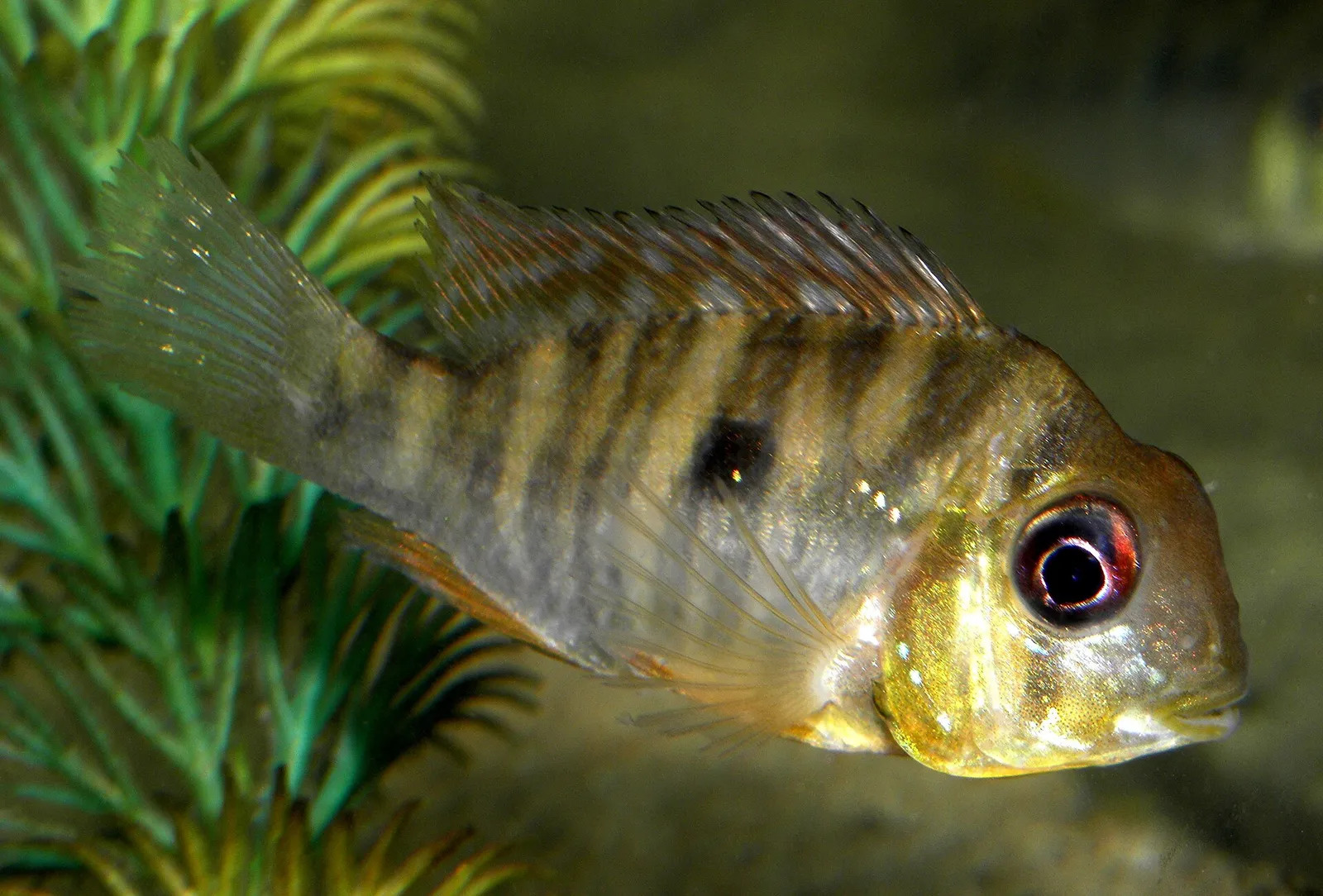
Gymnogeophagus balzanii is the bulkiest gymno: FishBase records a maximum of about 4.5 in standard length and roughly 8 in total length, and aquarists report males reaching some 8 in against females of around 5.5 in, with Weidner's monographic account putting the outer limit for the largest males at up to about 10 in total length. The body is extraordinarily deep and laterally compressed — Reis & Malabarba measured body-depth ratios that make it the most disk-shaped species in the genus — with a steeply rising forehead. Its single most arresting feature is the nuchal hump: dominant, reproductively active males develop a large, rounded adipose swelling over the nape that can be so swollen it squares off the head profile entirely. The hump is condition- and rank-dependent — only the dominant male in a group grows one, and it shrinks or vanishes if that male is deposed — and it is the clearest single mark of an alpha male. Coloration is otherwise restrained for the genus: a brassy-olive to grey ground broken by faint vertical bars and rows of small iridescent blue-green spangles on the flanks and fins, brightening considerably in dominant breeding males. Sexual dimorphism is extreme. Beyond size and the hump, mature males develop noticeably pointed, drawn-out dorsal and anal fins and intensified color, while females stay smaller, plainer and more uniformly drab; a brooding female assumes a special darkened brood-care pattern. As eartheaters the head bears the diagnostic genus trait — a partly scaleless ('bare') cheek and preorbital region — that gives Gymnogeophagus its name.
Habitat
The species is native to the La Plata (Río de la Plata) system of subtropical South America: the Paraguay drainage in Brazil, Bolivia and Paraguay, the Paraná drainage in Argentina, and the lower Uruguay drainage in Uruguay and southern Brazil. A single Amazon-basin record exists from the Río Guaporé, which has a natural connection to the headwaters of the Paraguayan tributary Río Jauru around 15°S, where the species is reportedly common; upstream of the great Sete Quedas falls at Guaíra the genus was historically absent until the Itaipú dam drowned that barrier. Catalog of Fishes accordingly lists Argentina, Brazil, Bolivia, Paraguay and Uruguay. Within these basins balzanii favours quieter water away from the main river channels — sluggish tributaries, creeks, oxbows, lagoons and floodplain margins — over soft sand and mud bottoms that suit its sifting habit. It is a fish of warm temperate to subtropical climates with a marked seasonal cycle: FishBase characterizes the species as subtropical with a preferred range near 72–79 °F, and across the genus's range winter water can fall far lower, with field observers noting that in the cooler parts of the range temperatures may drop toward 59 °F or below before rebounding in spring. Of all the gymnos, balzanii is among the most heat-tolerant because it occupies the warm northern end of the genus's distribution. Recorded in-situ chemistry is soft to moderately mineralized and near-neutral — FishBase gives a pH range of about 6.0–8.0 and hardness of roughly 5–19 dH.
Feeding
Like all eartheaters, Gymnogeophagus balzanii feeds by taking mouthfuls of sand and soft sediment, sorting edible material in the buccal cavity and pharyngeal mill and expelling the cleaned grit through the gills and mouth — the winnowing behaviour that earns the group its 'eartheater' name. The diet is that of a benthic invertivore and opportunistic omnivore: small benthic invertebrates, insect larvae, micro-crustaceans and other meiofauna taken from the substrate, supplemented with detritus and incidental plant and algal material. FishBase places its trophic level near 3.3, consistent with a small-invertebrate-dominated, partly omnivorous diet rather than strict carnivory or herbivory. The fish rarely feeds far from the bottom; in the wild it works the soft-sediment and sand zones of slow tributaries and floodplain pools, and in captivity it will only reliably take foods that sink to where it forages. This makes it a low-to-mid-level forager in its community — a processor of benthic invertebrates and organic sediment in the quieter backwaters of the Paraguay and Paraná systems.
Mating
The Paraguay eartheater is polygamous and organizes its breeding around a harem: one dominant male holds and patrols a territory and courts a series of females in turn, leaving each to raise her brood alone. This mating system is reflected in the sexes' very different roles and in the male's hump and finnage, which advertise his status. A reproductively active male courts almost incessantly, quivering and flaring at any female in range; unreceptive females are harried so persistently that in confinement they must hide to escape him, which is precisely why keepers run the species as one male with several females rather than as pairs. A female that comes into condition stakes out a small territory of her own centred on a flat stone or similar surface, which she cleans obsessively and around which she digs shallow pits. The male does not enter her territory until spawning is imminent — when her ovipositor is extended he begins to linger at its edge and may help clean the site, performing a series of 'dry runs' over it in the manner of a substrate-spawning cichlid. The transition from this open courtship to the female's solitary mouthbrooding is the species' defining behavioural twist.
Breeding
Gymnogeophagus balzanii is a delayed (larvophilous) maternal mouthbrooder — an intermediate strategy between the open substrate-spawning of its primitive relatives and the immediate egg mouthbrooding of the most derived gymnos. The female lays a clutch on the cleaned stone, where the male fertilizes it; estimates run from roughly 200 to 500 eggs (field and aquarium accounts converge near 500). The male is then driven off and takes no further part in care. Once fertilised, the female herself partially covers the clutch with sand for extra protection from predators, then keeps her distance — she typically stations herself only about 8 in from the nest and returns to check on it in brief visits over the first 24 hours rather than standing guard directly over it. The eggs remain attached to the spawning site for roughly that first day; once they are ready to hatch the female coaxes the larvae free from their shells with her mouth and takes them in, then broods the wrigglers for about a further week, releasing them for the first time around eight days after spawning, ready to feed immediately, and fasting herself throughout the whole period. Because pickup is deferred until just before hatching rather than at spawning, this is termed 'delayed' mouthbrooding, and within the genus balzanii represents its most fully evolved expression: unlike species that can still pick up whole eggs, the well-developed, sticky attachment coat on a balzanii egg would itself defeat true ovophilous (immediate) mouthbrooding, and the stimuli a female needs to trigger picking up a clutch simply are not present until the eggs are on the point of hatching — the strategy has, in an evolutionary sense, nowhere further to go. In the wild, breeding in the southern part of the range is concentrated in the austral summer (roughly November to January), and brooding females are routinely netted in those months. After release the female continues to guard the free-swimming fry for several weeks, gathering them back into her mouth at any threat — the fry's signal to bolt for shelter appears to be the dark circle of the parent's open mouth, an innate response. Spawning is triggered by good condition and by the seasonal warming that follows a cool winter; without that winter rest the cycle and the fish's longevity both suffer.
In the aquarium
The Paraguay eartheater has been kept and bred in the hobby for decades and is genuinely peaceful and undemanding in temperament, but it carries one major caveat that pushes it into specialist territory: it is a cool-water, seasonal fish that needs a real winter. Seriously Fish and field observers agree the species does best held around 70–77 °F for most of the year with a deliberate 'overwintering' period of three to four months at roughly 61–64 °F, simulating the seasons of its subtropical home; kept permanently warm in a heated tropical tank it becomes listless and drab and its lifespan is reportedly shortened substantially. Reproducing that cycle usually means a programmable chiller, which adds real cost and is the single biggest reason the fish is recommended only to keepers willing to provide it.
A tank of about 47 in length (on the order of 35–55 US gal) suits a male with two or more females; a larger group needs a correspondingly bigger footprint, and because males grow to roughly 8 in a generous tank is kinder. The substrate is non-negotiable: fine sand, deep enough for the fish to sift naturally. Gravel is a poor choice — it can be ingested and lodge in the gills, and the fish's constant sifting will rearrange it anyway. Décor can be minimal in a biotope spirit: open sand, a few pieces of driftwood and tangled roots, and some flat stones or large clay flowerpots to serve as cleaning surfaces and female refuges. Live plants are not part of the natural habitat and tend to be uprooted, so anchored or potted hardy species are the only realistic option. Like most geophagines the fish is prone to head-and-lateral-line erosion ('hole-in-the-head') and neuromast pitting if water quality slips, so strong filtration and large, regular water changes are essential.
Water should be soft to moderately hard and near neutral — about pH 6.5–7.5 and 5–15 dH — matching the documented in-situ chemistry. Feeding is easy provided food sinks: good sinking granules, flake, and small live or frozen foods such as bloodworm, daphnia and brine shrimp, with some vegetable matter (spirulina flake, blanched spinach or peas) rounding out the diet. On compatibility, balzanii is not a true community fish so much as a calm one with a temper toward its own kind: a dominant male is intolerant of rival males and of other cichlids, so keep only one male per tank and give him a harem of several females (females coexist peacefully). Mid- and upper-water dither fish that tolerate the cool conditions work best — robust temperate-zone characins such as Buenos Aires tetras (Hyphessobrycon anisitsi), which share the species' geographic origin, or hardy danionins, rather than warmth-demanding tankmates. The common mistakes are keeping it too warm year-round, skipping the winter rest, using gravel instead of sand, and attempting to pair rather than harem it.
Conservation
The IUCN Red List assesses Gymnogeophagus balzanii as Least Concern (assessed 18 November 2020 by R.G. Frederico, published 2023), reflecting a wide distribution across the Paraguay, Paraná and lower Uruguay drainages and no evidence of major decline. It carries no CITES listing. The species is taken for both the ornamental aquarium trade and local food fisheries, but at levels the assessment does not flag as a population-level threat, and as a widespread, adaptable backwater generalist it is far less exposed than the many narrow-range endemics of the same basins. The broader La Plata system is nonetheless under mounting pressure — large hydroelectric dams (the Itaipú impoundment itself reshaped this species' upstream distribution at Guaíra), water diversion, agricultural runoff and habitat conversion are all documented stressors on the Paraguay and Paraná fish faunas. None is identified as a present danger to balzanii specifically, but they form the backdrop against which its continued security should be read.