Taxonomy & naming
Crenicichla celidochilus was described by the Argentine ichthyologist Jorge R. Casciotta in 1987, in a Copeia paper that paired the formal description with a multivariate analysis of the so-called lacustris species group of southern Crenicichla. The type material came from two tributaries of the Río Cuareim in northern Uruguay: the holotype (ZVC-P 94) and most paratypes were taken at the Arroyo de la Invernada, Picada de la Negra Muerta, in the Departamento de Artigas, with a second series from the nearby Arroyo Tres Cruces Grande in the same department. The original combination is the one still in use — the species has accrued no synonyms — and it was redescribed in detail by Lucena and Kullander (1992) in their landmark revision of the Crenicichla of the Uruguay River drainage, which fixed its diagnosis, distribution and illustrations. The genus Crenicichla, erected by Johann Jakob Heckel in 1840, is the most species-rich of all Neotropical cichlid genera, with roughly eighty valid species ranging from northern South America south to the Río Negro of Patagonia. Casciotta placed celidochilus in the lacustris group, comparing it to Crenicichla haroldoi, Crenicichla iguassuensis, Crenicichla jupiaensis, Crenicichla scottii, Crenicichla niederleinii and Crenicichla vittata, and distinguishing it on colour pattern — a broad dark lateral band running onto the caudal fin and through the caudal ocellus, an absence of suborbital and vertical stripes, unmarked unpaired fins — together with details of the premaxilla, pharyngeal bone and tooth shape. Later multilocus phylogenetic work by Piálek and colleagues (2012) confirmed the lacustris group as a natural assemblage and recovered, within it, two endemic species flocks in the upper Uruguay (the Crenicichla missioneira and Crenicichla mandelburgeri flocks) that are held up as a model of sympatric speciation in rivers; Crenicichla celidochilus sits in this broader lacustris radiation rather than within either flock.
Morphology
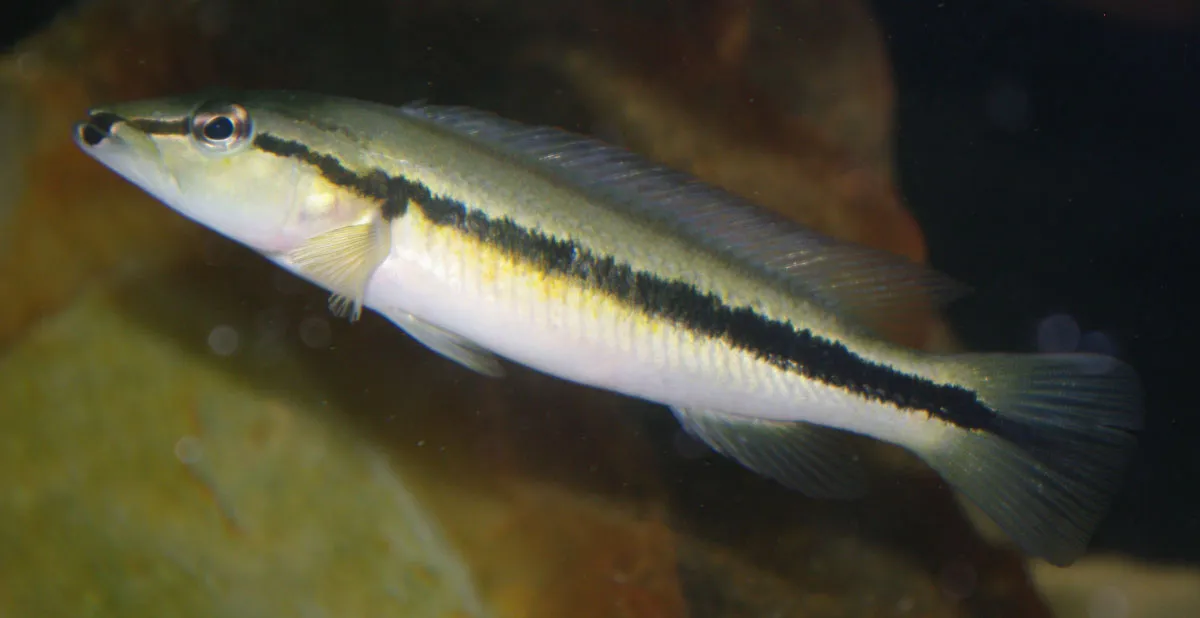
This is a medium-sized pike cichlid with the elongate, cylindrical, big-mouthed body plan that defines the genus — a shape built for lurking among rocks and lunging at passing prey. Casciotta's type series gave a maximum of about 5 in standard length, but the species grows considerably larger: FishBase, drawing on the Lucena and Kullander revision, lists a maximum of 10.5 in total length and a published weight of about 162 g, so a fully grown adult is a substantial, robust fish. The jaws are long and pointed, and as in its relatives the upper and lower jaws are roughly equal in length (isognathous). Colour in life is a brownish to greenish gray, paler below, crossed lengthwise by a broad dark lateral band that continues onto the tail and passes through the dark, often pale-ringed ocellus at the base of the caudal fin. The diagnostic feature, and the source of the name, is on the mouth itself: four dark, sharply defined spots — two on the upper lip and two on the lower — that no other pike in its range carries. Unlike many congeners it lacks a suborbital stripe and conspicuous vertical body bars, and its dorsal, anal and caudal fins are largely unmarked. Sexual dimorphism follows the usual Crenicichla pattern: males tend to grow larger and heavier-bodied, while ripe females are deeper through the belly and, as in other lacustris-group pikes, may show a rounded dark blotch with a light margin in the dorsal fin during breeding condition. Sexing is unreliable in juveniles and becomes clear only as the fish mature.
Habitat
Crenicichla celidochilus is endemic to the Uruguay River drainage of the lower La Plata basin, recorded from Argentina, Brazil and Uruguay in tributaries of the middle and upper Uruguay River. In Uruguay it is one of seven pike cichlids known from the country and is restricted to a few streams of the Río Cuareim system in the Departamento de Artigas, in the far north along the Brazilian border; this Cuareim corridor is recognised as a hotspot of freshwater fish diversity, where celidochilus co-occurs with Crenicichla minuano, Crenicichla scottii, Crenicichla lepidota, Crenicichla missioneira and Crenicichla tendybaguassu. Within the FEOW scheme these waters fall in the Lower Uruguay freshwater ecoregion. The setting is firmly subtropical rather than tropical: at this latitude the Uruguay drainage runs through rolling grassland and experiences a hot summer and a genuinely cool winter, with riverside nighttime air temperatures that can approach freezing in July — a seasonality unlike anything in the Amazon. Field accounts of the region's pike habitats describe clear, moderately flowing streams over a substrate of pebbles, gravel and larger rocks, often fringed with aquatic vegetation, alongside warmer, more stagnant backwaters. Measured water there is soft and runs roughly neutral, with pH spanning about 6.7 to 7.8 across nearby sites and seasons and summer water temperatures that can climb into the upper 20s and low 30s °C before falling sharply in winter. As a rock-dwelling stream pike, celidochilus keeps to shallow water within reach of cover; no precise depth band has been published for the species, but its biotope is the shallow littoral zone of small to medium rivers rather than open or deep water.
Feeding
Like pike cichlids generally, Crenicichla celidochilus is a carnivorous ambush predator. The genus is built around this lifestyle — an elongate body, a large protrusible mouth and cryptic coloration that let the fish hold station among rocks and roots and strike at prey that strays within range. FishBase estimates a trophic level near 3.3, consistent with a diet of small fishes together with aquatic insects, larvae, crustaceans and other benthic invertebrates rather than a strict fish-only piscivory; stomach analyses of related southern pikes routinely turn up insect larvae such as chironomids alongside small fish. Within its rocky stream community celidochilus functions as one of several mid-level predators — the Cuareim system supports six pike species side by side, and partitioning of prey, microhabitat and feeding mechanics among them is part of what allows so many closely related ambush hunters to coexist. There is no published quantitative gut-content study specific to this species, so the dietary picture is inferred from its morphology, its trophic position and the well-documented habits of its lacustris-group relatives.
Mating
No detailed field study of pair formation in Crenicichla celidochilus has been published, and what can be said is drawn from the consistent reproductive biology of the genus and the lacustris group. Pike cichlids are monogamous, biparental fish that form lasting pairs around a defended territory centred on a spawning cave or rock crevice. Courtship involves mutual displays, lateral posturing and jaw contact, and in many species the female advertises readiness through heightened colour — in lacustris-group pikes a swollen, reddened belly and a contrasting dark, light-ringed blotch in the dorsal fin are typical breeding signals. As with most members of the genus, the fish are territorial and intolerant of conspecifics outside the pair bond, so the social structure during the breeding season reduces to dispersed, aggressively held pair territories rather than aggregations. Pairs form best when several young fish are raised together and allowed to sort themselves out, since an arbitrarily introduced male and female may not accept one another.
Breeding
Crenicichla celidochilus has not, as far as the published record shows, been bred and documented in detail, but it is a substrate- and cave-spawning biparental cichlid like the rest of its genus, and its reproduction can be described confidently from that template. The pair selects a sheltered site — a rock crevice, an undercut or a cave — and the adhesive eggs are laid in a single layer on the ceiling or wall of the chamber. The female tends and fans the clutch while the male patrols and defends the surrounding territory; after hatching, the wrigglers are moved to pits and the free-swimming fry are guarded and herded by both parents, which is the hallmark of pike-cichlid care. Documented clutches in similarly sized Crenicichla typically run to a few hundred eggs (genus-typical, on the order of 100–300 in pikes of this size), and brood care is extended, often lasting several weeks until the fry are well grown. In the wild the spawning season would track the warm subtropical summer; in captivity, congeners are commonly brought into condition with heavy feeding of live and meaty foods followed by large, slightly cooler water changes that mimic seasonal rains. Because no spawning of celidochilus itself has been written up, these specifics are extrapolated from the genus and should be read as such.
In the aquarium
Crenicichla celidochilus is a rarely traded fish — it is endemic to a few northern Uruguayan and adjacent border streams, and even seasoned collectors travelling the region have failed to catch it on dedicated trips, so it reaches hobbyists only occasionally and is of interest mainly to specialists in southern pike cichlids rather than to general keepers. Anyone who does obtain it should plan around an adult of roughly 10–10.5 in: a single fish or a pair needs a long tank of at least 59 in (about 100 US gallons), and more is better, with the footprint mattering far more than height for a bottom-oriented, territorial predator. The décor should reproduce its rocky stream home — a sand or fine-gravel base, stacked rock providing several caves and broken sightlines, and some driftwood — since secure cave sites both reduce stress and are essential if breeding is ever attempted. Crucially, this is a subtropical fish, not a tropical one: it comes from water that swings from hot summers into genuinely cold winters, so it does not want to be held permanently warm. A range of roughly 68–79 °F suits it, with a cooler winter rest, and it tolerates soft to moderately hard, near-neutral water (pH about 6.5–7.8) far better than the strongly acidic blackwater some tropical pikes prefer. Filtration should be generous with moderate flow and clean, well-oxygenated water. Feeding is straightforward for a predator — frozen and live meaty foods such as earthworms, prawn, mussel and fish-based gel or pellet diets — but live feeder fish are unnecessary and best avoided on disease grounds. The main husbandry pitfall is the genus-wide intolerance of its own kind: outside a settled pair, two pikes in close quarters can fight to the death, so conspecifics should only be combined in a large tank with the option to separate them, and tankmates should be robust, similarly sized characins or catfishes rather than anything small enough to be eaten or slow enough to be bullied. Overall this is a fish for the patient, experienced keeper who values behaviour and rarity over colour.
Conservation
The IUCN Red List assesses Crenicichla celidochilus as Least Concern, in an assessment by R.G. Frederico dated 10 November 2020 and published in 2023, which records the population trend as unknown and notes that there are no threats currently known to affect the species across its range in Argentina, Brazil and Uruguay. It carries no CITES or CMS listing and is of negligible interest to fisheries. That reassuring status should be read against a genuinely small and specialised distribution, however: the species is confined to particular clear-water tributaries of the middle and upper Uruguay drainage, and in Uruguay it is restricted to the Río Cuareim system, a basin repeatedly flagged as a high-diversity, conservation-priority area for the country's freshwater fishes. Narrow-range stream endemics of this kind are inherently exposed to local pressures — agricultural runoff and land conversion in the surrounding grasslands, damming and flow alteration along the Uruguay River, and the removal of the marginal vegetation and rocky cover the fish depends on. None of these is documented as a present danger to celidochilus specifically, but they are the backdrop against which a Least Concern listing for so localised a fish should be interpreted.