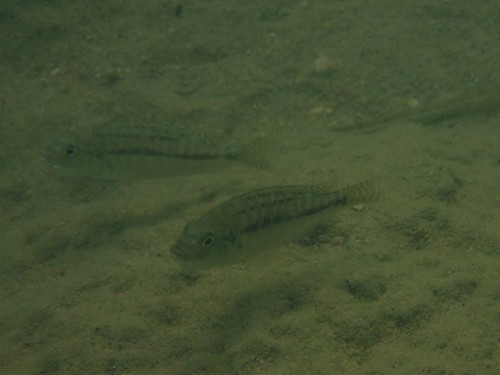
Taxonomy & naming
Cyathochromis obliquidens was described by the British ichthyologist Ethelwynn Trewavas in 1935, in her landmark paper "A Synopsis of the Cichlid Fishes of Lake Nyasa" (Annals and Magazine of Natural History). Catalog of Fishes and FishBase both list it as valid and unchanged since, and the genus remains monotypic — Cyathochromis contains this single species. The names are descriptive: the genus combines the Greek kyathos (a cup) with chromis, an old name for a perch-like fish, while the epithet obliquidens marks the diagnostic teeth of the outer jaw row, which lean obliquely toward the midline rather than standing upright.
The fish belongs to the mbuna, the rock-frequenting group within Lake Malawi's haplochromine cichlid flock, in the subfamily Pseudocrenilabrinae. Its taxonomic interest is out of proportion to its modest appearance. Early workers, including M. K. Oliver, noted that its faint barring and two thin lateral stripes recall the "primitive" colour pattern of the lake's haplochromines and suggested it might be a plesiomorphic form sitting close to the ancestral mbuna. Modern phylogenomic studies have wrestled with exactly where to place it: some analyses recover Cyathochromis obliquidens nested inside the mbuna clade, which would mean a plant-grazing specialist arose from within a radiation otherwise built around scraping rock. Hobbyists sometimes note its resemblance to certain Tropheops "weed" forms, but the elongated lower jaw and head profile set it apart.
Morphology
This is a moderately sized mbuna. Reported maximums vary with the source: FishBase cites a maximum of about 6 in (6 in) total length, the IUCN assessment gives roughly 5 in (5 in), and field-oriented references put wild males near 4.7 in (4.5 in) and females around 4 in (4 in), with captive fish sometimes a touch larger. The honest summary is that a healthy adult is a hand-sized fish in the 4–6 in (4–6 in) band.
Colour is understated by mbuna standards. The body is a pale tan to grey-brown crossed by narrow, faint vertical bars and overlaid by two thin horizontal stripes — a pattern close enough to the widespread Astatotilapia calliptera that the two can be confused at a glance. Males in breeding condition intensify and carry conspicuous yellow egg-spots on the anal fin; females stay smaller and plainer. The surest identification feature is in the mouth: the slender outer-row teeth angle inward, a built-in tool for the fish's unusual feeding style and the origin of its name.
Habitat
Cyathochromis obliquidens is a Lake Malawi endemic in the broad sense — restricted to the lake and its directly connected waters. The IUCN assessment records it from Lake Malawi proper, the satellite Lake Malombe, and the Upper Shire River that drains the lake's south end, with extant occurrences spanning the Malawian, Mozambican and Tanzanian shores. It is widely distributed around the lake rather than confined to a single shoreline, which is part of why it is considered secure.
Its habitat is specific and shallow. The fish lives in the "intermediate" zone where sand meets rock, almost always in the presence of submerged macrophytes — Vallisneria and Potamogeton beds are the classic setting. FishBase gives a depth range of about 3–20 ft (3–20 ft); the IUCN assessment notes it occurs mainly in plant beds of the intermediate zone at 3–7 ft and seldom ventures below about 16 ft (16 ft), and in Lake Malombe and the Shire it turns up among reed stands. Lake Malawi's surface waters are warm (mid-70s °F, around 75–82 °F), alkaline and well-buffered, with a pH typically near 7.7–8.6 — the soft, vegetated bays this species favours are the warm, well-lit margins of that system.
Feeding
What makes this fish worth a second look is how it feeds. The great majority of mbuna are grazers of aufwuchs — the dense algal-and-invertebrate turf coating the rocks — and their jaws are tuned for scraping stone. Cyathochromis obliquidens does some of that too, but its specialty is brushing loose algae from the leaves of Vallisneria and Potamogeton, using the inward-leaning teeth that give it its name. The IUCN account describes it feeding on algae from the surface of macrophytes, supplemented by small invertebrates and plankton, and FishBase places it at a low trophic level (about 2.0), consistent with a largely herbivorous diet.
That plant-grazing niche is unusual enough to matter to evolutionary biologists. If, as several phylogenomic analyses suggest, Cyathochromis obliquidens really is embedded within the rock-scraping mbuna, then this lineage evolved the ability to harvest soft plant-borne algae from within a radiation built around hard substrate — a small but instructive example of how Malawi's cichlids have repeatedly retooled the same basic jaw into new ecological roles. In the community, it is a common but not dominant member of the shallow vegetated bays, sharing the intermediate zone with assorted mbuna that it tolerates more readily than its own kind.
Mating
Males are the territorial sex. According to the IUCN assessment and the underwater observations of Ribbink and colleagues (1983), a breeding male excavates a spawning pit either beneath a rock or directly among the Vallisneria, sometimes uprooting a few plants to clear the site, and defends it vigorously — chasing both conspecifics and other mbuna sharing the intermediate habitat, though other cichlids are harassed less than its own species. The conspicuous yellow egg-dummies on the male's anal fin play the standard haplochromine role, drawing the female to fertilize the clutch as she collects it into her mouth.
Permanent male territoriality is close to universal among Malawi's mbuna — Konings notes that Melanochromis, Gephyrochromis, and Pseudotropheus sp. "acei" are among the rare exceptions whose males don't hold fixed ground — and Cyathochromis obliquidens follows the majority pattern: a territorial male keeps the same patch of vegetated habitat indefinitely rather than shifting from site to site.
Away from breeding, the species is loosely social rather than schooling. Females, juveniles and non-territorial males are seen singly or in small, scattered groups foraging through the weed beds, while territorial males hold their patches near rocks or within the plants.
Breeding
Like the rest of Lake Malawi's haplochromines, Cyathochromis obliquidens is a maternal mouthbrooder: the female takes the fertilized eggs into her mouth and incubates them there, releasing free-swimming fry after roughly three weeks with no further help from the male. The male contributes nothing beyond fertilization and defence of the spawning pit; once the female has collected the clutch she withdraws to brood it alone, ceasing to feed while she holds.
Reproductive output is modest, in the genus-typical range of a few dozen eggs per clutch rather than the hundreds a substrate-spawner might produce — the trade-off mouthbrooders make for the safety of carrying young inside the mouth. A short generation length — about a year, per the IUCN assessment — together with high reproductive resilience helps explain why local populations recover quickly even where they are fished.
In the aquarium
Cyathochromis obliquidens is kept by mbuna specialists more than by the general hobby; it is rarely exported and its subtle colouring keeps it off most retail shelves, so most aquarium fish trace to deliberate breeders. The natural history translates directly into care. Keepers consistently describe a hardy, manageable mbuna by Malawi standards, but one with the genus's signature flaw: males are intensely aggressive toward other males of their kind. The reliable approach is a harem — a single male with three or more females — and not attempting two males in anything but a very large tank.
Plan for a footprint, not just a volume: a tank around 90 gallons (roughly 90 US gal) or larger, aquascaped with fine sand, generous rockwork to break sightlines and define territories, and hardy plants such as Vallisneria that echo the wild biotope (and that the fish will graze). Water should be alkaline and well-buffered, pH in the high 7s to mid 8s, with the strong filtration and routine water changes any mbuna tank demands. The common mistakes are predictable — undersizing the tank, keeping multiple males, and pairing it with delicate tankmates that can't weather a territorial male. Treated as the harem-keeping rift-lake cichlid it is, it is a satisfying and undemanding species; treated as a community peaceful fish, it is not.
Conservation
On its own account, Cyathochromis obliquidens is in good standing. The IUCN Red List assesses it as Least Concern (assessed 22 June 2018 by Konings, Kazembe and Makocho, reaffirming a 2006 Least Concern listing), citing its wide distribution across Lake Malawi, Lake Malombe and the Upper Shire and the absence of any major lake-wide threat. The population trend is listed as unknown but the species is described as a common member of the shallow vegetated cichlid community, and it occurs within Lake Malawi National Park. The one threat singled out is incidental: it is caught — and eaten, despite its small size — in the subsistence beach-seine fishery rather than being targeted by the ornamental trade. Notably, its shallow plant beds give it a small buffer; observers report that where seining strips the macrophytes, the fish retreats to feed on the few plants sheltered among rocks.
That individually reassuring status sits inside a strained lake, and the honest framing is to say exactly that. The basin review by Chavula et al. (2023, Journal of Great Lakes Research 49(6):102241) documents mounting pressure on Lake Malawi/Niassa/Nyasa: heavy over-fishing and the collapse of the commercially vital chambo (Oreochromis spp.), rising sediment and nutrient loading washing off deforested catchments, roughly +33 °F of warming in shallow waters that strengthens stratification and suppresses the nutrient mixing the lake's productivity depends on, and the looming risk of invasive species. For a shallow, vegetation-tied grazer like Cyathochromis obliquidens, the most relevant of these are the ones that act on its habitat: sedimentation and nutrient enrichment that smother or overgrow the inshore plant beds it forages, and shoreline disturbance that thins the macrophytes outright. None of this has yet moved the species off Least Concern, and it should not be overstated — but a fish this tightly bound to one fragile, near-shore microhabitat is only as secure as those vegetated bays remain.