Taxonomy & naming
Placidochromis sp. "Electra Blue" carries no describing author, no publication date, and no entry under a validated name in Eschmeyer's Catalog of Fishes; it is an informal trade name built directly on the species it most closely resembles, Placidochromis electra (Konings, 1990), whose electric-blue nuptial males made it one of the most widely kept Lake Malawi cichlids in the aquarium hobby. P. electra itself was described from Chidunga Rocks near Cape Maclear, in the far south of the lake. This Tanzanian population, recorded well to the north around Hongi Island, Lundo Island, and Mbamba Bay, shares the same striking blue colouration but has not been shown by any published study to be the same species as the nominal, southern P. electra; the standard practice among Malawi cichlid specialists is to track such geographically separated, electra-like populations as distinct informal forms pending genetic or morphological study, rather than assume they are conspecific simply because they look alike. It is on that basis that this form carries the qualifier "sp." rather than being called P. electra outright.
Morphology
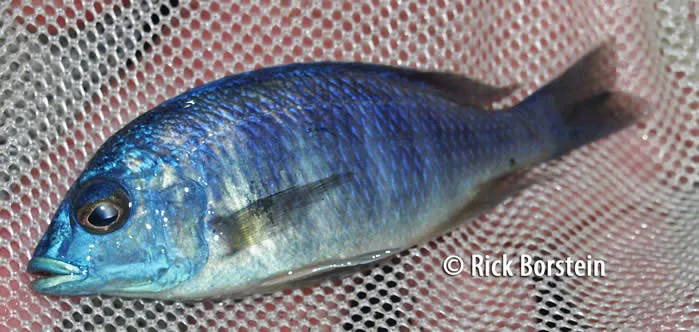
Breeding males of Placidochromis sp. "Electra Blue" are described as showing the same vivid, largely unpatterned electric-blue body colour that made P. electra famous, though the exact shade and any fine differences from the nominal southern population have not been documented in a formal comparison. The body should follow the genus-typical Placidochromis form — moderately elongate, deep-bodied, and laterally compressed. Genus-typical size runs to roughly 4.5–5.5 in total length for P. electra and its close relatives, with males somewhat larger than females; no validated maximum has been published specifically for this Tanzanian population. Sexual dichromatism is pronounced, as in P. electra: females are silvery-grey and comparatively drab, lacking the solid blue of nuptial males.
Habitat
The form is recorded from three localities on the Tanzanian shore of northern Lake Malawi — Hongi Island, Lundo Island, and Mbamba Bay, an area well known to Malawi cichlid collectors as a distinct northern collection ground quite separate from the classic P. electra range around Cape Maclear in the south. Placidochromis species of this type typically occupy the sand-rock interface, hovering near boulders at the edge of open sand at moderate depths rather than deep within dense rocky reef. The surrounding water follows the general Lake Malawi profile: warm, alkaline, and well-buffered. The geographic separation between this Tanzanian population and the southern P. electra type locality — several hundred kilometres of lake shoreline apart — is itself notable, since many Lake Malawi haplochromine lineages show measurable genetic and morphological divergence over comparable distances, further supporting the decision to track this form separately rather than assume it is identical to the nominal species.
Feeding
P. electra and its close relatives are documented as invertivores, hovering a short distance above the sand-rock interface and taking small benthic prey — insect larvae, crustaceans, and other invertebrates — disturbed from the substrate or picked directly from rock and sand, rather than grazing algae in the manner of the mbuna sharing the same rocky habitat. That hovering, watch-and-strike foraging style is a recognisable behavioural signature of the genus, distinguishing Placidochromis from both the territorial algae-grazers on the rock face and the sand-sifting haplochromines working the open flats further offshore. Placidochromis sp. "Electra Blue" is presumed to feed similarly, though no dedicated feeding study specific to this Tanzanian population has been published.
Mating
Mature males are expected to hold a territory at the sand-rock interface and display their electric-blue breeding colour to attract passing females, following the pattern well documented for the widely kept P. electra. Courtship follows the standard haplochromine sequence built around egg-spot markings on the male's anal fin: the female, having collected the fertilised eggs into her mouth, continues to peck at these egg-like markings as the male displays them, triggering further fertilisation as sperm is released and drawn into her mouth along with the eggs. In aquarium populations of P. electra, males are often kept successfully with several females at once, suggesting a mating system in which one territory-holding male fertilises multiple females rather than forming a pair bond, though no locality-specific behavioural account has been published for this Tanzanian population specifically.
Breeding
As in all Lake Malawi haplochromines, reproduction is by maternal mouthbrooding: the female alone carries the fertilised eggs and subsequent fry in her mouth, without normal feeding, for several weeks until they are ready for independent release, with no further parental role for the male. P. electra is well established and widely bred in the aquarium hobby, with clutch sizes typically in the range of a few dozen eggs and a brooding period of roughly three to four weeks; exact figures for this specific Tanzanian population have not been documented in the wild. Because P. electra breeds readily in captivity, most of what is known in detail about clutch size, brooding duration, and fry development for electra-type Placidochromis actually comes from aquarium observation rather than wild field study — a common pattern for popular Malawi cichlids, where the hobby has in some respects outpaced formal science in documenting reproductive biology.
In the aquarium
Given its resemblance to the widely kept P. electra, Placidochromis sp. "Electra Blue" would be housed the same way: a tank of at least 47 in with a sand substrate, moderate rockwork at the margins, and open swimming space. Water chemistry should follow the Lake Malawi standard — alkaline and well-buffered, pH roughly 7.7 to 8.6, temperature 75–82 °F. Electric-blue Placidochromis are generally calm by Malawi cichlid standards and are commonly kept as a single male with several females within a mixed community of similarly non-aggressive haps, rather than housed like territorial mbuna. Diet should include a quality cichlid pellet supplemented with small live or frozen invertebrates such as bloodworm and mysis shrimp.
Conservation
Placidochromis sp. "Electra Blue" has not been evaluated by the IUCN and, as an undescribed form, has no Red List status of any kind. Its close relative P. electra has itself been subject to conservation discussion given its enormous popularity in the trade and the pressure that popularity can place on collection sites; the same consideration applies to this Tanzanian population, and any electra-type Placidochromis collected from a narrow, specific locality should be treated with the caution due any narrow-range Malawi endemic, absent a formal assessment. Because captive-bred P. electra are now widely available through the aquarium trade, wild collection pressure on any single electra-type locality, including this Tanzanian form, may be lower today than it was when the fish first entered the hobby, though this has not been documented specifically.