Taxonomy & naming
The species was described by the Belgian-British ichthyologist George Albert Boulenger in 1911 as Paratilapia parvidens, in a paper on the third collection of fishes made by Dr. E. Bayon in Uganda (Annali del Museo Civico di Storia Naturale di Genova, ser. 3, vol. 5). The single type specimen — the holotype, MSNG 12959, still held in Genoa — was taken at Jinja, by the Ripon Falls at the head of the Victoria Nile in Uganda, the outflow of Lake Victoria. Peter Humphry Greenwood transferred the species to Haplochromis in 1959, and it has carried the binomial Haplochromis parvidens (Boulenger, 1911) ever since; the Check-list of the Freshwater Fishes of Africa (van Oijen et al., 1991) and Eschmeyer's Catalog of Fishes both treat that combination as valid. In his sweeping 1980 revision of the Lake Victoria flock Greenwood resurrected Regan's 1920 genus Lipochromis for the lake's anatomically derived paedophages, and parvidens is one of the species assigned to that lineage — so the fish appears in the literature and the hobby variously as Haplochromis (Lipochromis) parvidens, Lipochromis parvidens, and (under a more recent splitting scheme) Cleptochromis parvidens. Because the Lake Victoria 'genera' Greenwood erected are largely informal lineage labels rather than universally accepted genera, this atlas keeps the conservative, widely-used heading Haplochromis while noting the Lipochromis placement that defines the fish's ecology.
Morphology
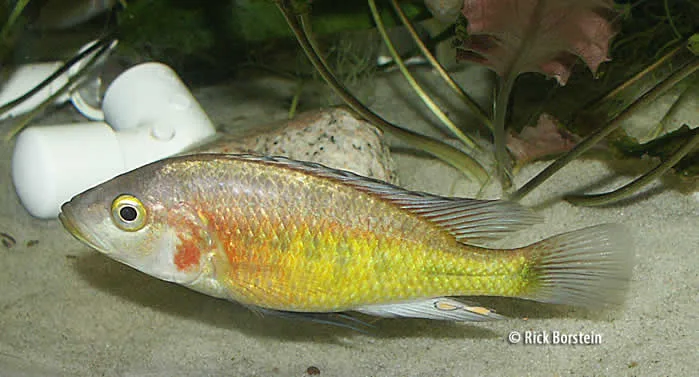
Haplochromis parvidens is a modest-sized haplochromine, reaching about 6.5 in standard length (FishBase, after CLOFFA). The build is the generalized deep-bodied haplochromine shape, but the head and mouth carry the diagnostic signature of the Lipochromis paedophages: a thick-lipped, widely distensible and protractile mouth, with the posterior end of the maxilla deeply embedded in the oral mucosa, and oral teeth that are small and largely buried in the gum — the feature that gives the species its name (Latin parvus, 'small', plus dens, 'tooth'). This reduced, almost inconspicuous dentition is the opposite of what the lake's biting and scraping cichlids show, and it is an adaptation for swallowing soft, slippery prey whole rather than seizing or rasping. As in essentially all Lake Victoria haplochromines, the sexes differ in colour and size: breeding males are the showier and somewhat larger fish, while females and non-breeding individuals are a plainer silver. Aquarium-line fish traded as the 'Red' form show males with red and yellow on the flanks against silver females. No comprehensive modern colour description of wild parvidens survives the lake's collapse, so much of what is known of its appearance comes from preserved museum material and a handful of aquarium strains.
Habitat
Haplochromis parvidens is endemic to the Lake Victoria basin in East Africa, the lake shared by Uganda, Kenya and Tanzania, and reported also from associated satellite lakes and lagoons of the system (aquarium stock has circulated under the locality Lake Nawampasa, a small Ugandan satellite lake). FishBase places it in the littoral and sublittoral zones, where it may occur commonly over mud bottoms, across a depth range down to about 49 ft. Lake Victoria is a large, shallow, equatorial lake: its open waters are warm year-round, typically around 73–81 °F, and the water is alkaline and well-buffered, with pH generally in the range of about 7.2 to 9.0 and moderate hardness. No in-situ chemistry was published for parvidens specifically before the population collapsed, so these figures describe the lake it lived in rather than measurements taken at its capture sites. One of the central tragedies of the Victoria flock is that the lake itself changed — eutrophication and rising turbidity since the mid-20th century degraded the clear, structured visual environment in which these cichlids evolved.
Feeding
Haplochromis parvidens is a paedophage — a specialist that feeds on the eggs and buccal-stage larvae of other cichlids, prey it obtains from brooding females. FishBase records it bluntly as feeding 'on cichlid embryos or larvae,' and assigns it a high trophic level of about 4.0, on par with outright fish-eaters. The mechanism, debated since Greenwood's day, is now understood to be forceful rather than opportunistic: Greenwood (1959) hypothesized that these fish engulf the snout of a mouthbrooding female and suck the clutch out of her buccal cavity, and he noted that parvidens itself displayed snout-engulfing behaviour in captivity. Fryer & Iles (1972) countered that females might simply jettison their broods under stress, but the behavioural observations that have since accumulated support the forceful view — the paedophage harasses and tires a holding female, then clamps its distensible mouth over her snout and draws out the eggs or fry. The reduced, deeply embedded teeth and the highly protrusible, thick-lipped mouth are precisely the toolkit for this: nothing needs to be bitten or held, only enveloped and swallowed. Paedophagy evolved repeatedly and independently across the haplochromine radiations of Lakes Victoria, Edward, George, Kivu and Malawi, and the anatomical convergence between these unrelated lineages is striking.
Mating
Like the rest of the Lake Victoria flock, Haplochromis parvidens is a maternal mouthbrooder, and its reproductive behaviour follows the haplochromine pattern: there is no lasting pair bond, and the male's role ends at spawning. Breeding males develop their fuller colour and defend a courting space, displaying to ripe females; courtship in the group typically involves the male leading and quivering before the female, who follows and spawns with him. Detailed wild courtship for this particular species was never documented before its decline, but in aquaria it behaves much as its relatives do. Sam Borstein, who maintained the 'Red' aquarium strain, found it only moderately aggressive — capable of squabbling but rarely inflicting serious injury — and reported that, perhaps because it is itself a brood-robber, it does well kept in groups. The species is comparatively slow to mature, with females taking a long time to ripen and become gravid.
Breeding
Spawning follows the classic haplochromine sequence: the female lays a small batch of eggs, takes them into her mouth, and they are fertilized as she mouths at the male's anal-fin markings; she then incubates the developing eggs and larvae in her buccal cavity, releasing free-swimming fry after a period of brooding and continuing to shelter them in her mouth at the first sign of danger. The male provides no parental care. Wild fecundity was never recorded, but for the aquarium 'Red' strain Borstein reports that females are good holders, carrying for roughly 18–22 days, with clutches of about 18–30 fry — small numbers, consistent with the modest size of the fish and broadly typical of small Victoria haplochromines (congeners commonly produce a few tens of eggs per spawn). The fry are not large and have proven prone to bloat if fed too rich a protein diet, so keepers temper their food with spirulina-based flake. There is a grim irony in breeding a paedophage in a mixed mouthbrooder tank: the same fish will harass and strip other holding females, so it is a poor companion for any cichlid one is hoping to spawn.
In the aquarium
Haplochromis parvidens is a rarely-kept fish, never a pet-shop species and uncommon even in specialist Lake Victoria circles; the stock that does circulate descends from a small number of aquarium lines (notably the 'Red' form). For anyone who finds it, husbandry follows the general Victorian-haplochromine template. It is undemanding chemically — Lake Victoria water is alkaline and buffered, so a pH on the basic side (around 7.5–8.5) suits it, at a temperature of roughly 75–81 °F. A group rather than a single pair works best: it is only moderately aggressive and tends to settle in a small shoal, which also spreads out any sparring. A tank of around 75 US gallons or more is appropriate given that it reaches over 6 in. The one husbandry quirk that genuinely matters flows directly from its biology: it is a paedophage, and it will pursue, exhaust and rob mouthbrooding females of other species, so it should not be combined with any mouthbrooder one intends to breed. It is otherwise unfussy about food and will take standard prepared and frozen diets readily in captivity, despite its specialized wild diet. Because the wild populations are functionally gone, maintaining and breeding the aquarium lines has genuine conservation value, and the species is exactly the kind of Victorian endemic the C.A.R.E.S. preservation program exists to keep alive in captivity.
Conservation
The IUCN Red List assesses Haplochromis parvidens as Critically Endangered (Possibly Extinct), under criterion C2a(ii), assessed on 31 March 2010 by Witte, de Zeeuw and Brooks, with a decreasing population trend. The 'Possibly Extinct' tag reflects that the species has not been reliably recorded in the lake in recent decades. The principal threat named is predation by the introduced Nile perch (Lates niloticus), stocked into Lake Victoria in the mid-20th century, whose explosive population growth from the 1980s onward coincided with the disappearance of an estimated two-thirds or more of the lake's roughly 500 endemic haplochromine species — one of the largest vertebrate extinction events of modern times. A second, more insidious threat is hybridization: eutrophication-driven turbidity blurs the visual signals these cichlids use for mate recognition, breaking down the colour-based reproductive barriers that kept closely related species distinct. Pollution from domestic, urban, industrial and agricultural sources further degrades the habitat. The IUCN notes that Nile-perch predation is, in principle, a reversible pressure; whether parvidens still survives somewhere in the basin to benefit from any recovery is unknown.