Taxonomy & naming
The spotted severum was described in 1843 by the Scottish naturalist Sir William Jardine, writing within Robert Hermann Schomburgk's account 'The Natural History of Fishes of Guiana, Part II' in Jardine's own series The Naturalists' Library. The fish was named Centrarchus notatus and illustrated on Plate 13; no preserved holotype was set aside, and the figured specimen on that plate serves as the name-bearer (selected as the lectotype by Staeck & Schindler). Eschmeyer's Catalog of Fishes treats the type locality as effectively unknown — the often-repeated restriction to the Essequibo River is, in the Catalog's reading, not formally justified — even though FishBase and most modern checklists give the Essequibo of Guyana as the type river. The species was later moved into Heros, the genus Heckel had erected in 1840 around the original severum, Heros severus. Heros is an old and historically overloaded name: for much of the nineteenth and twentieth centuries it served as a catch-all for dozens of unrelated New World cichlids that have since been parcelled out to Central and South American genera. Sven O. Kullander stabilized the genus, restricting it to the true severums; his 2003 checklist of South and Central American freshwater fishes recognizes four to five valid species, among them Heros notatus. Within the Cichlinae the severums sit in the tribe Heroini (the Cichlid Room Companion places them in Therapsini), the large radiation of 'heroine' cichlids that also contains the chocolate cichlids, Uaru, and the angelfish. The alpha-taxonomy of Heros remains incompletely resolved — Staeck & Schindler's 2015 work, which added Heros liberifer from the Orinoco, notes that several nominal names still lack adequate diagnoses — but Heros notatus itself is a well-characterized, diagnosable species.
Morphology
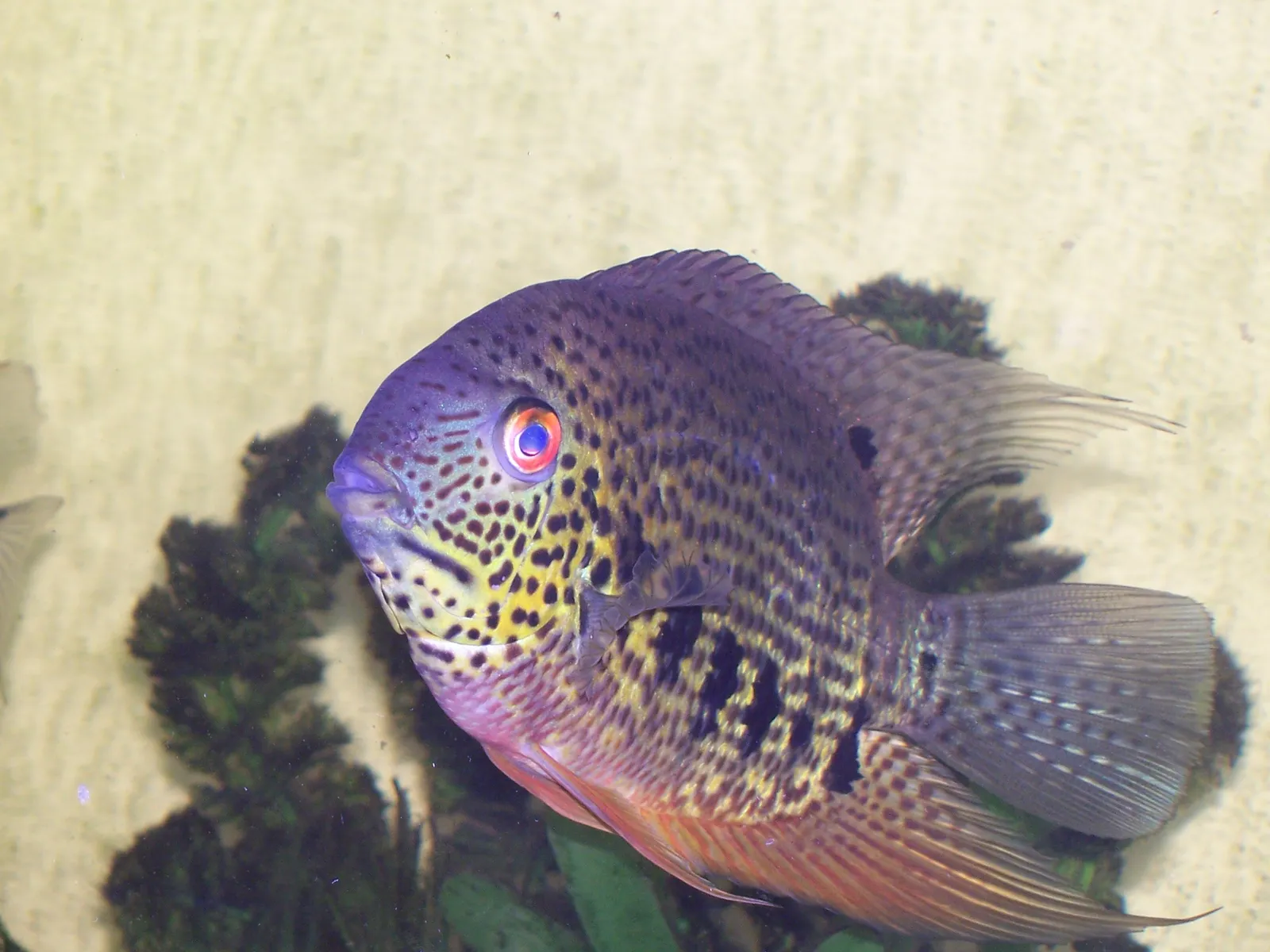
Heros notatus has the classic severum silhouette: a tall, strongly compressed, almost disc-shaped body, a steep forehead and a small mouth, built for life among submerged branches rather than open water. FishBase gives a maximum of about 6 in standard length; in practice wild-type Heros in good aquarium conditions commonly reach 8 in or more in total length, with the largest fish approaching the roughly 10–12 in cited for the genus as a whole. What sets Heros notatus apart from its relatives is its colour and pattern. The ground colour is typically gold to yellow, overlaid with several clean horizontal rows of small bright-red dots running along the flanks — a tidy, lined-up arrangement that distinguishes it from Heros spurius, in which the red spots are scattered irregularly. The strong vertical bars that define many cichlasomines are here strongly reduced: rather than full bars, Heros notatus usually shows only a row of about five dark blotches across the lower half of the body, with the single bar that runs from the dorsal-fin base down to the anal fin remaining the most prominent. Staeck & Schindler note that adult males additionally carry dark dots on the flank scales — the 'marked' character the species is named for — and that bars four through seven break up into four dark ventral blotches in adults. The cheeks and gill covers bear scattered rounded spots. Sexual dimorphism is modest and typical of the genus: mature males tend to be larger and develop more vermiculation and spotting on the head, while ripe females are rounder-bodied; sexing immature fish reliably is difficult.
Habitat
Heros notatus is a fish of the Rio Negro basin of the Amazon and the adjacent Essequibo drainage of the Guianas — the western edge of the great blackwater country of northern South America. FishBase summarizes its range as the Amazon and Negro basins of Brazil, with the Essequibo of Guyana as the type river; field workers describe it as 'largely a blackwater species,' though like other severums it also turns up in clearwater creeks. Project Piaba documented the fish in Maquari Creek, a clearwater tributary of the Rio Branco within the Negro system. The genus as a whole favours quiet, structured water: areas of slow to moderate current along river margins, thick with sunken trees, roots, fallen branches and leaf litter, where the high-bodied fish can manoeuvre among cover and graze the substrate. Oliver Lucanus, who has snorkelled these habitats, notes that even rivers with surprisingly strong central flow offer slack, branch-choked margins where severums congregate in loose groups of six to twenty. The water is the soft, acidic, tannin-stained blackwater characteristic of the Negro — typically very low in dissolved minerals, pH often well below neutral, and warm, in the broad 75–84 °F band of the lowland Amazon. These are shallow-margin and flooded-forest fish; depth in occupied habitat is on the order of a few metres at most, and the fish move into seasonally inundated forest as the waters rise.
Feeding
Like the rest of the genus, the spotted severum is best described as an omnivore that leans herbivorous and detritivorous, foraging low on the food web — FishBase places its estimated trophic level near 2.8. In the wild, loose groups are seen grazing over the substrate during the dry season, working leaf litter, soft sediment and submerged wood for algae, plant matter, fallen seeds and fruit, small invertebrates and the organic debris of the flooded forest. The small mouth and deep body suit a deliberate, picking style of feeding among structure rather than the open-water pursuit of prey or the dedicated sand-sifting of eartheaters. In the community it is a slow, methodical forager, easily out-competed for food by faster, bolder fishes — a trait worth remembering when stocking a tank. There is no evidence that Heros notatus is a specialist of any single food; its success across the varied water types of the Negro and Essequibo reflects a generalist, opportunistic diet.
Mating
Severums are seasonal breeders whose reproduction is tied to the flood pulse, and the spotted severum follows the genus pattern. For most of the year Heros notatus lives socially, in loose aggregations of grazing adults and sub-adults. With the onset of the rainy season the fish move out into the newly flooded forest, where abundant food and fresh cover allow pairs to separate from the group and stake out breeding territories — which is why the pairing and early courtship of wild Heros are so seldom witnessed by humans, who rarely enter these waters at high water. Pair formation is notably selective: severums choose their own partners, and in captivity simply placing a male and female together often fails. Keepers consistently find that pairs form best when half a dozen or more young fish are grown together and allowed to sort themselves out, a pair emerging and bonding from within the group at around 6 in. Once bonded, the pair is comparatively peaceful by cichlid standards — severums are among the gentler large New World cichlids — but a spawning pair will clear a territory and defend the chosen site against tankmates.
Breeding
Heros notatus is a biparental substrate spawner. Both wild observation and aquarium experience for the genus describe a pair selecting a firm vertical surface — a fallen log, an upright submerged stem, a rock or, in the tank, a slab or flowerpot — cleaning it meticulously, and depositing a sheet of eggs that both parents then guard and fan. Clutches are large: severum pairs have been recorded guarding well over 500 young, with the genus-typical figure for a healthy spawn running to several hundred eggs (FishBase gives up to about 200 eggs for the closely related Heros severus as a comparison point). After the eggs hatch, the parents move the wrigglers and then guard the free-swimming fry as a tight school, leading them through the shallows of the flooded forest; the young are defended fiercely against the characins and smaller cichlids that prey on them until they reach roughly the size of a coin, at which point they begin to disperse. This is open substrate brooding, not the deep-tunnel nesting of some eartheaters and not the larvophilic mouthbrooding recently described in the Orinoco Heros liberifer. In aquaria the proven triggers mirror the wild cue: warmer water around 81–82 °F, soft acidic conditions, and a sudden abundance of rich food, the conditions of the rising flood. Spotted severums are bred far less often than the common green and red aquarium severums, largely because the wild fish is so rarely imported, but the mechanics are those of a typical, attentive heroine pair.
In the aquarium
The spotted severum is a rewarding but uncommon aquarium fish — peaceful for its size and undemanding in temperament, but rarely offered because it is exported only sporadically from the Rio Negro and Essequibo. It is not difficult to keep once obtained, but it needs space and the right water. A deep-bodied fish that reaches 8 in or more wants a tank of generous footprint and height; a single pair is realistically a 75-US-gallon (roughly 280-litre) proposition, and a group needs considerably more. Because severums pair by choosing their own partners, the surest route to a bonded pair is to raise a group of six or more juveniles together in a large tank and let a pair form — sexing and force-pairing adults is unreliable and can end in a mismatched, bickering couple.
Water should reflect the blackwater origin: warm (75–84 °F), soft, and acidic to neutral, with pH best held in the 5.0–7.0 range for wild fish, though the species tolerates the harder end of that span in maintenance. Tannin-stained water from leaf litter or driftwood suits it and shows off the gold-and-red colouration. As with all severums, mature, stable water and generous filtration matter; the fish are sensitive to dissolved-waste accumulation, so regular water changes are part of the routine, but high turbulence should be avoided — these are fish of slack margins, not torrents.
The layout that suits them is a structured one: a fine sand substrate and, above all, plenty of wood — branches and roots reaching from the bottom toward the surface, which both reduces aggression and provides the vertical surfaces the fish use for spawning. Subdued lighting and a few sturdy or potted plants complete the biotope; delicate plants may be nibbled.
Feeding is easy. Spotted severums accept most prepared foods — quality flake and sinking pellets, including vegetable- and spirulina-based foods to suit their herbivorous lean — supplemented with frozen or live bloodworm, brine shrimp, chopped earthworm and the occasional plant matter. Because they feed slowly and deliberately, take care that faster tankmates do not strip the tank before the severums get their share.
Compatibility is one of the species' strengths. Outside of spawning, Heros notatus is mild-mannered and mixes well with other peaceful Amazonians of similar size: eartheaters (Geophagus, Satanoperca), angelfish, chocolate cichlids (Hypselecara), larger peaceful characins such as silver dollars, pencilfish-sized fish being too small. The two caveats are that severums will eat fish small enough to swallow, and that a spawning pair becomes territorial and is best given the run of the tank — or the tankmates moved aside — while it has eggs and fry.
Conservation
The IUCN Red List assesses Heros notatus as Least Concern (assessed 19 November 2020 by R.G. Frederico; published in the most recent Red List update), recording its range across the Rio Negro and Essequibo basins of Brazil and Guyana and noting no threats currently known to affect the species; the population trend is listed as unknown. It carries no CITES or CMS listing. As a fish of remote, sparsely populated blackwater drainages, Heros notatus faces little direct pressure: it is taken for the ornamental trade only in small numbers, precisely because exports from the upper Negro and the Guianas are limited, and it is not a food fish of any consequence. The broader backdrop is the accelerating, basin-wide pressure on Amazonian freshwaters — deforestation, hydroelectric dams, gold-mining and mercury contamination, and altered flood-pulse regimes — that conservation scientists warn is degrading aquatic habitats across the region even where individual species remain secure. None of these is documented as a present danger to the spotted severum, but they are the context in which its long-term status should be read.