Taxonomy & naming
Johann Jakob Heckel described Heros efasciatus in 1840, in the same Vienna museum paper that erected the genus Heros and named several of its members at once. The unique holotype (NMW 33341) sits in the Naturhistorisches Museum in Vienna; Heckel gave the type locality only loosely, as "Rio Negro or Amazon River." The Catalog of Fishes treats Heros efasciatus Heckel 1840 as the valid name, with Chromys appendiculata and Chromys fasciata (both Castelnau 1855), Uarus centrarchoides (Cope 1872), and Cichlasoma severum var. perpunctatum (Miranda Ribeiro 1918) among its junior synonyms.
The deeper story is the long confusion within the genus. Heros is small but tangled: in current usage it holds five valid species — Heros efasciatus, Heros severus, Heros notatus, Heros spurius, and the recently described Heros liberifer. Sven Kullander, the leading authority on Neotropical cichlids, redescribed Peruvian material as Heros appendiculatus in 1986, then in his 2003 checklist synonymized appendiculatus with Heros efasciatus and recognized four species as valid (severus, spurius, efasciatus, notatus), noting explicitly that the status of other nominal taxa needed further analysis. He was right to hedge. The single most persistent error is the "severum" name itself: the true Heros severus is a rare upper-Rio-Negro fish that was essentially absent from the hobby for most of its history, while the common aquarium severum is Heros efasciatus. To compound matters, a delayed biparental mouthbrooder traded since the 1980s was wrongly labeled "Heros severus" after 1994; Staeck and Schindler resolved this in 2015 by describing it as a new species, Heros liberifer ("child-carrier," for its mouthbrooding), and the genuine Heros severus was rediscovered around the same time. The upshot worth stating plainly: Heros efasciatus is not a mouthbrooder — that behavior is unique to Heros liberifer — and a good deal of the genus's alpha taxonomy remains genuinely unsettled, with several distinct populations that may yet prove to be undescribed species. The genus name itself has its own hobby saga: Loiselle's 1984 Buntbarsche Bulletin paper argued for reviving Heros as the catch-all for the cichlids then orphaned out of "Cichlasoma," a usage later overtaken by the modern, narrow circumscription of the genus.
Morphology
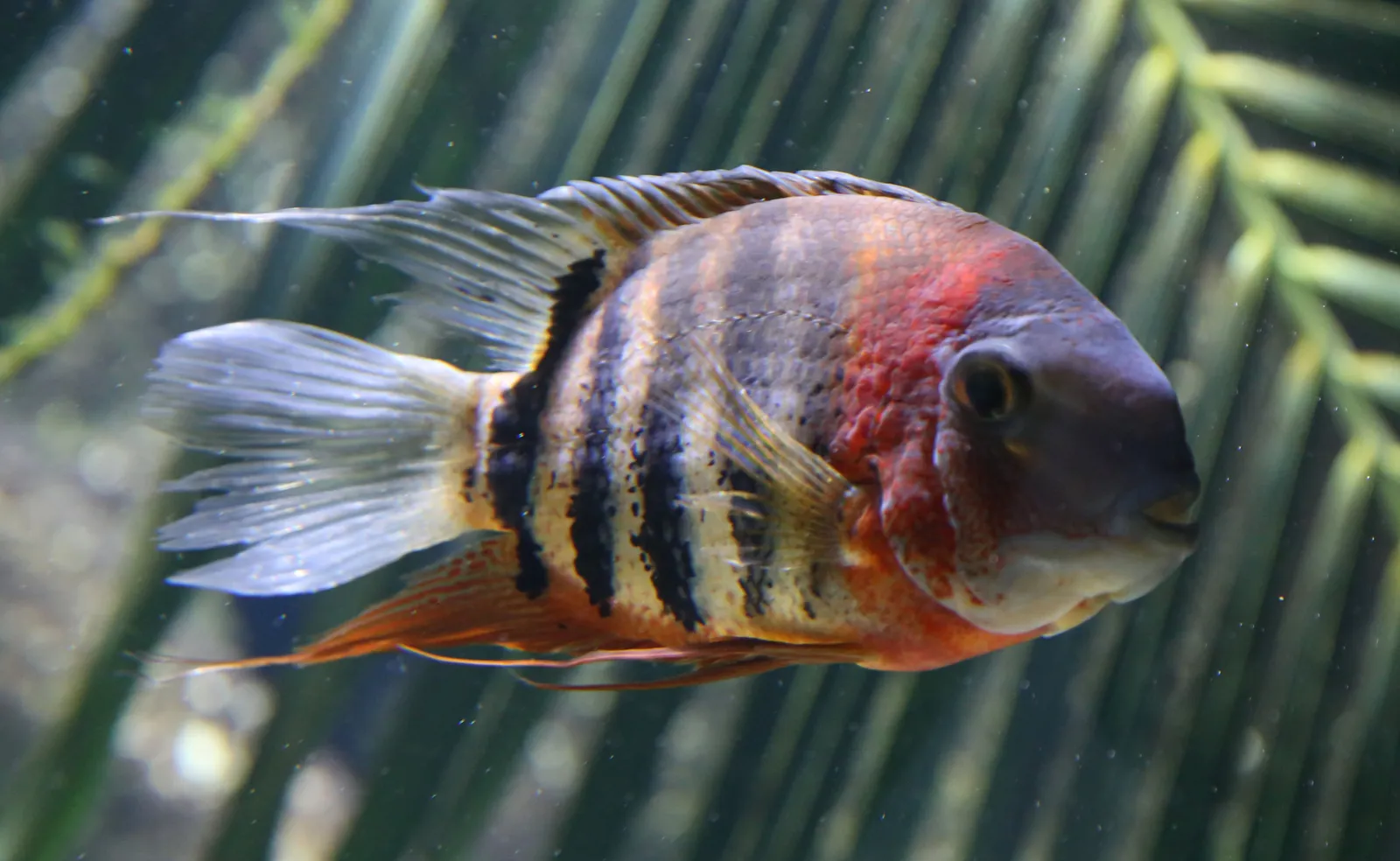
Heros efasciatus is built like a thrown discus: tall, strongly laterally compressed, and nearly circular in profile, the shape that lets it slip edge-on between roots and branches. Wild fish are typically olive to grass-green — hence the trade name "green severum" — usually with a series of faint dark vertical bars that are most intense on the lower flank, and a darker blotch toward the tail base. The species epithet is a deliberate joke at the fish's own expense: e- means "without" and fasciatus means "banded," so the name reads as "the unbanded one," coined by Heckel to contrast it with the more obviously barred Heros spurius described in the same work. The irony is that juveniles and stressed adults often show their bars plainly; it is mature, settled fish that tend to lose them.
Reported maximum size varies, and the gap is worth flagging rather than smoothing over. FishBase lists 6.7 in standard length and a maximum published weight of 268 g; hobby sources including Seriously Fish cite up to 12 in total length, with 8–10 in the realistic ceiling in aquaria. The difference is partly standard length versus total length and partly well-fed captive stock. Sexual dimorphism is modest: males grow larger, more often develop a nuchal hump and extended dorsal and anal fin tips, and tend to carry more red speckling and worm-like markings on the head and gill covers — a difference real but subtle, and unreliable in young fish. Selectively bred gold, red, and albino forms dominate shops; the wild green form and the striking red-shouldered "Rotkeil" variant from Peru's Rio Nanay are the standouts among collected fish.
Habitat
This is a fish of the central and eastern Amazon lowlands, not of any single body of water — which matters for a site that treats the water first. Heros efasciatus is widespread along the Solimões-Amazon main channel and its tributaries, from the Ucayali and upper Amazon in Peru eastward through Brazil toward the river's mouth, and it has been recorded from clearwater rivers of the Brazilian Shield such as the Xingu. (The IUCN range map also implies the Orinoco, but Orinoco "severums" are better referred to Heros liberifer, and that listing likely reflects the same long-running name confusion.) Across this range it turns up in all three classic Amazon water types — sediment-rich whitewater, tannin-stained acidic blackwater, and clearwater — rather than specializing on one. The fish John Moran collected on the Rio Pacaya in Peru, a deep-brown blackwater river clogged with floating vegetation during low water, are a representative slice of that habitat.
The constant across habitats is structure. Severums favor the slower or marginal water along river edges, floodplain (várzea) lakes, and the seasonally flooded forest, always in association with submerged trees, roots, and tangled branches that give these slow, deep-bodied fish cover from peacock bass and wolf fish. The collector Oliver Lucanus, who has snorkeled these biotopes, notes they are most abundant in the calmer pockets of otherwise moderate-current rivers, where leaf litter and fine debris settle out. Measured in-situ chemistry tracks the soft, warm conditions of the basin: aquarium-relevant figures gathered by Seriously Fish run pH 5.5-7.0, hardness 1-8 dH, and roughly 22-29 C (72-84 F), with the flood pulse — the annual rise and fall of the river — setting the rhythm of where the fish are and when they breed.
Feeding
Among the larger Amazon cichlids, Heros efasciatus leans unusually toward plants. FishBase characterizes it as omnivorous but mainly frugivorous, and places it at a low trophic level of about 2.7 — well down toward the herbivore end for a cichlid of its size. In the flooded forest it takes fallen fruit and seeds, soft plant material, and algae and detritus grazed off submerged wood and the substrate, supplemented by the invertebrates and other small animal prey that an opportunistic omnivore picks up along the way. Lucanus describes wild Heros in the dry season as loose groups of roughly six to twenty fish grazing over the bottom, which fits a fish that makes much of its living scraping and browsing rather than chasing.
That trophic position has real ecological weight: fruit- and seed-eating fishes are agents of seed dispersal in the flooded forest, moving plant propagules as the high water lets them range through the canopy-shaded igapó and várzea. As a mid-sized, slow-moving fish, the severum is also prey — its young especially are taken by characins and smaller cichlids, and adults share water with ambush predators like Hoplias wolf fish and peacock bass, which is exactly why the species clings so tightly to structured, wood-choked cover.
Mating
Outside of breeding, Heros efasciatus is gregarious and mild — strikingly so for a cichlid that can fill a dinner plate. In the wild it moves in loose grazing groups, and pairs form only as the breeding season approaches, triggered by the conditions of the rising flood: warmth around 27-28 C (80-82 F), soft water, and abundant food. Pairs are notoriously selective about mates, which is why the standard advice is to raise a group of six or more young together and let a pair sort itself out rather than forcing two adults together. As a pair forms, the fish lip-lock and begin cleaning a chosen surface, and the displaying partner often darkens dramatically; John Moran, breeding the species (as "Heros appendiculatus") from Peruvian stock, watched his prospective spawner turn a deep blue-black with a lighter blue face and rusty-orange anal and pectoral fins — so dark he briefly feared it was sick — before it laid. Sexing remains subtle until that point: males average larger with longer dorsal and anal extensions and more head speckling, but the cues are unreliable in immature fish.
Breeding
Heros efasciatus is unambiguously a substrate spawner with biparental care, and this is the point on which the hobby was long misled. A pair cleans a firm vertical or sloping surface — a fallen log, an upright submerged stem, a flat stone or aquarium glass — and lays its eggs there; both parents then guard, fan, and tend the clutch, and later shepherd the free-swimming fry, which are allowed to graze mucus-like secretions from the parents' flanks in the manner of angelfish and discus. Egg numbers are high: FishBase cites up to about 1,000 eggs deposited on flat stones or roots, and field observers report pairs guarding several hundred young against predators until the fry reach roughly coin size and disperse. Moran's account is a clean confirmation from a home aquarium — a single fish depositing its first batch on a rock and immediately beginning to fan, in a planted community tank kept warm and soft.
The behavior is worth stating against the record because many care sheets — including, historically, parts of the literature — claim severums mouthbrood. They do not. Among the five Heros species, oral incubation of fry is a one-off restricted to Heros liberifer, the Orinoco fish that masqueraded as "Heros severus" until 2015; Heros efasciatus and the genuine Heros severus are both ordinary substrate spawners. Breeders confirm this from the tank: the common gold, red, and albino strains spawn on surfaces and parent their broods exactly like angelfish, never picking the young up.
In the aquarium
The severum has been a beginner's first cichlid for generations, and deservedly: captive-bred stock is hardy, undemanding about exact water chemistry, and peaceful for its bulk. The honest caveat is size. This fish reaches 8–10 in in the tank and grows quickly, so a single adult or pair needs a tank no smaller than about 120 x 17.5 in (4 feet, ~65 US gal); the often-quoted "55-gallon" minimum is workable for one but tight for a pair or group. Aquascape it as a flooded-forest biotope — soft sand, a framework of driftwood and twisted roots reaching toward the surface, dim light, and tannin-stained water — and skip the live plants, which are not a feature of its natural waters and which a part-herbivore will sample anyway.
Diet should reflect the wild bias toward plant matter: a quality pellet or flake base, plus genuine vegetable fare (blanched spinach, shelled peas, spirulina-based foods), with bloodworm, chopped earthworm, and prawn as the meatier supplement rather than the staple. On temperament, the fish is mild-mannered until it spawns, then a guarding pair will clear a quarter of the tank; the well-documented fix for a lone severum that turns nasty with age is to keep it in the company of its own kind or other roomy, peaceful South Americans — eartheaters (Geophagus, Satanoperca), angelfish, chocolate cichlids (Hypselecara), silver dollars, and larger tetras all suit it. The two reliable mistakes are housing it with anything small enough to swallow (those big-eyed tetras will vanish) and underestimating the adult footprint. The familiar "gold" and "turquoise" severums of the trade are selectively bred color strains of this species (and, in some stock, of close relatives in the complex); keep collection-locality and strain labels with wild or line-bred fish, and be aware that much mass-produced "green severum" stock is of uncertain, possibly hybridized origin — fine as a pet, but not a stand-in for the wild species.
Conservation
The IUCN Red List assesses Heros efasciatus as Least Concern (assessment by R.G. Frederico, dated 19 November 2020, published 2023), on the strength of a very large estimated range — an extent of occurrence above five million square kilometres — and the absence of any documented threat specific to the species. Population trend is listed as unknown but the fish is described as common and abundant; it carries an ornamental-trade use at national and international levels, minor commercial fishery value, and a low fishing-vulnerability score, consistent with a fast-maturing, low-trophic-level fish that FishBase rates as highly resilient. CITES and CMS list it as Not Evaluated. In short, the species itself is not in trouble.
Two honest qualifications belong with that clean bill of health. First, the rating sits on a shaky taxonomic base: if "Heros efasciatus" is, as several authors suspect, a bundle of populations that includes undescribed species, a basin-wide Least Concern label could mask more localized lineages — the same problem that haunts many widespread Amazon "species." Second, the basin it depends on is under mounting strain. The Amazon faces accelerating deforestation, hydroelectric dams that fragment rivers and alter the flood pulse, mercury contamination from gold mining, and a large ornamental fishery — pressures that bear directly on a fish tied to flooded forest and seasonal inundation, even where the species is currently common. The measured conclusion is the accurate one: Heros efasciatus is genuinely widespread and not declining as presently defined, but its security is only as solid as its taxonomy and the health of the floodplains it lives in.