Taxonomy & naming
Labidochromis sp. "Perlmutt" has never been formally described: it has no authority, no year of publication, and no FishBase entry. Its trade name — German for “mother-of-pearl” — was coined by the collector who first observed it at Higga Reef near Mbamba Bay, Tanzania, choosing a name to match a pearly iridescent sheen he considered unusual among Malawi cichlids. The account, published in Konings’ Cichlids Yearbook, describes a small, apparently localised population that was shy in the field and took some time to observe closely. It is treated here as its own undescribed population, not assumed identical to any other Labidochromis trade form from the southeastern arm of the lake.
Morphology
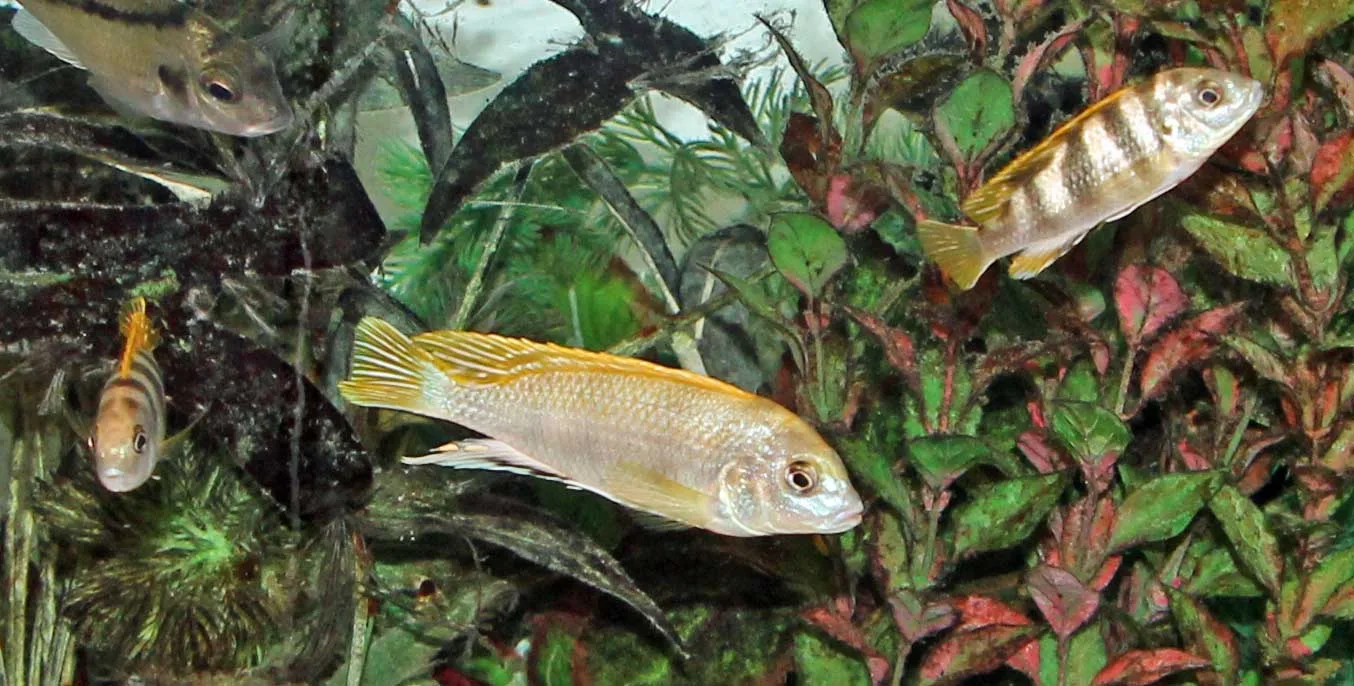
According to the field account published in Cichlids Yearbook, Volume 5, male “Perlmutt” appear pure white across the head and flanks at first glance, but under direct light show a distinctive mother-of-pearl gleam — a trait the observer described as unique among the Malawi cichlids known to him. The dorsal fin is bright lemon yellow, with the intensity and extent of that yellow varying between individuals and sometimes spreading onto the head and upper body; the anal and ventral fins carry a black marginal band, with several light yellow egg-spots on the anal fin, and the caudal fin shows yellow streaks over a pearly ground. Juveniles and females instead show broad dark brown bars on a cream-white background — sometimes split into two narrower bars, varying in number between individuals — with a yellowish tinge on the dorsal and caudal fins. The species reaches roughly 3 in TL. This account is one of the more detailed colour records available for any undescribed Labidochromis form.
Habitat
Labidochromis sp. “Perlmutt” is recorded from Higga Reef near Mbamba Bay, on Tanzania’s Lake Malawi shore, where the original field account describes it inhabiting a rocky biotope at a depth of roughly 39 ft or more; an accompanying photograph caption places a male at around 98 ft depth, examining aufwuchs on a rock face. The population was described as small and the fish themselves as shy, taking the observer several hours in the field to get a clear look at a female. Water conditions follow Lake Malawi’s standard inshore rocky-habitat profile: warm, alkaline, and well-buffered.
Feeding
The published field account describes “Perlmutt” examining aufwuchs on rock faces at depth, consistent with the aufwuchs-grazing and invertebrate-picking habits typical of rock-dwelling Labidochromis generally. Notably, the same account records the male defending a feeding area even though he did not defend a conventional breeding territory — a detail suggesting food resources at Higga Reef's rocky depth are worth guarding independently of reproduction, which is not the usual pattern for shallower, territory-driven mbuna. No detailed dietary study beyond that field observation has been published, so it is presented here as a rock-associated aufwuchs grazer and invertebrate picker in line with the genus.
Mating
The Cichlids Yearbook account describes a male that did not appear to defend a breeding territory in the conventional sense, but did defend a feeding area; when another male Labidochromis approached, he responded with evident excitement and began courting the intruder, which the observer took to be a female. That single field observation is the only courtship record available for this form and should be read as an anecdotal account from one encounter rather than a established behavioural pattern.
Breeding
As with every Lake Malawi cichlid, “Perlmutt” is presumed to be a maternal mouthbrooder, though the published field account does not describe a spawning event directly — only a male displaying to a presumed female. The observer noted that establishing the female's identity and colour pattern took considerable time in the field, since the population is small and the fish shy; this practical difficulty is likely why a full spawning sequence was never recorded and witnessed for publication. No clutch size or brood duration specific to this form has been published; genus-typical Labidochromis broods run to a few dozen eggs and take roughly three to four weeks to release free-swimming fry, offered here only as a general expectation.
In the aquarium
“Perlmutt” is a rarely traded, historically wild-collected form rather than a mainstream aquarium fish; the original account describes the collector arranging for divers to locate and collect the species specifically for the hobby trade after observing it in the field. A keeper obtaining it should provide a standard rocky-reef Lake Malawi setup: substantial rockwork with caves and crevices, fine sand substrate, and alkaline, well-buffered water in the range of roughly 75–82 °F and pH 7.7–8.6, mirroring the moderate-depth rocky habitat it occupies in the lake. Given the population’s apparently small natural size, a cautious approach to sourcing and stocking density is warranted.
Conservation
“Perlmutt” has no IUCN Red List assessment, because formal evaluation requires a validly published scientific name, and none exists for this form. The original field account describes the population at Higga Reef as small, which — combined with a single documented locality and the fact that specimens were deliberately collected for the aquarium trade following that first sighting — suggests a form with limited natural range and some exposure to collecting pressure, though no formal population assessment exists to confirm that picture.