Taxonomy & naming
Serranochromis meridianus was described by the South African ichthyologist Rex A. Jubb in 1967, in the Annals of the Cape Provincial Museums (Natural History) volume 6. The holotype (AMG P913) and paratypes (AMG P914, 24 specimens; BMNH 1967.4.14.1) came from the Sabie River near its confluence with the Sand River, a tributary of the Incomati River, in what was then "Portuguese East Africa" border country and is today within Kruger National Park, Mpumalanga, South Africa. The Catalog of Fishes lists the species as valid as Serranochromis meridianus Jubb 1967, in the family Cichlidae, subfamily Pseudocrenilabrinae, with no junior synonyms; it has been upheld by Skelton & Teugels (1991), Skelton's standard 'Complete Guide to the Freshwater Fishes of Southern Africa' (1993, 2001), the genus key of Stauffer, Bills & Skelton (2021), and Ntokoane et al. (2024). The specific name meridianus is Latin for 'southern' or 'of the south,' marking this as the most southerly species of the genus. The genus Serranochromis was erected by C. Tate Regan in 1920 and revised in full by Ethelwynn Trewavas in 1964; it belongs to the serranochromine lineage of riverine haplochromines that radiated across the Zambezi, Okavango, Cunene and upper Congo systems. Serranochromis meridianus is the lineage's southern frontier — isolated in the Incomati and adjacent coastal drainages south of the Limpopo, far from the genus's south-central-African core. The widely used English name is the lowveld largemouth, after the South African lowveld it inhabits.
Morphology
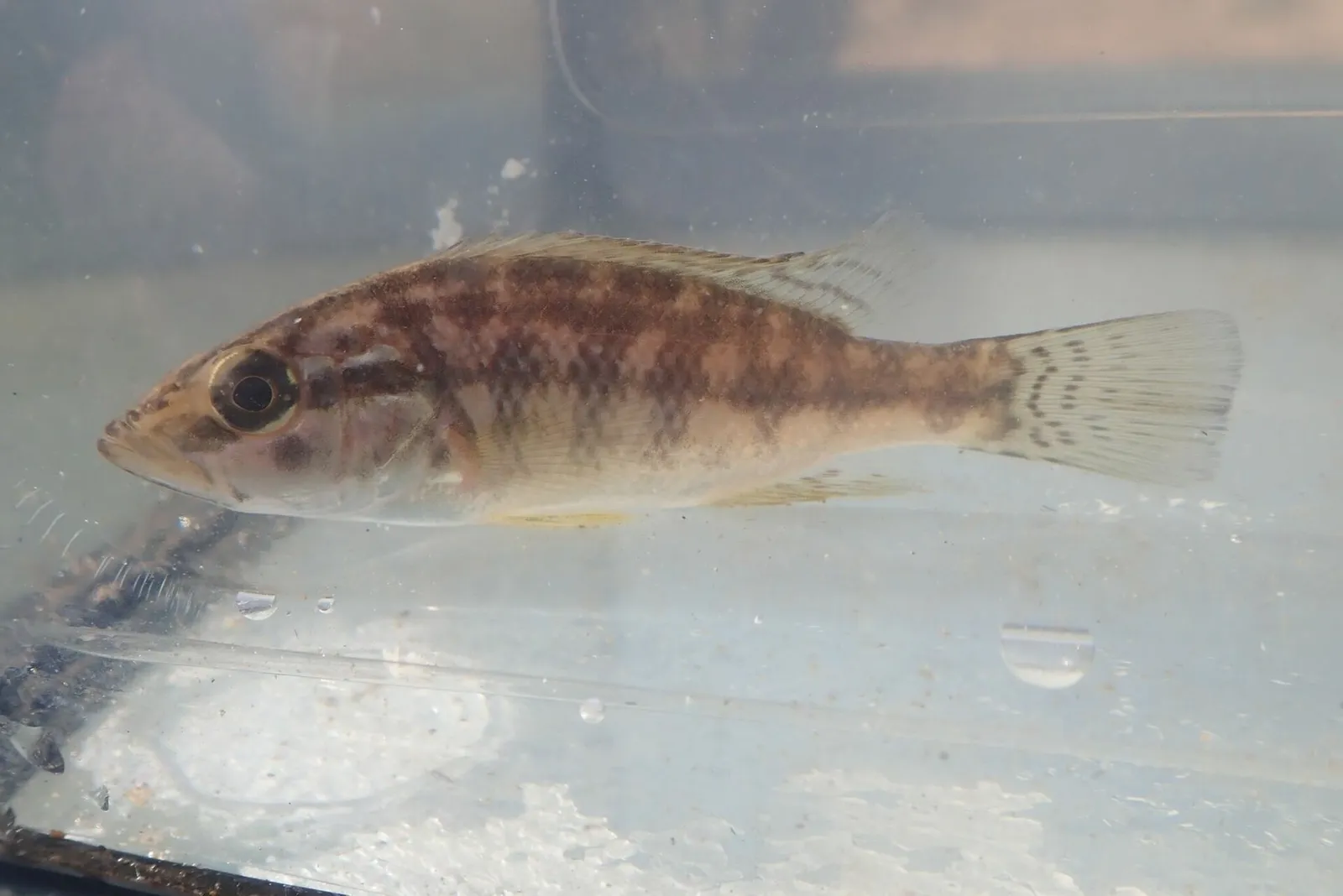
Serranochromis meridianus is a large, robust cichlid, reaching about 14.5 in in total length and a documented maximum weight of around 1.2 kg — a substantial predatory fish. The body is the genus norm: fusiform, deep-chested and laterally compressed, deepest around the start of the dorsal fin. The defining feature is the mouth: large, terminal and protrusible, with a notably steep gape — the describers and later workers cite the acute angle of the cleft of the mouth (around 50–60 degrees from the horizontal) as a diagnostic character separating it from the shallower-gaped Angolan largemouths — and armed with exposed, widely spaced caniniform teeth set in bands on each jaw. This is the classic equipment of a fish that seizes and holds slippery prey. The head is large, the eyes well developed, and the long-based dorsal fin carries many spines followed by soft rays, with three anal spines and the egg-spot ocelli on the anal fin typical of haplochromine courtship. Coloration in life is a silvery to olive-grey body, often with darker mottling or barring and the brassy sheen common to the genus, lighter below. As in other mouthbrooding haplochromines, sexual dimorphism is expected in breeding condition, with males developing brighter nuptial coloration and more prominent anal-fin ocelli; ripe females are rounder-bodied. It is a recognised angling fish within its range, taken by lure and bait as a hard-fighting lowveld predator.
Habitat
Serranochromis meridianus is endemic to the southeastern-African lowveld, centred on the Incomati (Inkomati) River system. Its core range is the Sabie-Sand tributaries of the Incomati in Mpumalanga, South Africa — including the rivers of Kruger National Park — extending into the Incomati in Mozambique, with records from coastal pans between the Incomati and Limpopo mouths and from Lake Mgobezeleni in northern KwaZulu-Natal; it has also been introduced to some impoundments within Kruger National Park. The Catalog of Fishes summarises its distribution as the southern Limpopo and Incomati basins of South Africa and Mozambique. Ecologically it favours standing or slow-flowing pools with marginal vegetation, and it thrives in impounded waters — a preference for sluggish, structured, weed-fringed habitat shared with other largemouths, where a sit-and-wait predator can use cover to ambush prey. This makes it a fish of the lower-gradient reaches, pools and floodplain pans of the lowveld rather than the fast upland streams. Water is warm and tropical-to-subtropical; the lowveld rivers run low and can become severely stressed in the dry season, a vulnerability that bears directly on the species' conservation. Its restriction to this single region, well south of the rest of the genus, is the geographic signature of a relict southern endemic.
Feeding
Serranochromis meridianus is a predator, in keeping with the genus, but with a somewhat broader diet than the pure piscivores among its relatives. Published accounts describe it as a mid-level predator taking small fishes, aquatic insects and other invertebrates, including snails — and FishBase places it at a trophic level of about 3.8, in the carnivore range. The large, protrusible jaws and exposed, widely spaced canine teeth are the equipment of a fish that seizes prey rather than rasping or sifting, while the inclusion of snails points to a capacity to crush harder-shelled invertebrates as well. In the slow pools and vegetated margins it favours, Serranochromis meridianus hunts from cover, picking off small fishes and the abundant invertebrate life of the lowveld pools and pans. As a fairly large, opportunistic predator it occupies a top-end role in the small-fish communities of its range, and its readiness to take a lure reflects that active, prey-seizing habit.
Mating
The detailed reproductive behavior of Serranochromis meridianus is not well documented in the popular literature, but its mode follows the consistent pattern across Serranochromis and the serranochromine haplochromines. These are maternal mouthbrooders, breeding seasonally in step with the warm-season rains and the filling of lowveld pools and floodplains. Males develop nuptial coloration and the anal-fin ocelli, and take a territory, courting and displaying to females rather than forming a lasting pair bond. The egg-spot ocelli on the male's anal fin are the classic haplochromine courtship device: as the female mouths at the spots she is induced to take up the male's milt, fertilising the clutch she already carries. After spawning the male's involvement ends; parental investment falls entirely to the female, who carries and protects the brood. The marginal vegetation of the standing or slow-flowing pools the species favours provides both spawning substrate and the cover in which a brooding female can shelter.
Breeding
Like all Serranochromis, Serranochromis meridianus is a maternal mouthbrooder. The female takes the fertilised eggs into her mouth and incubates them there through hatching and the early larval stage, the brood sheltered in the buccal cavity from the egg- and fry-predators of the pool; after release the fry may continue to shelter in her mouth when threatened, a hallmark of advanced haplochromine care. Clutch size is not separately well documented for this species; in the genus, fecundity is modest by cichlid standards — on the order of tens to a few hundred relatively large eggs, scaling with female size, the trade-off inherent to mouthbrooders, which sacrifice egg number for the heavy parental protection of oral incubation. As one of the larger species, a big female would sit toward the upper end of that range. Breeding is expected to be seasonal, tied to the warm wet season when lowveld pools and pans are full. That the species 'thrives in impounded waters' suggests it recruits successfully in standing water with suitable vegetated margins, a trait that has let it persist in some dams within its range even as its riverine habitat has declined.
In the aquarium
Serranochromis meridianus is occasionally encountered as a regional angling and display fish within southern Africa, but it is not a mainstream ornamental species and is little kept by hobbyists abroad. As a predator that can reach 14.5 in and over a kilogram, it demands a very large tank — well into the hundreds of litres, with a long footprint and open swimming room — together with the slow-flowing or standing, well-vegetated conditions of its natural lowveld pools. Water should be kept warm and clean, roughly 72–82 °F and near neutral to slightly alkaline, with strong filtration and generous water changes to handle the waste load of a large piscivore. It would have to be fed as the predator it is, on meaty foods, and could not be trusted with any tankmate small enough to be swallowed; like other largemouths it would likely be intolerant of conspecifics outside of breeding. Given its Endangered status and small natural range, wild collection for the aquarium is inappropriate; the conservation priority is protecting its lowveld habitat, and any aquarium interest is best directed toward captive-bred or research stock rather than wild fish.
Conservation
The IUCN Red List assesses Serranochromis meridianus as Endangered (assessed 8 December 2016, published 2017), under criteria reflecting both a continuing population decline and a small, fragmented range. The species is a narrow endemic of the Incomati and adjacent lowveld drainages, and its natural population is in continuous decline as a result of habitat degradation: over-abstraction of water (the lowveld rivers are heavily drawn down for agriculture and supply), reduced water quality and pollution, increased sedimentation and siltation, and invasive alien plants choking the vegetated margins it depends on. The assessment notes that the species persists in some impoundments, including within Kruger National Park, but its riverine habitat — the Sabie-Sand and Incomati system — is under sustained pressure, and its small range leaves little buffer. It carries no CITES or CMS listing. Of the Serranochromis treated here, meridianus is the one with a clear, formally documented conservation problem: a southern relict of the genus whose lowveld waters are among the most water-stressed in the region, and whose future depends on maintaining adequate environmental flows and habitat quality in the Incomati system.