Taxonomy & naming
The nembwe was described by the Belgian-British ichthyologist George Albert Boulenger in 1896 as Hemichromis jallae, from a short collection of fishes the Waldensian missionary Rev. Louis (Luigi) Jalla had gathered at Kazungula on the upper Zambezi and sent to the Genoa museum. Boulenger placed it in his catch-all cichlid genus Hemichromis; the holotype is a modest 3 in standard-length specimen. Two later names from the south — Paratilapia zambesensis and Pelmatochromis ngamensis, both Gilchrist & Thompson, 1917 — fall into its synonymy, and an earlier Boulenger record ("Paratilapia thumbergi," 1911) from the Lake Ngami basin was a misidentification of this fish. The genus Serranochromis was erected by Charles Tate Regan in 1920 (in a footnote, with Chromis thumbergi Castelnau as type species) to hold the large, deep-bodied, predatory haplochromine "breams" of the southern African rivers. The taxonomic history then took a long detour: in her 1964 revision of Serranochromis, Ethelwynn Trewavas reduced jallae to a subspecies of Serranochromis robustus, and for the next half-century most checklists and field guides simply called this fish Serranochromis robustus or Serranochromis robustus jallae. It was Jay Stauffer, Roger Bills, Paul Skelton and Olaf Weyl who, in a 2020 redescription (Zootaxa 4858), re-elevated jallae to full species and separated it cleanly from the true robustus of the Zambezi-Malawi system — a distinction that matters, because much of the older angling and ecological literature published under the name "Serranochromis robustus" from the Okavango and upper Zambezi actually refers to Serranochromis jallae.
Morphology
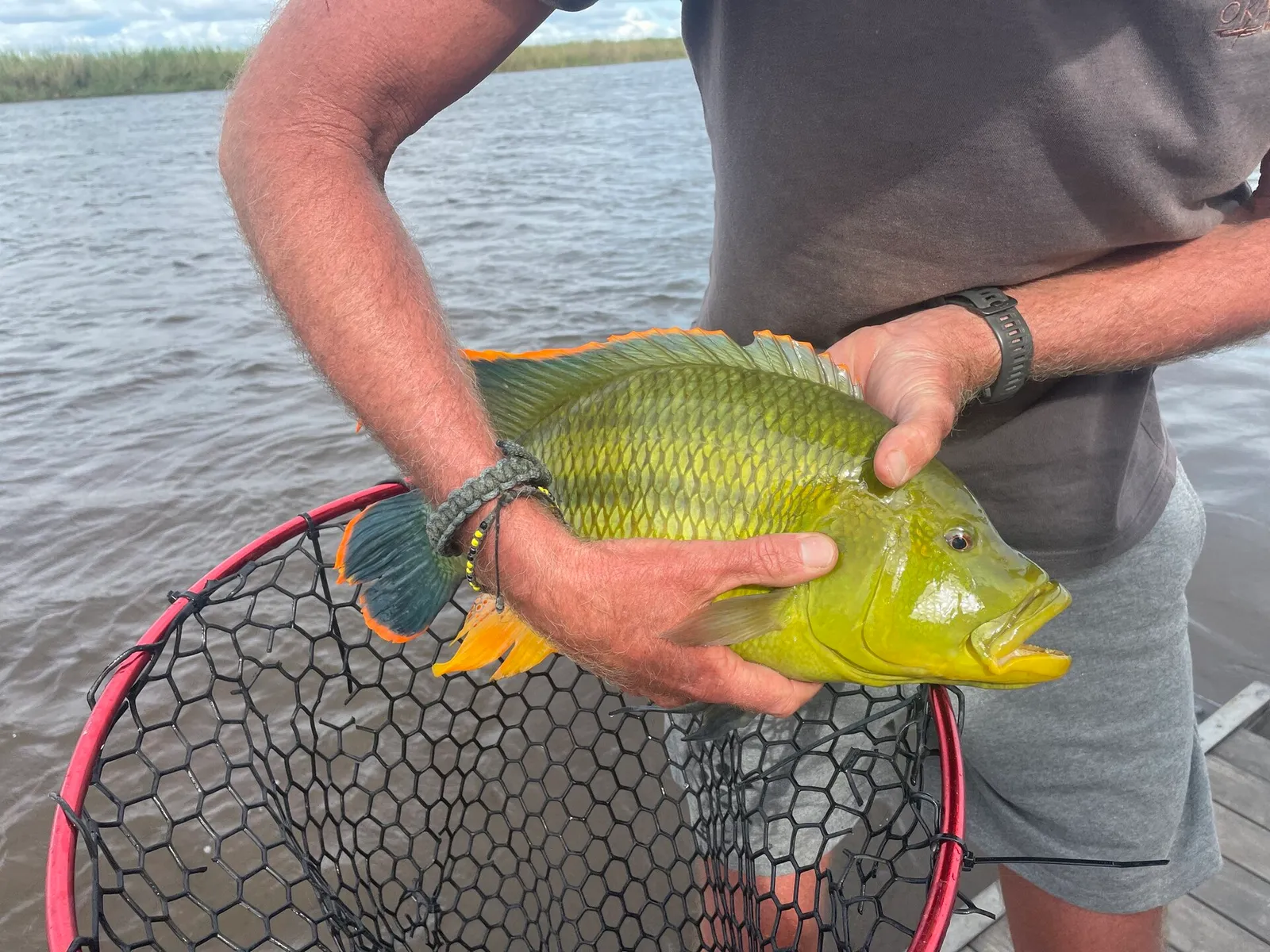
Serranochromis jallae is a large, robust, deep-bodied cichlid; FishBase records a maximum of 15.5 in standard length and a published weight of about 4 kg, though fish that heavy are rare and most are considerably smaller. The head is elongate, the snout long, and the mouth large with the posterior end of the lower jaw reaching forward to about the front margin of the eye — the equipment of an ambush piscivore. The jaws bear widely spaced, unicuspid (conical) teeth in two rows, the gill rakers are short and well separated, and the caudal fin is rounded. The diagnostic feature separating it from every other Serranochromis except its close relative Serranochromis robustus lies in the breeding males' anal-fin egg-spots (ocelli): in Serranochromis jallae these are restricted to the rearmost four or five membranes of the fin, whereas in the other largemouths they run the full length. From Serranochromis robustus it differs in being deeper-bodied with a stouter caudal peduncle, a slightly shorter lower jaw, and fewer outer teeth in the lower jaw. Colour is geographically variable and strongest in breeding dress: adults turn yellow-green along the flanks, with a vivid orange marginal band on the dorsal and caudal fins in fish from the Okavango, and creamier yellow bands in upper Zambezi fish. The throat and belly flush intensely yellow-orange when ripe — the source of the local name "yellow-belly." The fin formula is roughly XV–XVII dorsal spines with 14–16 soft rays and three anal spines with 10–12 soft rays.
Habitat
The nembwe is native to the great floodplain river systems of south-central Africa: the Okavango, the upper Zambezi, the Kafue, the Kasai, and the Zambian (upper) Congo drainage — reaching the upper Lualaba and the Mweru–Bangweulu swamps — with a population also in the Cunene. It has been widely introduced beyond that natural range, notably into Lake Kariba and elsewhere in Zimbabwe (where it is reported to have an adverse impact on native fishes), into the Sabi/Save catchment, and into dams in Botswana and South Africa. Within its rivers the species shows a clear ontogenetic shift in habitat: juveniles live mostly out on the floodplain and in lagoons and secondary channels, while larger adults move into mainstream habitats — deep main channels and permanent lagoons — where they associate closely with in-stream structure: submerged woody debris, beds of aquatic macrophytes, reed fringes, and the eroded clay cliffs on the outside bends of the river. From this cover they patrol the adjacent open water, never straying far from shore, and lunge out to seize passing prey. A telemetry study of fifteen adults on the upper Zambezi found them surprisingly sedentary, holding small home ranges averaging about 0.8 mi of river; during the flood pulse many shifted onto newly inundated margins but did not undertake long migrations onto the floodplain proper. These are warm-water fish of the tropical floodplain — typically soft to moderately mineralised, near-neutral to mildly alkaline water in the broad pH 6.5–8.0 band and temperatures of roughly 64–82 °F through the seasons. Although demersal in habit, they live in the upper few metres of these shallow channels and lagoons rather than in deep water.
Feeding
Serranochromis jallae is a piscivore — a fish-eating ambush predator, which FishBase places near the top of the food web at an estimated trophic level of about 4.1. Adults hold station in cover and dart out to engulf smaller fishes; on the Barotse floodplain of the upper Zambezi, Kirk Winemiller's dietary study found small catfishes, especially squeakers (Synodontis), dominating the stomach contents of mature nembwe. Beyond fish, the diet also includes aquatic and terrestrial insects, freshwater shrimps and small crabs, particularly in smaller individuals. Among the several Serranochromis "largemouths" that share these floodplains, interspecific diet overlap is low across both immature and mature size classes — the predatory subgenus has partitioned its prey rather than competing head-on — and Serranochromis jallae's particular leaning toward catfish is part of that partitioning. The widely separated unicuspid teeth and capacious mouth are the tools of a grab-and-hold predator rather than a sifter or scraper.
Mating
Like all Serranochromis, the nembwe is a maternal mouthbrooder, and its breeding behaviour follows the haplochromine pattern of a male-prepared spawning site. Reproduction is seasonal: gonad examination on the upper Zambezi shows the species breeds in summer, during the warm high-water months. Males build the spawning arena — a simple, shallow, saucer-shaped depression (a "bower" or nest) about 12 in across, scooped out on sandy or muddy substrate in fairly shallow water, often among vegetation. There the male displays to ripe females; the heightened breeding colours, the yellow-orange belly and the bright-margined fins are courtship signals, and the male's anal-fin egg-spots play the classic haplochromine role in spawning. Sexual maturity comes at roughly three years of age on the Barotse floodplain, with males maturing at about 11–12 in and females at about 10–11 in standard length. Outside the breeding season nembwe are solitary, structure-bound hunters rather than schooling fish, so the gathering at spawning grounds is a temporary reorganisation of an otherwise dispersed population.
Breeding
After spawning over the male's saucer nest, the female takes the fertilised eggs into her mouth and broods them there — incubating the eggs and then the larvae in her buccal cavity until the young are free-swimming, in the standard maternal-mouthbrooding manner of the genus. The species is a multiple (batch) spawner, breeding repeatedly through the summer season. Fecundity is substantial for a mouthbrooder: counts from the Barotse floodplain averaged about 1,165 mature oocytes per female, a genus-typical figure for these large serranochromines (the eggs, as in mouthbrooders generally, are relatively large and yolky, and the realised brood a fraction of the standing oocyte count). Brood care is entirely the female's: the male's involvement ends once spawning is complete and he resumes guarding or rebuilding the nest. Mouthbrooding shelters the eggs and fry from the floodplain's heavy predation — including from other Serranochromis — during their most vulnerable stage, and the summer timing places the release of young into the productive, food-rich high-water period. Wild fry development beyond release has not been documented in detail, and the species is not bred commercially in aquaria.
In the aquarium
The nembwe is far better known to anglers than to aquarists, and it is not a typical hobby fish. It reaches roughly 15.5 in and several kilograms, is an obligate piscivore, and is territorial around its spawning site — a combination that puts it firmly in the realm of dedicated large-cichlid and 'monster-fish' keepers rather than the general community aquarium. A single adult needs a very large tank: think on the order of 78.5 in of length and several hundred litres at minimum, with even more room if more than one large individual is kept. Décor should mirror the wild biotope — open swimming water over sand, broken up by stout driftwood, sunken branches and rockwork that provide the ambush cover this fish instinctively seeks, with a clear sand-floored area where a male might excavate a shallow nest.
Water should be warm and stable (broadly 72–82 °F), well-filtered and well-oxygenated, at a near-neutral to mildly alkaline pH (about 6.5–8.0) and soft to moderately hard — the conditions of its floodplain rivers. As a large predator with a heavy protein intake it imposes a serious biological load, so over-filtration and large regular water changes are essential. Feeding is straightforward in principle but demanding in practice: this is a fish-eater that takes other fish, large invertebrates and meaty foods, and (with patience) can often be weaned onto dead foods such as fish fillet, prawns and large sinking carnivore pellets; live feeders are best avoided for disease and welfare reasons once the fish accepts substitutes. Tankmates must be too large to be swallowed and robust enough to share space with a predatory cichlid — other large, sturdy African river fishes rather than anything bite-sized. The honest summary is that Serranochromis jallae is a specialist's fish: rewarding for its size, colour and intelligence, but a long-term commitment in tank space and filtration that most hobbyists are not set up for, and one rarely offered in the trade outside its native region.
Conservation
The IUCN Red List assesses Serranochromis jallae as Least Concern (assessed 1 May 2009 by B. Marshall, T. Moelants and D. Tweddle; the assessment lists the fish under the common name 'Yellowbelly Bream'). The rating reflects a wide native distribution across the Okavango, upper Zambezi, Kafue, Kasai, Cunene and Zambian Congo systems and no evidence of range-wide decline. The species carries no CITES or CMS listing. It is, however, an economically important fish — taken in minor commercial and subsistence fisheries and the most sought-after of the Zambezi-Okavango 'breams' among recreational anglers — and that prominence brings local pressure: nembwe are heavily targeted by gillnets across much of their range, and as a slow-maturing (about three years) top predator they are vulnerable to over-harvest where fishing is intense. The 2009 assessment predates the 2020 re-elevation of jallae from robustus, so its underlying data partly reflect the older, lumped concept of the species; a modern reassessment of jallae on its own footing has not yet been published. The broader threats to its floodplain habitat — altered flood-pulse regimes, water abstraction and the cascading effects of its own introduction into systems such as Lake Kariba, where it is reported to harm native fishes — form the backdrop against which its long-term status should be read.