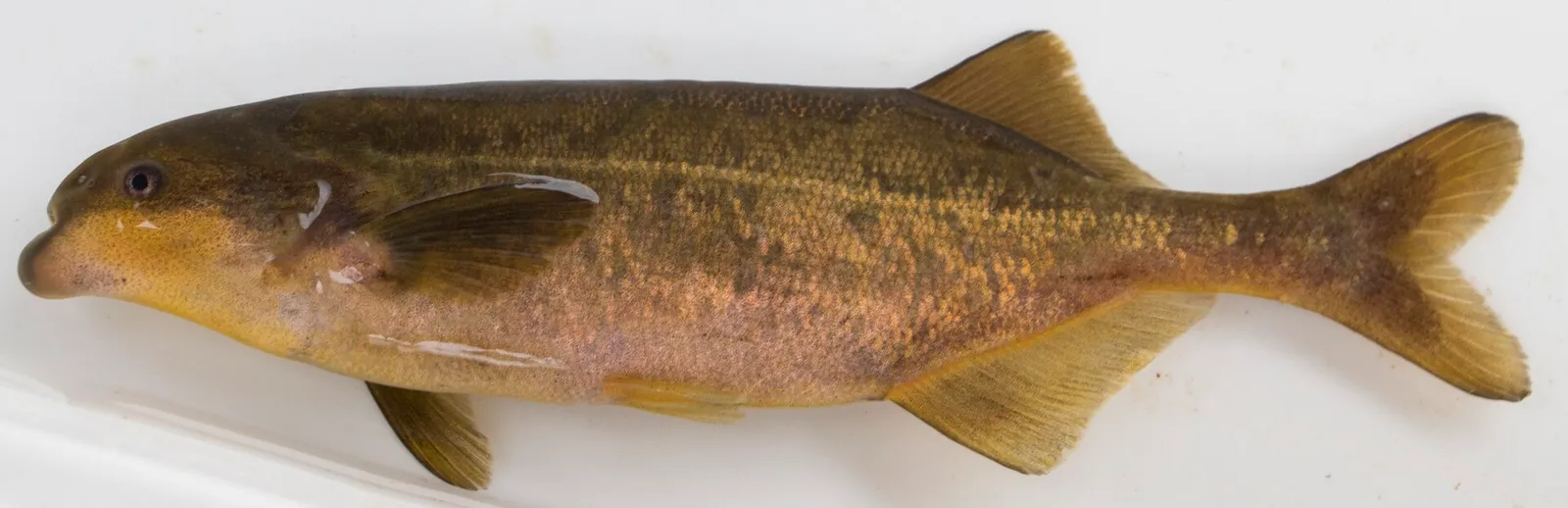
Taxonomy & naming
Marcusenius pongolensis was described by the American ichthyologist Henry Weed Fowler in 1934, with its type locality on the Pongolo (Pongola) River, the waterway that gives the species its name. It belongs to the family Mormyridae — the elephantnoses and mormyrids — within the order Osteoglossiformes, the bonytongues: one of the most ancient surviving lineages of ray-finned fish, its name referring to a toothed bone on the floor of the mouth that bites against a matching toothed pad on the roof. The Catalog of Fishes (Eschmeyer, California Academy of Sciences) treats Marcusenius pongolensis as the valid name.
The genus Marcusenius is a large, mostly sub-Saharan African group whose species are notoriously difficult to separate by eye and are more reliably distinguished, where studied, by the waveform of their electric-organ discharge (EOD) than by external appearance. The species epithet pongolensis follows the standard Latin geographic pattern — the suffix -ensis, "belonging to" or "from", attached to the place name — and simply means "of the Pongolo (River)". At around 9.5 in maximum length it is a genuinely smaller, geographically narrower species than the widespread congener M. macrolepidotus (to about 12.5 in), even though the two share the same blunt-faced "bulldog" build typical of the genus and could plausibly be confused where their ranges approach one another.
Morphology
Like other Marcusenius, the Southern bulldog has the laterally compressed, elongated body typical of mormyrids, with a small, low-set mouth and weak teeth suited to picking tiny invertebrates from soft substrate and root tangles rather than tackling larger prey. The dorsal and anal fins are long-based and set opposite one another toward the rear of the body, with a deeply forked tail.
At the base of the tail sits the electric organ, a modified muscle mass that fires the fish's pulse-type discharge many times a second for electrolocation and communication. As in other mormyrids, the brain is disproportionately large for the fish's size, with an oversized, richly folded cerebellum dedicated to processing the constant stream of electrosensory information — the physical basis for the family's reputation as unusually intelligent, "thinking" fish.
FishBase records a maximum length of about 9.5 in (9.5 in fork length), a von Bertalanffy growth study of a Eswatini population arriving at the same theoretical asymptotic size independently. That makes it a distinctly smaller fish than the congener M. macrolepidotus, which reaches about 12.5 in — one of the features that helps separate the two species where their ranges overlap.
Habitat
Marcusenius pongolensis is a narrow-range endemic of the short coastal rivers of the Maputaland region, recorded from systems running roughly from the Limpopo south to the Kosi and Pongolo (Pongola) drainages, all draining east into the Indian Ocean across the border zone of South Africa and Eswatini (formerly Swaziland). It is a demersal fish, living on or near the bottom, and FishBase specifically notes it beneath undercut banks with tangled root systems — sheltered, current-shadowed microhabitat that also happens to be the dim, obstacle-rich setting in which electrolocation outperforms eyesight.
A dedicated age, growth and reproduction study sampled the species in an oligotrophic (nutrient-poor) impoundment in Eswatini, indicating it also persists in still, dammed water and not only in flowing river channels. That same study recorded a maximum age of 8 years, giving a rare data point on longevity for a Marcusenius species that is otherwise sparsely studied outside its taxonomy and distribution.
Feeding
The small mouth and weak teeth of Marcusenius pongolensis restrict it to small prey items: aquarium care literature covering this group of elephantnoses describes it taking small aquatic insects, insect larvae and snails, gleaned from beneath the undercut banks and root tangles that make up its preferred habitat. As in other mormyrids, foraging is thought to lean heavily on the electric sense to locate hidden invertebrates in low-visibility conditions rather than on vision alone.
Species-specific captive feeding data is sparse, but general guidance for this genus and family points to small live or frozen foods — bloodworm, mosquito larvae and similarly sized invertebrates — offered in a form the fish's small mouth can manage, rather than pellets or larger prepared foods.
Mating
A dedicated study of electric-organ discharge (EOD) plasticity in Marcusenius pongolensis found that individuals vary their EOD waveform, and interpreted this variation as reflecting an ecological tradeoff between two competing pressures: a discharge distinctive enough to attract and be recognised by potential mates, versus one subdued or altered enough to avoid drawing in electroreceptive predators. This is one of the few pieces of species-specific behavioural biology documented for M. pongolensis, and it fits the broader mormyrid pattern in which the EOD carries courtship and species-recognition information alongside its electrolocation role.
Beyond that EOD finding, the mating behaviour of this species is not well documented. As in mormyrids generally, spawning in the wild is thought to be seasonal and cued to environmental triggers such as rainfall or flooding, but the specific timing, courtship sequence and mate-selection behaviour of M. pongolensis have not been described in the sources available here.
Breeding
Breeding biology in Marcusenius pongolensis is poorly known, in keeping with mormyrids generally, and the species has not been reported bred in captivity. The age, growth and reproduction study conducted in a Eswatini impoundment examined reproductive traits alongside growth, but the cached record here does not carry spawning-season, fecundity or egg-development detail beyond the age and growth figures already noted, so this account does not speculate on numbers or dates that are not documented.
Aquarists should not expect to spawn this species: mormyrids as a family are notoriously resistant to captive reproduction, and nothing in the available sources suggests M. pongolensis is an exception. Where mormyrid parental behaviour has been documented at all, in a handful of better-studied relatives, it involves rudimentary egg-guarding among vegetation rather than active brood care — but this has not been confirmed for M. pongolensis itself, and the honest state of knowledge is that its breeding biology remains largely unrecorded.
In the aquarium
Marcusenius pongolensis is not a fish regularly seen in the trade, and species-specific aquarium data is sparse; the care picture here is built mainly from general guidance for elephantnose mormyrids of similar size and habits. General care literature for this group calls for a tank of at least 39.5 in in length, a soft substrate, driftwood and root-like structure echoing the undercut-bank habitat it uses in the wild, and subdued lighting, since these are shy fish that favour cover over open water. Water should be kept soft and close to neutral, roughly pH 6.8–7.2, at a warm tropical 75–82 °F — general mormyrid parameters rather than measurements taken specifically from M. pongolensis populations.
Feeding needs to account for the small mouth and weak teeth: offer small live or frozen foods such as bloodworm and mosquito larvae rather than larger prepared foods the fish cannot easily take. As with mormyrids generally, this species is likely sensitive to poor water quality and to some medications, so introduction into a mature, stable, well-cycled tank is advisable, and conservative dosing is the safer default until more is known about this particular species' tolerances.
Conservation
The IUCN Red List assesses Marcusenius pongolensis as Least Concern, an assessment dated 30 November 2016. Although the species is a genuine range-restricted endemic — confined to a limited band of Maputaland coastal rivers rather than distributed across multiple major basins — its documented presence in both natural river channels and an artificial impoundment suggests some ecological flexibility that likely supports the non-threatened status.
As with other small-range African coastal-river fish, the longer-term risks are indirect rather than acute: damming and impoundment of the rivers it inhabits, water abstraction, and habitat degradation along the Maputaland coastal plain. The species is only sparingly, if ever, collected for the aquarium trade, so hobby demand is not considered a meaningful pressure on its conservation outlook.