Taxonomy & naming
The brownspot largemouth was described by the French naturalist François Louis de Laporte, Comte de Castelnau, in 1861, in his Mémoire sur les poissons de l'Afrique australe, as Chromys thumbergi — the original genus was a misspelling of Chromis, and the type locality is the Okovango (Okavango) River. Castelnau's account left no surviving type, and the name was eventually anchored by a neotype, BMNH 1910.5.31.58, designated by Ethelwynn Trewavas in her landmark 1964 revision of the genus. The species carries unusual taxonomic weight, because it is the type species of the genus itself: Charles Tate Regan erected Serranochromis in 1920 — in a footnote to his classification of the cichlids — and fixed Chromis thumbergi Castelnau as its type. Over the years the fish has been shuffled through Chromys, Hemichromis, Paratilapia and Pelmatochromis before settling in Serranochromis, and its validity as Serranochromis thumbergi has been upheld by every modern authority on the southern African fauna, from Greenwood (1984) and Skelton & Teugels (1991) through Skelton's Freshwater Fishes of Southern Africa (1993, 2001), Marshall's Fishes of Zimbabwe (2011), and Stauffer and colleagues (2021). Within the genus it belongs to the largemouth, piscivorous subgenus Serranochromis (as opposed to the smallmouth, invertebrate-feeding Sargochromis), a split formalized by Bell-Cross and Greenwood in the 1970s and still useful as an ecological shorthand. The epithet has been a persistent source of confusion: it honours the Swedish naturalist Carl Peter Thunberg, whose name is spelled with an 'n', so the form thumbergi (with an 'm') is a transcription error baked into the original publication. Both spellings — thumbergi and the 'corrected' thumbergii — circulate in the literature; this atlas follows the original-publication form thumbergi that the nomenclatural codes preserve. Historically the species was also repeatedly confused with the much larger nembwe, Serranochromis robustus, in early Lake Nyasa and Zambezi fisheries reports.
Morphology
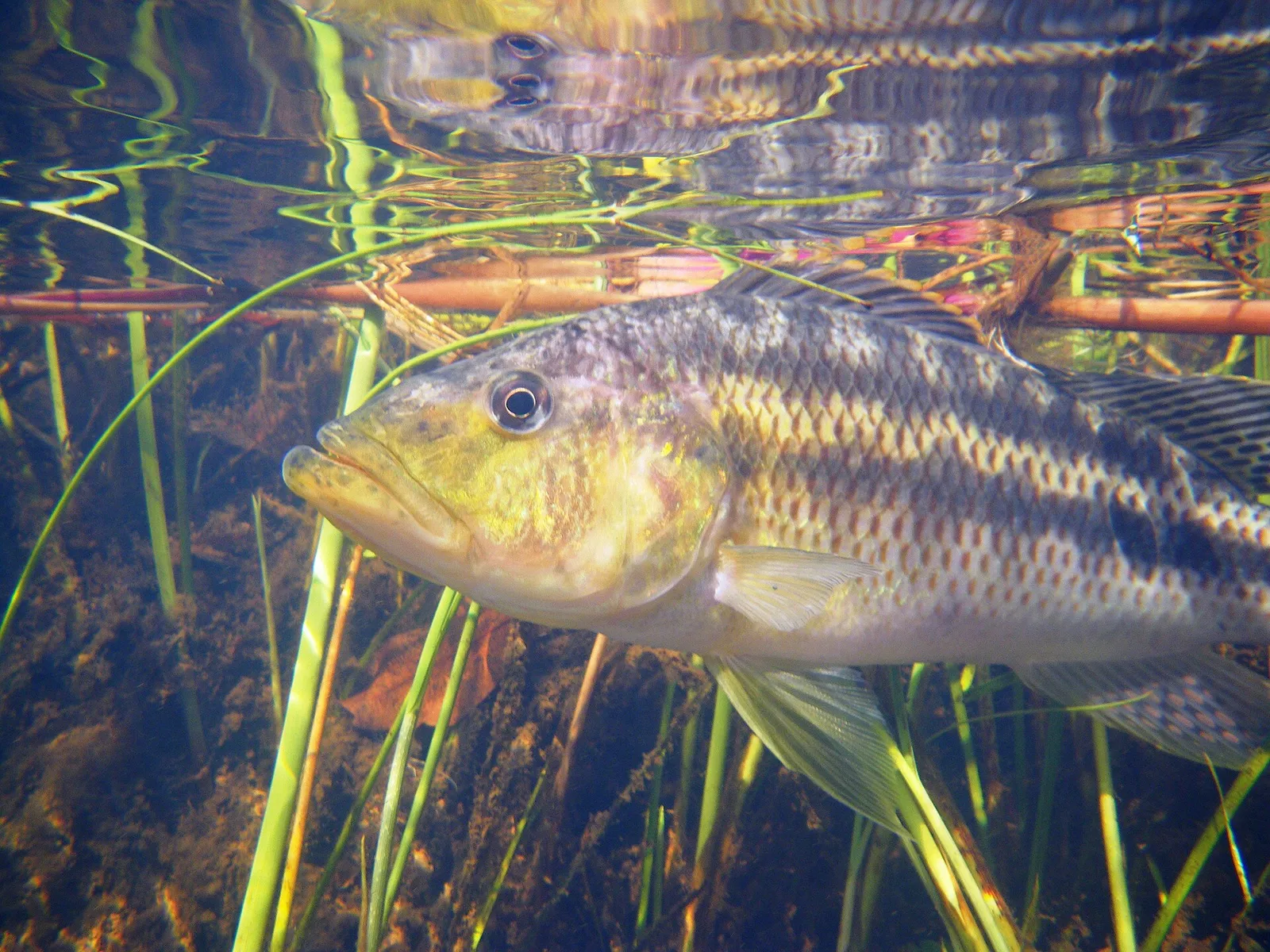
Serranochromis thumbergi reaches about 13 in in total length and a published maximum weight near 1.2 kg, making it a mid-sized member of the largemouth group — substantially smaller than the nembwe (Serranochromis robustus) or humpback (Serranochromis altus), which run well over 15.5 in. It is built more slenderly than most of its congeners, with a large, pointed head, a big terminal mouth set with the widely spaced unicuspid teeth typical of the genus, and a truncate (squared-off) caudal fin. The ground colour is olive-green to olive-brown, and the diagnostic feature that gives the fish its name is not a single mark but a field of them: most body scales carry a rusty-brown to reddish dot at the centre, so the flanks read as finely stippled rather than barred or blotched. The dorsal and caudal fins are a greyish blue overlaid with many reddish maculae or dots. As in all Serranochromis, the anal fin of breeding males bears egg-dummy ocelli. Sexual dimorphism is marked but largely a matter of intensity rather than form: all the colour patterns are much weaker in females, while courting males become very intensely coloured and develop a distinctive yellow throat and breast. Local names recorded for the fish include 'mununga' in the Barotse floodplain, where anglers know it simply as the brown-spot bream.
Habitat
The brownspot largemouth is a fish of the warm floodplain river systems of south-central Africa. Its native range runs across the Cunene River (and possibly coastal streams near Moçâmedes in Angola), the Okavango River and its delta swamps, the upper Zambezi above Victoria Falls, and the Kafue and Luangwa rivers; it also reaches the Lufira, Lake Mweru, and the Lake Bangweulu region of the upper Congo (Lualaba) basin. Records from the Shashi–Limpopo system stem from introduction and fall outside the natural range. These are typically clear but tea-stained, soft, slightly acidic waters draining the ancient, nutrient-poor Kalahari sands; Winemiller's 1989 survey of the upper Zambezi recorded pH between about 5.5 in floodplain pools and 7.0 in tributaries, with water temperatures from roughly 64 °F in deep winter canals to 82 °F at the surface in late spring, and near-full oxygen saturation throughout. The species occupies shallow to moderate depths along channels, lagoons and inundated margins rather than open deep water. What most sharply defines its distribution, however, is biological: its habitat use is strongly governed by the presence or absence of the tigerfish, Hydrocynus. Where tigerfish are absent — as in the lower Okavango Delta and parts of the Kafue — Serranochromis thumbergi ranges freely in open water and even fast-flowing rocky stretches; where the tigerfish occurs, it is relegated to lagoons, backwaters and marshy shallows. It is, in this sense, one of the more conspicuous open-water predatory cichlids of tigerfish-free reaches.
Feeding
Serranochromis thumbergi is a piscivore, a member of the largemouth subgenus whose deep gape, elongate head and conical teeth are the gear of a fish-eater. FishBase places it at a trophic level near 3.7 and records a diet of small fish, insects and snails — the largemouth Serranochromis are predators first, but not exclusively so, and like several of its relatives it takes a measure of aquatic invertebrates and molluscs alongside its piscine prey. Winemiller's comparative study of the upper Zambezi Serranochromis flock showed how finely these predators partition resources: the river-channel species specialise (nembwe on armoured Synodontis catfish, the humpback on nocturnal mormyrids, the molluscivore Sargochromis giardi on bivalves), while the lagoon species ambush midwater fishes from cover. Serranochromis thumbergi itself was uncommon in that particular floodplain and so was not dissected in detail there, but its assignment to the open-water piscivore guild is consistent across the literature; it hunts small fishes in the upper and mid water of channels and lagoons. As a sizeable mid-level predator it helps structure the small-fish communities of the floodplains it inhabits, and its near-exclusive occupancy of open water in tigerfish-free systems suggests it fills, in part, the predatory role the tigerfish would otherwise dominate.
Mating
Reproduction in Serranochromis is tied to the flood pulse. Across the genus, ripe gonads appear toward the end of the low-water season, and most species appear to spawn in the weeks just before the annual flood — a timing that lets a mouthbrooding female carry her young onto the newly inundated plain, where predator densities are low and the brood can be released into comparatively safe, food-rich shallows. Population densities peak at the end of the dry season, which is thought to ease the finding of mates. As courtship approaches, male Serranochromis thumbergi assume their most intense colouration, the yellow throat and breast flushing strongly, and they develop the conspicuous anal-fin ocelli that function as egg dummies during spawning. Direct field observations of pair formation in this particular species are sparse, but the genus pattern is one of a male preparing and defending a spawning site — a cleared depression in sand — to which a ripe female is courted. Once eggs are laid and fertilised, the social bond effectively ends with the female, who takes the eggs into her mouth; there is no prolonged biparental partnership of the kind seen in substrate-spawning cichlids.
Breeding
Like all members of its genus, Serranochromis thumbergi is a maternal mouthbrooder. FishBase records that it constructs a sandscrape nest — a simple cleared depression in the sand — and that the female incubates the eggs in her mouth. The closely studied congeners give a reliable picture of the genus-typical figures: bowers are saucer-shaped depressions of roughly 12 in diameter built on sandy substrates among vegetation, and fecundity in the largemouth Serranochromis runs from several hundred to over a thousand mature oocytes per female (the nembwe averaged about 1,165, the smaller species fewer), with comparatively large eggs around 0.5 in in diameter. Given its 13 in maximum size — intermediate among the largemouths — a clutch of several hundred eggs is the reasonable expectation for Serranochromis thumbergi, though no large dedicated fecundity series has been published for the species specifically. Spawning is timed to the rising-water period: the female broods the developing eggs and then the free-swimming young in the buccal cavity, releasing the fry onto the flooded plain. Maturity in comparable largemouth Serranochromis is reached at roughly three years of age and at body lengths in the 10–12 in range. As with most riverine African mouthbrooders, the male contributes no parental care beyond fertilisation; care is wholly maternal and oral.
In the aquarium
The brownspot largemouth is essentially a fisheries and angling fish, not an aquarium subject, and it is rarely if ever offered in the ornamental trade. There is no established body of hobbyist husbandry literature for the species, and anyone keeping it would be improvising from what is known of the genus rather than following a tested protocol — so the honest summary is that this is a specialist's fish kept by almost no one.
That said, the requirements implied by its biology are clear enough. This is a 13 in predatory cichlid that grows to over a kilogram, so it demands a very large tank — on the order of 7 ft of length and several hundred litres at minimum — with a long, open swimming lane, since it is an open-water hunter rather than a rock-dweller. A deep bed of fine sand suits both its sandscrape spawning behaviour and the soft floodplain substrates it evolved on; scattered driftwood, reed-like plantings and a few sightline breaks help, but the fish needs room far more than it needs décor. Water should be warm and soft to neutral, mirroring its native rivers: roughly 72–82 °F, pH about 6.5–7.5, with low to moderate hardness, strong biological filtration and generous water changes, but without the violent current the fish would only encounter in the rockiest reaches.
Feeding is straightforward in principle — it is a piscivore, and would take live or frozen fish, large invertebrates and, with patience, sinking carnivore pellets — but feeding live fish raises disease and welfare concerns and is best avoided in favour of frozen and prepared foods. Tankmates are the hard part: anything small enough to swallow will be eaten, and the fish's size and predatory temperament rule out delicate community companions, so realistic cohabitants are limited to robust, similarly sized African river fishes in a tank large enough to dilute aggression. In short, Serranochromis thumbergi is keepable by an experienced large-cichlid keeper with the space and intent, but it offers little to the general aquarist and should never be bought on impulse as a small juvenile.
Conservation
The IUCN Red List assesses Serranochromis thumbergi as Least Concern, in an assessment by B. Marshall, T. Moelants and D. Tweddle dated 1 May 2009 and published in 2010, with the population trend listed as unknown. The rating reflects a wide distribution across multiple southern and central African river systems and the absence of any documented range-wide threat. The species is harmless to people and is valued as a subsistence-fishery and gamefish — it is caught with hook-and-line, gillnets and drawnets — but its fishing vulnerability is rated low and it carries no CITES or CMS listing. The broader context is the steady pressure on the floodplain rivers it depends on: the Okavango, Zambezi and Kafue basins face dam development, altered flood-pulse regimes, water abstraction, and locally intense artisanal fishing, and the largemouth Serranochromis as a group are sensitive to the loss of the seasonal inundation that triggers their spawning. None of these is documented as a present danger to this particular species, but they are the backdrop against which its Least Concern status — now more than fifteen years old — should be read, and a reassessment would be timely.