Taxonomy & naming
Marcusenius altisambesi was described in 2007 by Bernd Kramer, Paul Skelton, Michael van der Bank and Michael Wink, with its type locality on the Upper Zambezi River at Lisikili, Namibia. It belongs to the family Mormyridae, within the order Osteoglossiformes, the bonytongues: a scattered, deep-time radiation of fishes found on four continents — South America, Africa, Southeast Asia and Australasia — united not by any shared modern habitat but by that toothed lingual bone, and numbered among the most ancient lineages of living teleosts. The Mormyridae are an exclusively African family, every member weakly electric, and entirely convergent with — not related to — the electric knifefishes of South America (order Gymnotiformes), which evolved an equivalent electric sense independently on the opposite side of the Atlantic.
The species was recognised as distinct from its wider-ranging relatives using a combination of morphology and molecular genetics, with differences in electric organ discharge (EOD) waveform reinforcing the split — the same kind of evidence that, across the genus, regularly reveals that fish once lumped together as a single wide-ranging species are in fact several narrow-range ones. The Catalog of Fishes (Eschmeyer, California Academy of Sciences) treats Marcusenius altisambesi as the valid name. The genus Marcusenius was erected by the American ichthyologist Theodore Gill in 1862 and is traditionally said to honour the naturalist J. H. Marcusen; the species epithet altisambesi is built from Latin altus, "high" or "upper", and Sambesi, the German/older spelling of the Zambezi, together naming the fish for its home range on the upper Zambezi.
Morphology
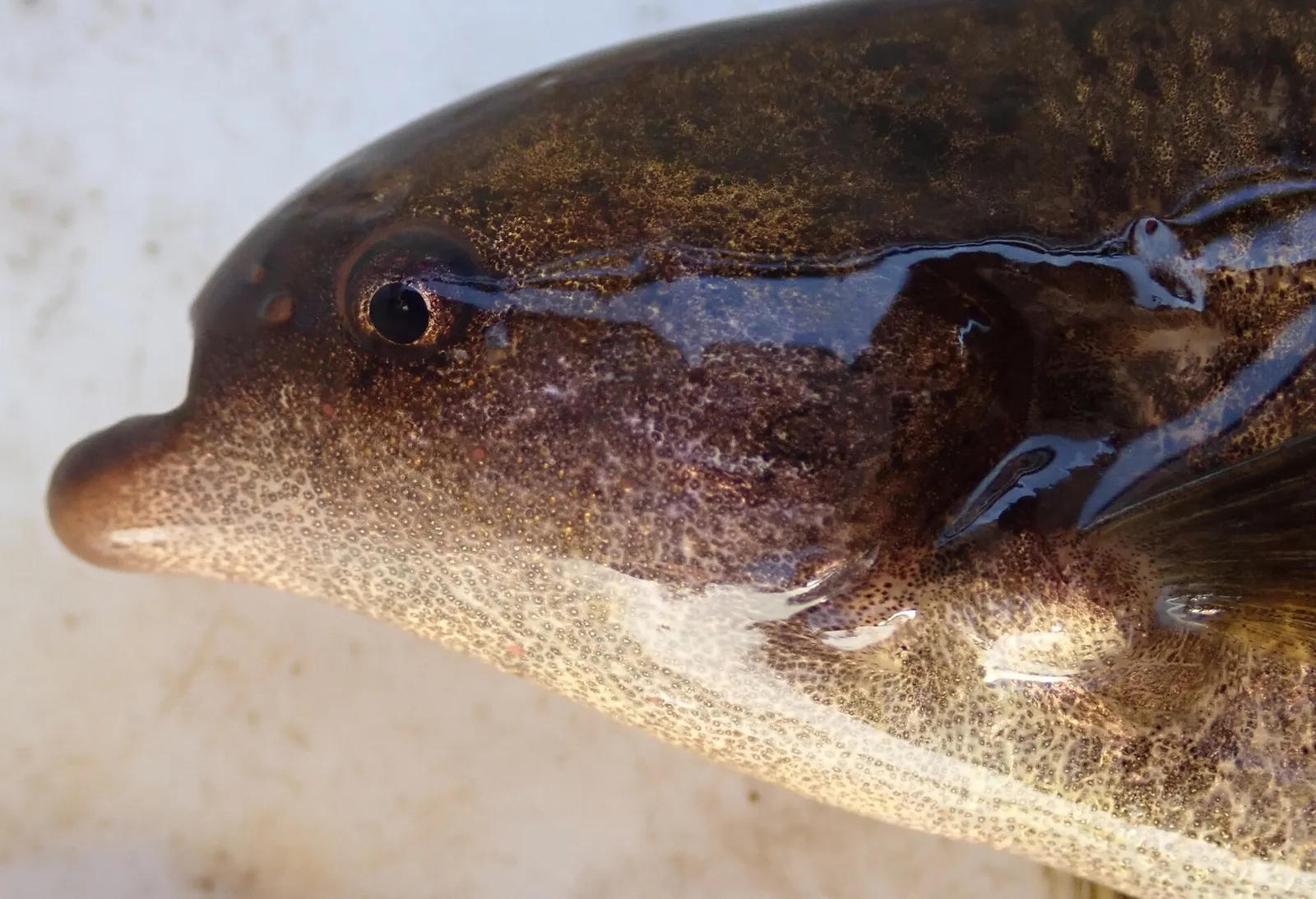
Marcusenius altisambesi shows the general mormyrid build: a laterally compressed body, a small, close-set mouth, and a caudal peduncle housing the tail-mounted electric organ that defines the family. FishBase records a maximum size of about 7.5 in, a modest figure that places it among the smaller-to-mid-sized members of the genus rather than the handful of larger Marcusenius found elsewhere on the continent.
The original description separates it from similar Zambezi-Okavango congeners on a set of fine scale and fin counts: 12–14 scales around the caudal peduncle, 49–60 scales along the lateral line, 26–30 anal-fin rays, 20–26 dorsal-fin rays, and a body depth of roughly 20–33% of standard length. As in other mormyrids, confident field identification among closely related species is difficult from external appearance alone and often rests on the electric organ discharge rather than on colour or shape. Also as in other mormyrids, an outsized cerebellum drives one of the highest brain-to-body ratios recorded in any vertebrate, the physiological cost of running a sensitive electrolocation and communication system built around that tail organ.
Habitat
Marcusenius altisambesi is native to the upper Zambezi River system, including the Caprivi Strip and the lower Kwando River, and to the western Okavango system, with confirmed occurrence in Angola, Botswana and Namibia. It is a freshwater, bottom-associated (demersal) fish of this floodplain drainage rather than a wide-ranging African species.
The upper Zambezi and Okavango are seasonally flooding, sediment-laden river systems with extensive papyrus and reed-fringed floodplain, exactly the low-visibility setting in which an electric sense outperforms eyesight. Species-specific temperature and pH figures for Marcusenius altisambesi were not available in the sources consulted here; the water is presumed to follow the warm, generally soft-to-moderate tropical southern African river conditions typical of the family, and this article does not invent precise figures beyond that.
Feeding
FishBase records Marcusenius altisambesi as feeding on aquatic invertebrates, especially insect larvae, taken from the sand and mud substrate of its river and floodplain habitat. Like other mormyrids it is presumed to forage mainly after dark, using its weak electric organ discharge to detect prey hidden in turbid or dim water where vision is of limited use.
Aquarium-specific feeding data is sparse for this species; other small-to-mid-sized Marcusenius in the trade typically settle onto frozen and sinking prepared foods once acclimated, offered after lights-out when the fish is naturally active, and this article notes that pattern as a reasonable expectation rather than a confirmed fact for this exact species.
Mating
The clearest documented biological detail for this species concerns its electric signal rather than any visible courtship display: Marcusenius altisambesi shows sexual dimorphism in EOD waveform, with males over about 5 in standard length developing a markedly longer discharge duration than females and juveniles. Across mormyrids generally, the pulse is thought to encode species identity, sex and readiness to spawn, and the pronounced male EOD shift in this species is consistent with that signal playing a role in courtship or mate recognition, though the specifics have not been directly observed and documented for wild altisambesi.
Wild spawning is presumed, as in related mormyrids of the region, to be seasonal and cued by the Zambezi–Okavango flood cycle. The electrical and acoustic noise of a home aquarium — filters, heaters, pumps, reflective glass — readily interferes with the weak EOD signal mormyrids rely on for this kind of communication, one reason natural courtship essentially never plays out under aquarium conditions for fish in this family.
Breeding
Marcusenius altisambesi is, so far as the sources consulted here record, essentially not bred in the aquarium hobby, and — as with most mormyrids — its reproductive biology in the wild is poorly understood beyond the EOD dimorphism noted above. Breeding is presumed to be seasonal and flood-triggered, and some mormyrids are thought to guard eggs among vegetation, but no such detail has been confirmed for this species.
Aquarists should not expect or attempt to breed this fish. Mormyrids in the trade, this species included, are typically wild-caught, and any claim of routine captive spawning in this genus should be treated with real scepticism absent solid documentation.
In the aquarium
At a modest maximum size of around 7.5 in, Marcusenius altisambesi is one of the more manageable mormyrids for a dedicated species tank, though it still wants dim lighting, soft substrate and ample cover — roots, wood and plant thickets — to feel secure, becoming more active after dark. It is best kept in the soft-to-moderate, warm tropical river water typical of southern African mormyrids rather than hard or alkaline conditions, and given a sandy substrate to forage over in the way it does in the wild.
As with other mormyrids, keepers should stay cautious about tankmates and water quality generally: this genus can be intolerant of its own kind and of other electric fish in a confined space, and — being scaleless-skinned, electrosensitive fish — mormyrids are notably sensitive to poor water quality and to many aquarium medications, copper-based treatments in particular. Water quality should be kept excellent and stable, and any dosing approached carefully. This is not a fish for a brightly lit, noisy community tank; it wants calm equipment, calm company, and a keeper who accepts that breeding in captivity is rarely if ever achieved.
Conservation
The IUCN Red List assesses Marcusenius altisambesi as Least Concern, an assessment from the 2022 review cycle. The species is not listed under CITES.
It is recorded from the upper Zambezi and Okavango river systems across Angola, Botswana and Namibia — a range narrower than many African mormyrids but not currently flagged with a specific range-wide threat in the sources consulted here. As with other fish of this drainage, the general long-term pressures on the upper Zambezi–Okavango system — water abstraction, damming, agricultural runoff and habitat change — remain the relevant backdrop even for a species not currently considered threatened.