Taxonomy & naming
Corydoras acutus was described by the American naturalist Edward Drinker Cope in 1872, in his account of the fishes of the 'Ambyiacu' River — an apparent misspelling of the Ampiyacu, a small affluent of the Amazon near Pebas in Loreto, Peru, which is the type locality. The specific name 'acutus' is Latin for 'sharpened', a reference to the narrow, abruptly contracted snout Cope singled out in his brief original description. Because the original syntypes (ANSP 8292–8293) were lost, Nijssen & Isbrücker designated a neotype in 1980.
The genus Corydoras Lacépède, 1803 had grown to over 170 species and proved, on molecular evidence, not to be a single natural lineage. The 2024 phylogenomic revision by Dias, Tencatt and colleagues split it into several genera (Brochis, Hoplisoma, Gastrodermus, Osteogaster and others). Crucially, C. acutus falls within Corydoras in the strict sense — it belongs to the 'saddle-snout' assemblage retained under the original genus name — so, unlike many of its relatives, its name is unchanged: the Catalog of Fishes gives the current status as 'Valid as Corydoras acutus Cope 1872'. In the hobby the 'blacktop' is also part of a cluster of similar long-snouted forms carrying C-numbers (C024, C076, C077, C109), some of which are almost certainly distinct, undescribed species rather than true C. acutus.
Morphology
This is a medium-sized, long-snouted cory reaching roughly 2–3 in; FishBase records about 2 in standard length, while aquarium references often cite total lengths up to around 3 in. As in all Corydoras it is armoured with two rows of overlapping bony scutes down each flank, a hard helmet-like head and three pairs of barbels around the inferior mouth. Cope counted 22–21 lateral scutes and the typical fin formula (dorsal I,7; anal I,6) in his type material.
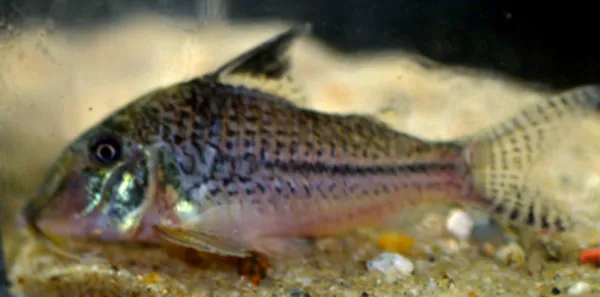
The defining feature is the muzzle: viewed from above it is narrow and 'contracted abruptly from the general outline', a sharp snout rather than the blunt face of a bronze cory. The ground colour is a pale olive to greyish, often with a faint lateral band, and the diagnostic mark of the hobby name is a large dark blotch on the distal part of the dorsal fin — the 'black top'. The caudal fin is marked with several vertical bars, and the clavicle and gill cover can show bluish reflections. Across its wide range the pattern varies, and some populations lack the dorsal marking altogether. The dorsal, pectoral and adipose fins each bear a stiff, serrate spine; the pectoral spines can sting.
Habitat
Corydoras acutus is a fish of the upper Amazon basin, recorded across northern Peru and Ecuador and into western Brazil, with FishBase also noting it from the Machado (Ji-Paraná) River basin in Rondônia. Reported localities span the río Yavarí, the río Abunã (Madeira system), Nueva Rocafuerte on the río Napo, and the río Huitoyacu in the Marañón system — a broad western-Amazonian range that helps explain the variation in its appearance.
These are warm lowland forest waters: slow streams, river margins and floodplain channels over soft substrates. Reported water conditions are warm and soft to moderately hard — broadly a temperature band around 77–82 °F and a pH from acidic to neutral-alkaline (about 6.0–8.0). Like all Corydoradinae it is a facultative air-breather, periodically darting to the surface to gulp air and absorb oxygen through its modified, vascularised intestine, which lets it cope with the low-oxygen conditions of warm, shrinking dry-season pools.
Feeding
The blacktop cory is a benthic omnivore. It forages over the bottom, sifting sand and leaf litter with its barbels to find small invertebrates, insect larvae, worms, micro-crustaceans, fallen seeds and detritus, and expelling cleaned substrate through the gills. In the aquarium it readily takes sinking pellets and granules together with frozen and live foods such as bloodworm and Tubifex; a varied diet keeps it in condition. Like all corys it should never be expected to subsist on the leftovers of other fish or treated as a tank 'cleaner'.
Mating
Corydoras acutus follows the well-documented cory spawning pattern. The fish are egg-laying shoalers without a pair bond. A receptive female cleans a surface, and a male adopts the classic 'T-position', aligning at right angles to her head; the female appears to take milt at the male's vent. FishBase, drawing on aquarium observation, describes the female holding just two to four eggs between her pelvic fins while the male fertilises them over roughly thirty seconds, after which she swims off to attach the very sticky eggs to a chosen spot. The pair repeats the sequence until on the order of a hundred eggs have been laid in small batches.
Breeding
Breeding follows the general Corydoras template and has been observed in aquaria. Spawning is typically prompted by a large, cooler water change simulating the rains. The adhesive eggs are laid a few at a time across firm surfaces — glass, plants, stones — accumulating to roughly a hundred in total, and receive no parental care; adults will eat them, so breeders move either the eggs or the parents. Eggs hatch in a matter of days, and the fry take microworm, baby brine shrimp and powdered foods once the yolk sac is absorbed. As a long-snouted species it is regarded as a little more demanding to spawn than the easy short-snouted corys, but it is far from impossible.
In the aquarium
The blacktop cory is a rewarding, peaceful community catfish for aquarists who can give it the right setup. Keep it as a shoal of six or more — corys are genuinely stressed when kept alone or in pairs — in a tank with ample floor area. Substrate is the single most important detail: use soft sand or very smooth, rounded fine gravel, because these fish feed by sifting and sharp or coarse gravel wears down and infects their barbels, leaving the blunted faces that mark poor husbandry. As a longer-snouted species it is especially fond of nosing into sand, so a clean sand bed suits it well.
Provide warm (about 75–81 °F), well-filtered, well-oxygenated water with gentle current, some cover and regular water changes; it tolerates a broad pH and hardness range. It is utterly peaceful and makes an ideal companion for tetras, pencilfish, rasboras, dwarf cichlids and other calm community fish, and should not be housed with anything large enough to bully it. The usual cory cautions apply: the stiff fin spines tangle easily in nets, so move them in a cup, and a distressed cory can release skin toxins that, in the confined volume of a bag or bucket, can kill the whole group — so transport them with care.
Conservation
Corydoras acutus was assessed by the IUCN in 2020 as Least Concern. It is widely distributed across the upper Amazon, is collected for the aquarium trade but not under heavy targeted pressure, and faces no identified species-specific threat. As with all Amazonian fishes it is exposed to the broad regional pressures of deforestation, run-off, damming and habitat degradation, but as a wide-ranging species it is not considered at risk. The taxonomic footnote is the more interesting issue: because several similar long-snouted forms travel under the 'acutus' label in the hobby, some of these may prove to be narrower-ranged, undescribed species needing assessment in their own right.