Taxonomy & naming
The reticulated cory was described by Alec Fraser-Brunner in 1938, in the British hobby magazine The Aquarist and Pondkeeper — an unusual debut for a fish, in a popular 'debutantes of the month' column rather than a formal journal. He placed it in Corydoras Lacépède, 1803, the vast genus of South American armoured catfishes (family Callichthyidae) that has long held the great majority of the hobby's 'cory cats,' and as Corydoras reticulatus it has been imported, bred and written about ever since.
That genus had grown to well over 170 species and molecular work showed it was not a single natural group. In 2024 Dias, Tencatt and colleagues published a large revision (Zoological Journal of the Linnean Society) that split Corydoras into several genera — among them Brochis, Hoplisoma, Gastrodermus and Osteogaster — and under that scheme the network cory becomes Brochis reticulatus, grouped with the type species Brochis splendens and its relatives. Eschmeyer's Catalog of Fishes now lists the species under this combination. The change is recent and far from universally adopted, and aquarists overwhelmingly still say 'Corydoras reticulatus,' so we keep that heading while flagging the new name. The species is also a long-standing source of confusion with the very similar Corydoras (now Hoplisoma) sodalis, and the two have repeatedly been muddled in the trade.
Morphology
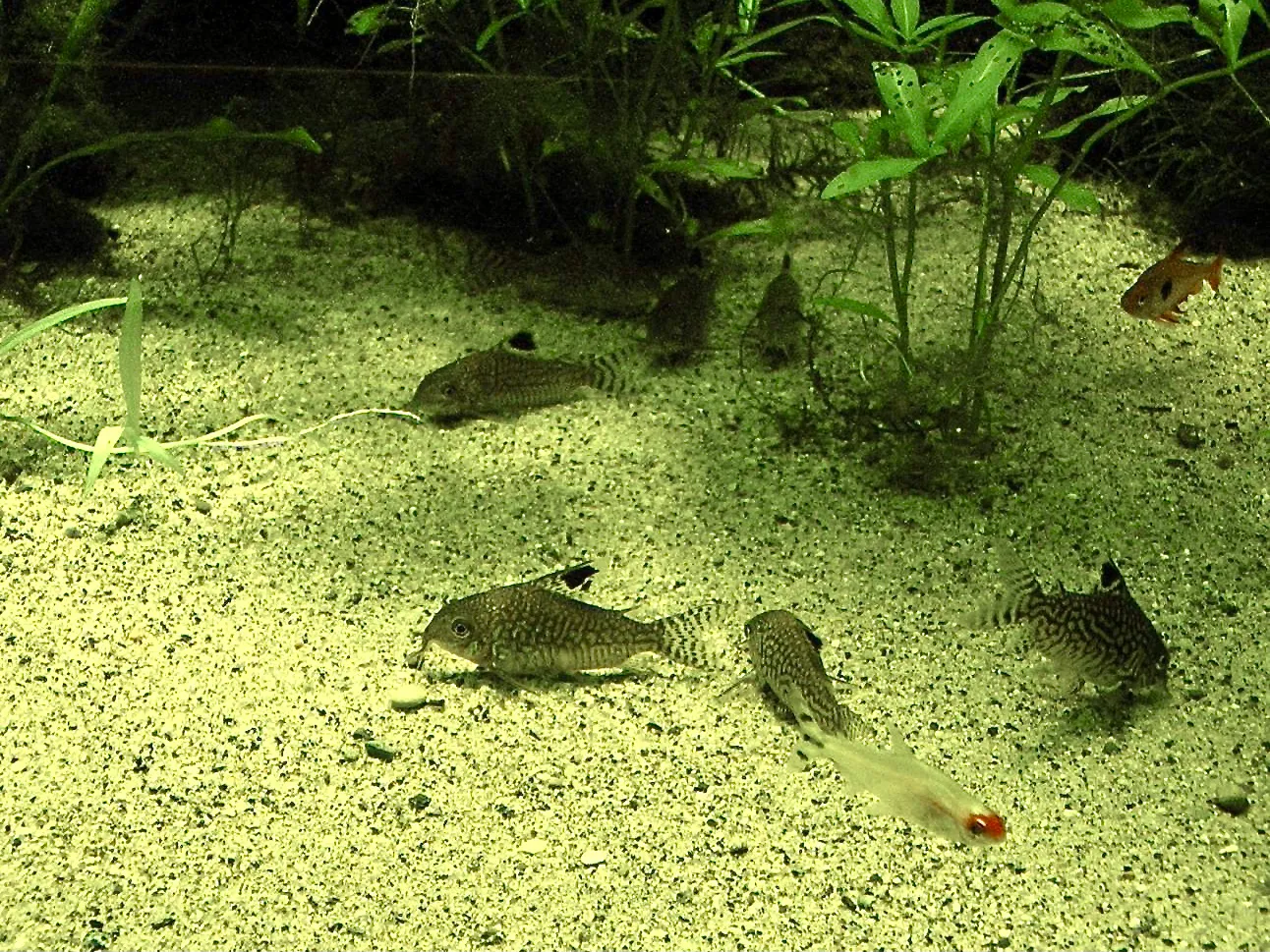
This is a medium-sized cory, deep-bodied and stocky, reaching roughly 2.5 in in standard length (about 2.5–3 in total including the tail); females grow larger and visibly rounder than males. Like all corys it is armoured rather than scaled: two rows of overlapping bony plates (scutes) run down each flank, meeting in a ridge along the back, and the head is a hard, blunt helmet. Three pairs of sensory barbels fringe the downturned mouth, the tools it uses to taste and sift the substrate.
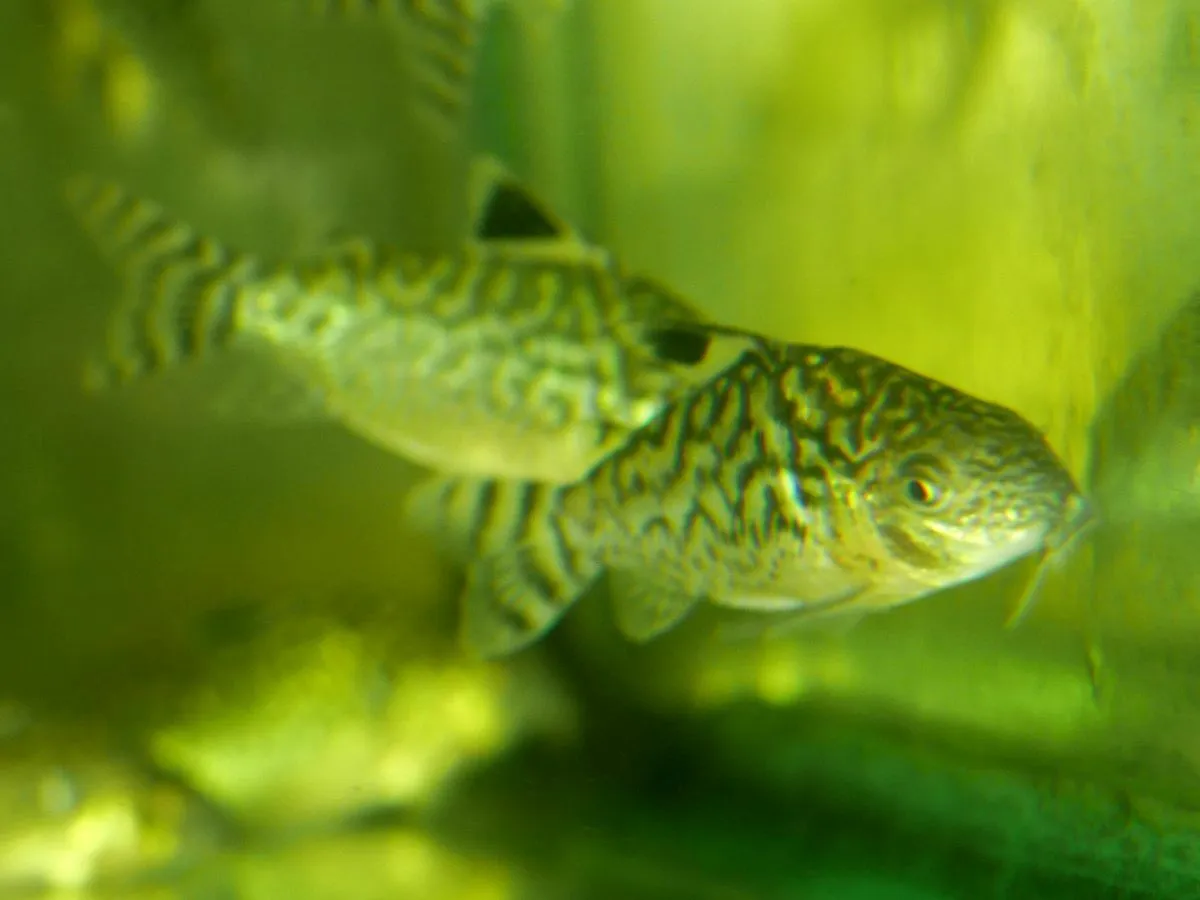
The ground colour is a pale, silvery pinkish-grey, and over it runs the feature that names the fish: a dense network of fine dark lines and spots across the flank, breaking the body into a reticulated, net-like mesh. The single most useful field mark is in the dorsal fin, which carries a large, deep-black blotch — the cleanest way to separate C. reticulatus from the otherwise very similar C. sodalis, which lacks that bold dorsal spot. The dorsal and pectoral fins bear stiff, sharply pointed, mildly venomous spines that readily tangle in a net and can give a careless hand a jab, so the fish is better lifted in a cup.
Habitat
Corydoras reticulatus is a fish of the western and upper Amazon. Aquarium exporters and most hobby sources place it in Peruvian and adjacent waters — the tributaries and floodplains of the Marañón, Ucayali, Huallaga, Napo and Putumayo/Içá systems — while FishBase, more conservatively, gives only 'lower Amazon basin'; the precise limits of its range are genuinely uncertain and tangled with the C. sodalis confusion, so it is honest to call it an upper-Amazon species without over-claiming the detail.
The habitats it is taken from are typical cory country: shallow, soft-bottomed margins of streams and rivers, floodplain creeks, oxbow lakes and seasonally flooded forest pools, over sand or silt with leaf litter and submerged wood. These are warm, often soft and slightly acidic to neutral waters — broadly 72–79 °F, a pH band of about 6.0–8.0 and soft to moderately hard water (around 2–25 dH). Like other corys it is a facultative air-breather, darting to the surface to gulp air and absorb oxygen through a modified, vascularised hindgut, which lets it cope with the warm, low-oxygen pools it sometimes inhabits.
Feeding
The reticulated cory is a benthic omnivore and detritivore. It works the bottom continuously, burying its snout and barbels in sand to taste out small invertebrates, insect larvae, worms, crustaceans and fallen organic matter, expelling cleaned sand through the gills as it goes. It is an opportunist rather than a specialist, which is part of its hardiness in captivity. In the aquarium it readily takes good-quality sinking dried foods alongside small live and frozen fare — bloodworm, brine shrimp and chopped earthworm are all relished — but it should never be left to subsist only on whatever tankmates let fall to the bottom.
Mating
Corydoras are egg-laying shoalers with no pair bond and a distinctive, well-studied courtship. When a female is ready she cleans a site — a leaf, a stone, the aquarium glass — and the group becomes active; a male positions himself at right angles to her head in the classic 'T-position,' grasping her barbels between his pectoral fin and body, and she appears to take his milt. Sperm is then thought to pass rapidly through her gut to fertilise the one to few eggs she clasps in a basket formed by her pelvic fins, which she carries to the cleaned site and presses into place. The sequence repeats, an egg or a small batch at a time, until the clutch is scattered across the chosen surfaces.
Breeding
C. reticulatus has been bred in aquaria but is less of a guaranteed beginner's project than the bronze cory. As with most corys, spawning is typically triggered by a large, cooler water change that mimics the arrival of the rainy season, and a productive group skews to more males than females — around two males per female is a common recommendation. Females release eggs a few at a time, often only one to four per spawning pass, fertilising and placing each before returning for more, so a full clutch builds up gradually over a session. The adhesive eggs receive no parental care — the adults will eat them — so breeders move either the eggs or the parents. Eggs hatch in about three to four days, and the fry, after absorbing the yolk sac, take microworm and baby brine shrimp.
In the aquarium
The reticulated cory is a rewarding, peaceful aquarium fish, but it has the same non-negotiable needs as the rest of its tribe. First, it is a shoaling species and is genuinely stressed when kept alone or in twos — keep six or more, and they reward you with constant, confident, busy activity along the bottom.
Second, substrate is not optional decoration. Provide soft sand or very smooth, rounded fine gravel: corys feed by sifting, and sharp or coarse gravel erodes and infects their barbels, leaving stubby, blunted faces — one of the commonest signs of poor husbandry. Keep the bottom clean, because they are always nosing in it. Water should be warm (about 72–79 °F), well-filtered and well-oxygenated, with the gentle current and regular changes any catfish appreciates; they tolerate a broad pH and hardness range. They are utterly peaceful and make ideal companions for tetras, rasboras, dwarf cichlids and other calm community fish, never with anything large enough to bully them. Two cautions worth knowing: the sharply pointed fin spines tangle easily in nets (a cup is safer), and a distressed cory can release a skin toxin that, in the confined volume of a bag or bucket, can kill the whole group — so transport them with care.
Conservation
Corydoras reticulatus is assessed by the IUCN as Least Concern. It is a reasonably widespread upper-Amazon fish, ecologically flexible and tolerant of the warm, shallow, soft-water habitats that are common across its range, and it faces no known species-wide threat. That status does not exempt it from the broad pressures on Amazonian freshwaters — deforestation, agricultural run-off, mining sediment and pollution all degrade the shallow marginal habitats it favours — but as a species it is in no danger. The most interesting footnotes are taxonomic rather than conservational: its long confusion with C. sodalis means range and trade figures should be read with some caution, and its recent move into Brochis is still settling into use.