Taxonomy & naming
The elegant cory was described by the Austrian ichthyologist Franz Steindachner in 1876, from the Amazon at Tefe in Brazil, which remains the type locality. For nearly a century and a half it has been listed as Corydoras elegans Steindachner, 1876 — the name under which it is still traded and written about — with Corydoras pestai Holly, 1940 falling into synonymy.
Its taxonomy carries unusual weight, because the genus-group name Gastrodermus Cope, 1878 was erected with elegans as its type species. Gastrodermus spent most of the twentieth century treated as a junior synonym of Corydoras Lacepede, 1803, but in 2024 Dias, Tencatt and colleagues published a large molecular-and-morphological revision of the subfamily Corydoradinae that split the swollen genus Corydoras into several genera and resurrected Gastrodermus for this lineage. Under that scheme the species becomes Gastrodermus elegans (Steindachner, 1876), and as the type species it anchors the genus. The change is recent and not yet universally adopted — the hobby still overwhelmingly says 'Corydoras elegans' — so we keep that as the heading while flagging the current Catalog of Fishes combination. Long before this formal split, hobbyists and earlier authors already recognised an informal 'elegans group' of small, similar species (including forms such as C. nanus, C. gracilis and C. bilineatus, plus a string of undescribed 'C-' and 'CW-' codes); much of that group is what the resurrected Gastrodermus now formalises.
Morphology
This is one of the smaller corys, slender and comparatively elongate, reaching only about 2 in (FishBase gives a maximum around 2 in SL); females grow a little larger and become noticeably rounder and broader when gravid. Like all corys it wears armour rather than scales — two rows of overlapping bony plates (scutes) run down each flank and meet along the back, and the head is a hard, blunt helmet — and three pairs of barbels fringe the small downturned mouth. The dorsal, pectoral and adipose fins each carry a stiff, mildly venomous spine.
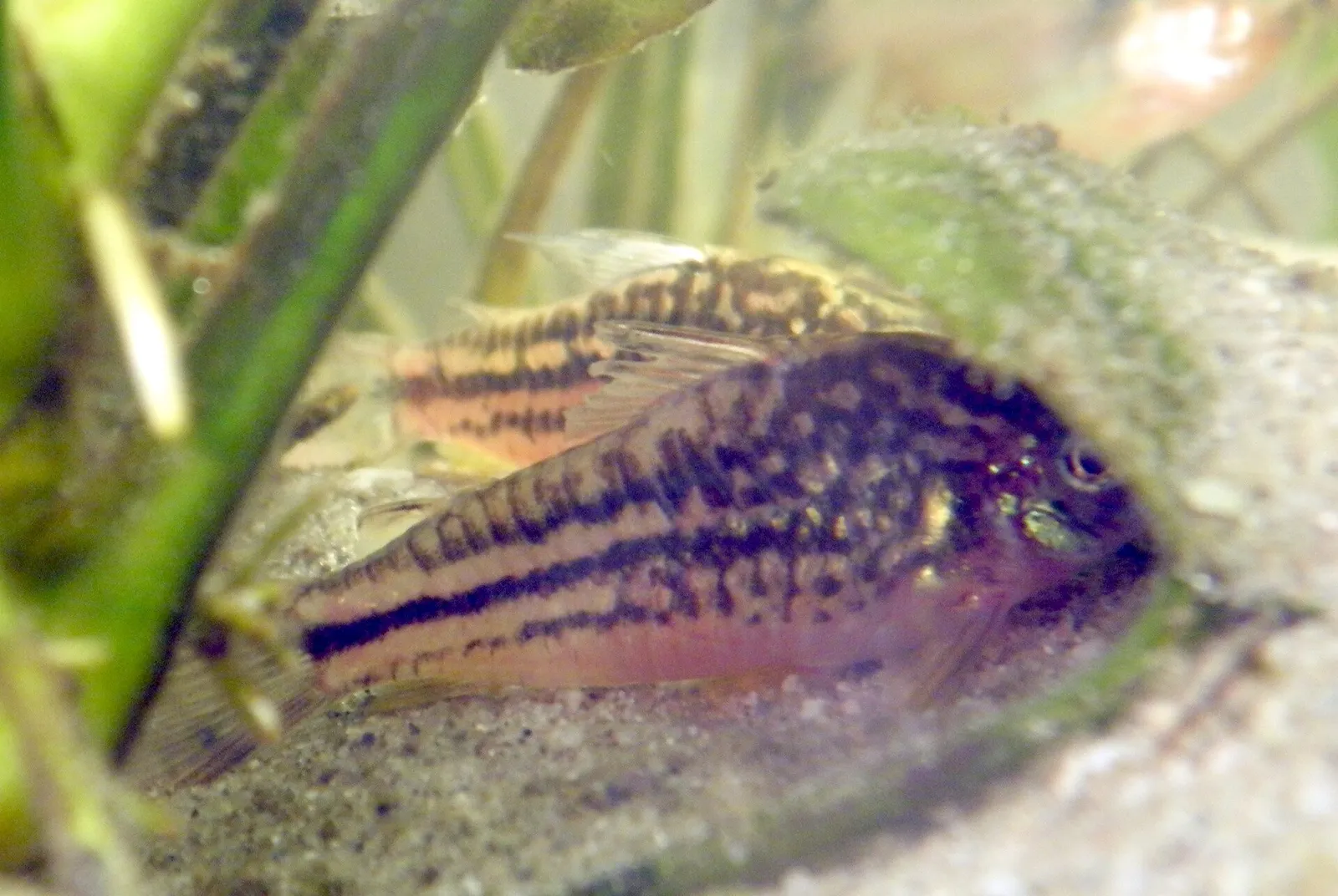
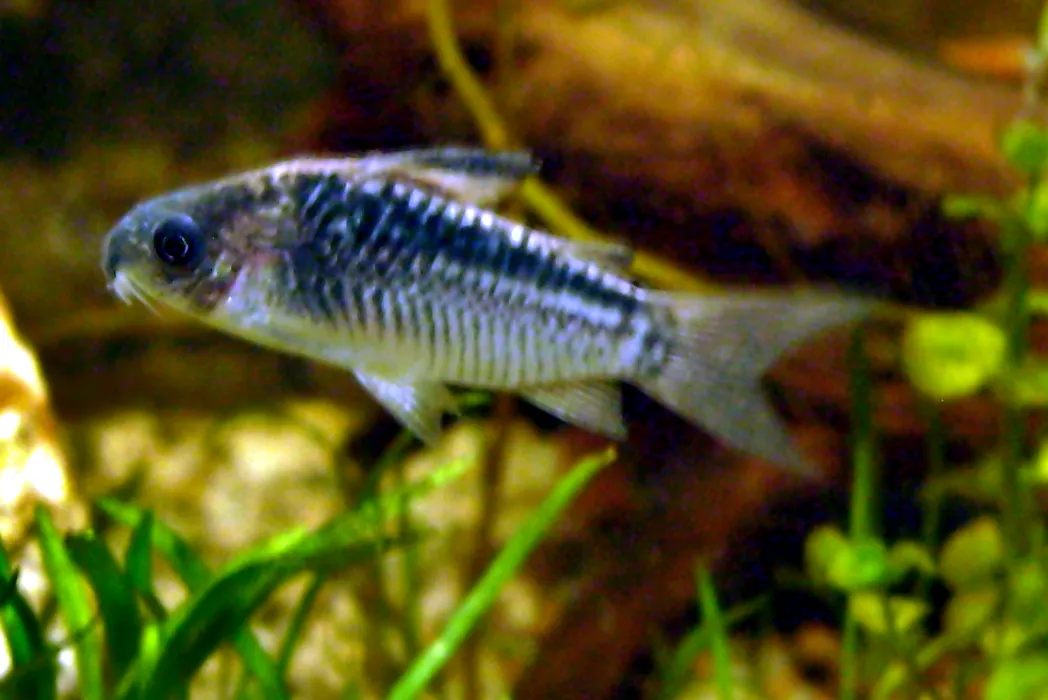
The colour is the species' calling card and the reason for its name. The ground is a pale greenish-grey overlaid with fine dark reticulation and speckling; crucially, the sexes differ. Males are more heavily and intricately marked — denser dark speckling and reticulation, especially toward the head and on the dorsal fin — while females carry fewer, weaker markings concentrated more on the fins. This genuine sexual dichromatism is unusual among corys, and it sharpens further when the fish are in spawning condition, the males becoming markedly more contrasty and the whole shoal at its most colourful.
Habitat
Corydoras elegans is a western-Amazon fish, distributed across the upper Amazon basin in Peru (the Yavari, Itaya, Nanay, Ampiyacu, Tamaya, Ucayali and other drainages), Ecuador (the Aguarico and Napo) and adjacent Brazil along the rio Solimoes. It lives in forested lowland streams and the margins of slow rivers, over substrates of sand and mud strewn with leaf litter and fallen branches — the tannin-stained, shaded blackwater and clearwater of the flooded forest.
These are warm, soft, gently acidic to near-neutral waters: temperatures of roughly 22-26 C, a pH band around 6.0-7.5 (FishBase extends the captive tolerance to about 8.0), and soft to moderately hard water. Like other corys it is a facultative air-breather, darting to the surface to gulp air and absorb oxygen through a vascularised hindgut, which lets it cope with the warm, oxygen-poor pools of the forest floor. What sets it apart behaviourally is that it is far less bottom-bound than most corys, spending much of its time hovering and swimming up in the water column.
Feeding
The elegant cory is a foraging benthic omnivore. In the wild it works leaf litter and soft substrate for small invertebrates, insect larvae, micro-crustaceans, worms and the organic detritus of the forest floor, sifting fine sand through its gills as it tastes out food with its barbels. Because it ranges higher into the water than most corys, it also takes drifting and suspended food more readily. In the aquarium it accepts sinking dried foods — granules, wafers and tablets — alongside small live and frozen items such as bloodworm, Daphnia and brine shrimp. A varied diet keeps it in condition; it should never be left to subsist on what tankmates drop.
Mating
Like other corys, Corydoras elegans is an egg-laying shoaler with no pair bond and the family's characteristic 'T-position' courtship. When a female ripens she cleans a site, the group becomes active and a male aligns himself at right angles to her head, in the classic T; she appears to take his milt and clasps a small batch of eggs in a basket formed by her pelvic fins, carrying them to the cleaned surface. The sequence repeats a few eggs at a time. In this species the males' stronger markings flush brightest during these bouts, and the mid-water activity of the shoal makes the courtship conspicuous. Eggs are deposited on plant leaves, wood and the aquarium glass.
Breeding
Corydoras elegans is bred in the hobby, though it is a little less automatic than the bronze cory. A productive group skews toward more males than females — roughly two males to a female is a common recommendation, which also suits the male-driven courtship. Spawning is triggered as in other corys by a large, cooler water change (on the order of 50-70 percent) that mimics the rainy season, paired with brisk oxygenation. The adhesive eggs are scattered on glass and vegetation and receive no parental care; adults will eat them, so the breeder removes either the eggs or the parents. Eggs hatch in about three to four days, and the fry, once the yolk is absorbed, take microworm and newly hatched brine shrimp before moving on to crushed dried foods. They grow steadily if kept clean and well fed.
In the aquarium
This is a rewarding small cory with one defining quirk: it is among the most active and mid-water of the genus, so a group spends far more time swimming and hovering than a typical bottom-grubbing cory. It is a shoaling fish and is stressed in ones and twos — keep six or more, and they reward you with constant, confident, open-water activity. A footprint of around 23.5 in and 20 US gal or more suits a group; bottom area and swimming room both matter.
Substrate still matters even in an active species: provide soft sand or very smooth, rounded fine gravel, because corys feed by sifting and sharp or coarse grit erodes and infects their barbels, leaving the blunted faces that betray poor husbandry. Keep the bottom clean. Water should be warm but not hot (about 22-26 C), soft to moderately hard, gently acidic to neutral, well-filtered and well-oxygenated with a little flow; the species appreciates the tannin-stained, shaded conditions of its home streams. It is utterly peaceful and an ideal companion for tetras, pencilfish, rasboras, dwarf cichlids and other calm community fish. Two standard cory cautions apply: the fin spines can snag in a net (a cup is safer), and a badly stressed cory can release a skin toxin that, in the small volume of a bag or bucket, may kill a whole group, so transport them carefully.
Conservation
Corydoras elegans is assessed by the IUCN as Least Concern (assessed 2020). It is widely distributed across the upper Amazon, occupies a common and adaptable forested-stream habitat, and faces no known species-wide threat; much of the fish in trade is captive-bred or sustainably collected. None of that exempts the western Amazon from the broad pressures of deforestation, agricultural run-off, mining and pollution that degrade the shallow forest streams it favours, but as a species it is in no danger. As with much of this group, the more interesting wrinkle is taxonomic: 'C. elegans' has long been an umbrella for similar small forms, and as the elegans group is resolved into the resurrected Gastrodermus some narrowly distributed populations may need assessing on their own terms.