Taxonomy & naming
The two-saddle cory was described by the Dutch ichthyologist Han Nijssen in 1971, in the journal Beaufortia, on the basis of material from the Río Vilcanota system at Cuzco, in the southern Peruvian Andes — still the type locality. It was placed in Corydoras Lacépède, 1803, the large genus of South American armoured catfishes (family Callichthyidae, subfamily Corydoradinae) that has long held the great majority of the hobby's 'cory cats'. The species honours the American ichthyologist Stanley H. Weitzman (1927–2017), a long-serving curator of fishes at the Smithsonian.
For more than 150 years Corydoras grew into an unwieldy assemblage of well over 170 species, and molecular work eventually showed it was not a single natural lineage. In 2024 Dias, Tencatt and colleagues published a large phylogenetic revision (Zoological Journal of the Linnean Society, zlae053) that split the old genus into several genera — among them Brochis, Hoplisoma, Gastrodermus and Osteogaster. Under that scheme the two-saddle cory becomes Hoplisoma weitzmani, and Eschmeyer's Catalog of Fishes now lists it as valid in Hoplisoma. The combination is recent and not yet universal: the aquarium trade still overwhelmingly says 'Corydoras weitzmani', so we keep that as our heading while recording the new name. A historical footnote runs alongside the taxonomy — for decades C. weitzmani was conflated in the hobby with the superficially similar Colombian C. simulatus, and many fish sold under one name were in fact the other, a confusion only resolved once living Peruvian weitzmani reached aquarists in numbers.
Morphology
This is a small, deep-bodied cory reaching roughly 2 in standard length (around 2.5 in in total length); females grow larger and noticeably broader than males, a difference best seen from above. Like all corys it is armoured rather than scaled: two rows of overlapping bony plates (scutes) run down each flank and meet in a ridge along the back, and the head is a hard, blunt helmet. Three pairs of short sensory barbels fringe the downturned mouth, the tools it uses to taste and sift the substrate.
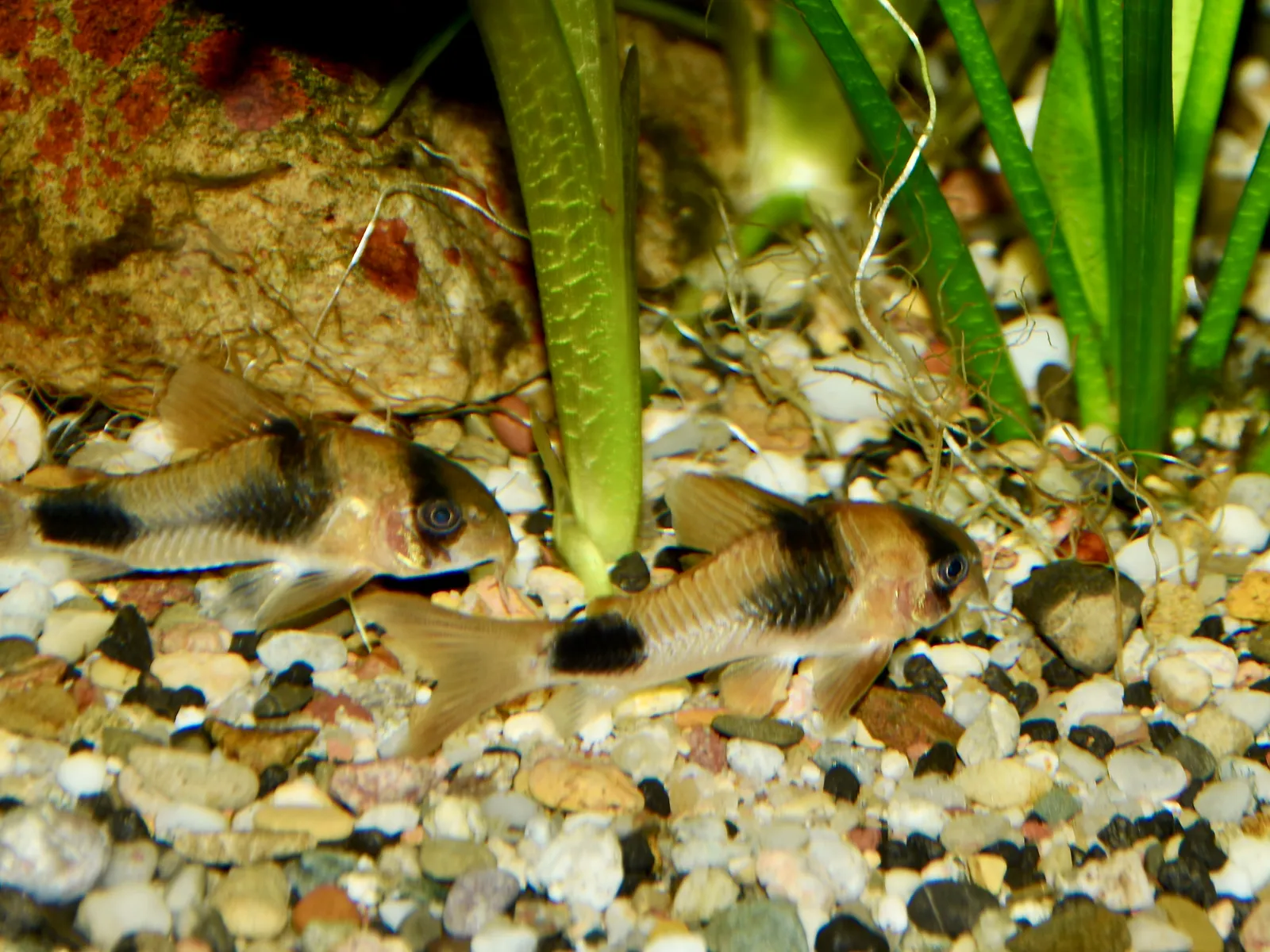
What sets weitzmani apart is its pattern, and it is a striking one. The body is high-backed and pale — a clean silvery to faintly golden ground — crossed by two bold dark 'saddles' that give the fish its English name: the first a broad blotch over the nape and shoulder running down through the eye as a mask, the second a large patch beneath and behind the dorsal fin. Between and below the saddles the flank is finely speckled. The dorsal fin carries a dark blotch at its base and leading edge, and the whole effect is high-contrast and unmistakable. As in all corys, the dorsal, pectoral and adipose fins each bear a stiff, mildly venomous spine — a defence that can jab a careless hand and snag in a net. Unlike many popular corys this species is essentially only seen as the wild form; no fixed albino or long-finned strains dominate the trade.
Habitat
Corydoras weitzmani is a fish of the upper Madeira drainage on the eastern, Andean flank of the Amazon basin. The type series came from the Río Vilcanota system at Cuzco, high in southern Peru, and the populations exported for the hobby come from the Río Madre de Dios drainage downstream — clear, cool, fast-flowing piedmont streams and their quieter margins, running over sand and gravel with leaf litter and submerged wood. This is montane and foothill water rather than steamy lowland Amazon, and that origin matters: weitzmani comes from cooler, well-oxygenated streams than most tropical corys.
Reported parameters span a broad but distinctly cool-leaning envelope — temperatures of roughly 72–79 °F, a pH band from about 6.0 to 8.0, and soft to moderately hard water (around 2–25 dH). The species tolerates the warm end poorly and does best kept cooler than the community-tank default. Like other corys it is a facultative air-breather, periodically darting to the surface to gulp air and absorb oxygen through a modified, vascularised hindgut — an adaptation for the warm, low-oxygen pools that can form as dry-season flows shrink.
Feeding
The two-saddle cory is a benthic omnivore. In its home streams it works the bottom continuously, burying its snout and barbels in sand and fine gravel to taste out small invertebrates, insect larvae, worms, crustaceans and the organic film of detritus, expelling cleaned substrate through the gills as it sifts. It is an opportunist rather than a specialist. In the aquarium it readily takes sinking tablets, granules and larger flakes that reach the bottom, and it relishes live or frozen foods — bloodworm, white worm, grindal worm, Daphnia and Tubifex — which are also the standard conditioning diet for bringing a group into spawning trim. As with all corys it should never be left to scavenge only what tankmates drop; it needs food deliberately delivered to the substrate.
Mating
Corydoras are egg-laying shoalers with no pair bond and a distinctive, well-studied courtship, and weitzmani follows the family script. When a female is ready the group becomes active and she cleans a site — a leaf, a stone, a pad of plants or the aquarium glass. A male then positions himself at right angles to her head in the classic 'T-position', and she appears to take his milt; sperm is thought to pass rapidly through her gut to fertilise the few eggs she clasps in a basket formed by her pelvic fins. She carries that small clutch to the cleaned surface and presses the sticky eggs into place. The sequence repeats, a handful of eggs at a time, until the chosen surfaces are dotted with them.
Breeding
Long one of the most sought-after corys, weitzmani is now bred in the hobby with some regularity, though it is more demanding than the beginner's bronze cory. Spawning is typically triggered by a large, cool water change that mimics the arrival of meltwater and rains in its montane home, dropping the temperature several degrees into the high teens or low twenties Celsius — this species responds to cool water where many corys want warmth. A conditioned group skewed toward more males than females is the usual recipe. The adhesive eggs — laid in small batches, with clutches commonly on the order of dozens up to roughly a hundred or more — receive no parental care, and the adults will eat them, so breeders move either the eggs or the parents. Eggs hatch in a few days; once the yolk sac is absorbed the fry take microworm, baby brine shrimp and powdered foods and grow steadily. Captive breeding is exactly what released this species from its 'unobtainable' reputation and now supplies much of the trade alongside wild imports.
In the aquarium
Once almost impossible to find, weitzmani is now an attainable but still prized aquarium fish, and a rewarding one for a keeper who respects its origins. First, it is a shoaling species and is genuinely stressed kept alone or in pairs — keep six or more, and a group rewards you with constant, confident foraging. A group is comfortable in a tank of around 23.5 in / 20 US gal or more; bottom area and footprint matter far more than height.
Second, and unusually for a 'tropical' fish, temperature is the make-or-break variable. This is a cool-water cory from Andean piedmont streams: keep it on the cool side, roughly 72–75 °F, and avoid the warm, plant-tank temperatures that suit lowland species — sustained heat stresses it and shortens its life. Provide soft sand or very smooth, rounded fine gravel, because corys feed by sifting and sharp or coarse substrate erodes and infects their barbels, leaving the blunted faces that betray poor husbandry. Keep the bottom clean, the water well-oxygenated and well-filtered with a gentle current, and change it regularly. The fish is utterly peaceful and makes an ideal companion for tetras, rasboras, dwarf cichlids and other calm community fish that share its preference for cooler water — never anything large enough to bully it. Two standing cautions apply to all corys: the fin spines catch in nets (a cup is safer), and a badly stressed cory can release a skin toxin that, in the small volume of a bag or bucket, can kill the whole group, so transport them with care.
Conservation
Corydoras weitzmani has not been formally assessed by the IUCN Red List; its status there is Not Evaluated. That gap is worth noting because the species is far more narrowly distributed than the cosmopolitan corys of the trade — it is tied to a particular set of cool piedmont drainages on the Andean flank of the upper Madeira system, and a restricted, montane range is exactly the kind of distribution that can carry conservation risk. The Andean foothill streams it favours are subject to the broad pressures on the region's freshwaters: deforestation, agriculture, road-building, alluvial gold mining and the sedimentation and pollution that come with them. Against that, the growth of captive breeding has reduced the hobby's reliance on wild-caught fish, easing collection pressure on a species that was once dug out of the wild precisely because it was so prized. A proper Red List assessment would be the sensible next step for a fish with this kind of limited range.