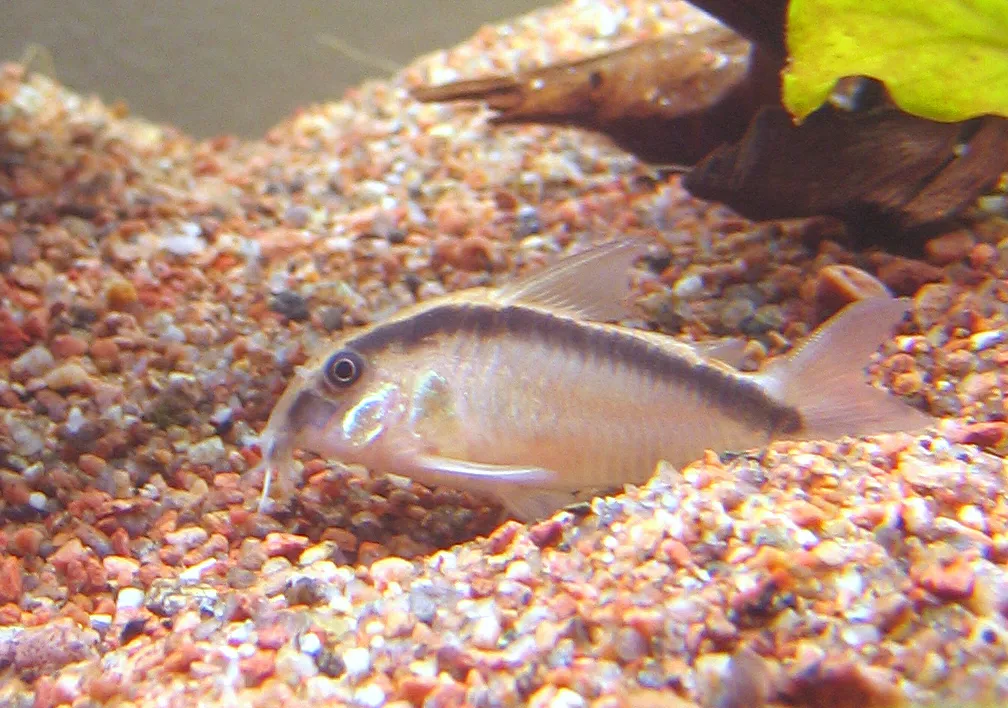
Taxonomy & naming
The skunk cory was described by Margery Elwin in 1938 (in the issue of the Annals and Magazine of Natural History dated January 1939) from aquarium imports that reached England via Germany, with one specimen said to originate at Tefé (Teffé) on the Amazon in Brazil — still cited as the type locality. It was placed in Corydoras Lacépède, 1803, the vast genus of South American armoured catfishes (family Callichthyidae).
What followed is one of the hobby's great taxonomic detective stories. For roughly seventy-five years the fish everyone bred, sold and photographed as 'C. arcuatus' matched the picture in Elwin's paper — but that picture was of a live aquarium specimen, not the preserved holotype lodged in London's Natural History Museum. Work by Steven Grant, and then the 2019 paper by Tencatt, Lima and Britto ('Deconstructing an octogenarian misconception...', Journal of Fish Biology), showed that the holotype is a different, round-snouted fish: the familiar hobby 'skunk cory' is actually Corydoras granti Tencatt & Britto, 2020, while the true arcuatus is a less commonly imported species. So the name on the tank label and the name in the catalogue do not always point to the same animal — a caveat worth keeping in mind for any 'arcuatus' in trade.
The genus itself was overgrown — well over 170 species and demonstrably not a single natural lineage. In 2024 Dias, Tencatt and colleagues published a large phylogenomic revision (Zoological Journal of the Linnean Society 203(3); DOI 10.1093/zoolinnean/zlae053) that split Corydoras into several genera, resurrecting Brochis, Hoplisoma, Gastrodermus and Osteogaster among them. Under that scheme arcuatus becomes Brochis arcuatus, and the Eschmeyer Catalog of Fishes and FishBase now list it under Brochis. The combination is recent and not yet universal, and the trade still says 'Corydoras arcuatus,' so we keep that heading while recording the new placement.
Morphology
This is a small, streamlined cory — more elongate and torpedo-shaped than the deep-bodied bronze cory — reaching roughly 2 in in standard length; females grow a little larger and rounder than males. Like all members of the family it is armoured rather than scaled, with two rows of overlapping bony plates (scutes) along each flank meeting in a ridge over the back, a hard helmeted head, and three pairs of barbels fringing the downturned mouth for tasting and sifting the substrate.
The body is a pale pinkish to greyish ground colour, and the defining feature is a single clean black stripe that runs the length of the upper body in a smooth arc — beginning on the snout, passing through the eye, sweeping up over the nape and along the dorsal ridge, then dipping down toward the lower edge of the caudal fin. That through-the-eye, onto-the-snout course is the field mark that separates the true arched corys from look-alikes whose stripe stops behind the eye. The dorsal, pectoral and adipose fins each bear a stiff, mildly venomous spine, the family's standard defence. The species sits within the narcissus-group of arched-patterned corys, a cluster that also includes the larger long-snouted C. narcissus and the round-snouted C. urucu.
Habitat
Corydoras arcuatus is a fish of the upper (western) Amazon basin, recorded from the Solimões and its tributaries across Brazil, Peru, Ecuador and Colombia, with the historic export hub of Tabatinga/Leticia on the Brazil–Colombia border giving it the old trade name 'Tabatinga catfish.' Distribution statements for it are inevitably blurred by the long-running confusion with C. granti, but the genuine species is an upper-Amazon blackwater and clearwater stream fish.
These are warm, soft, often tannin-stained waters over fine sand and leaf litter, shaded by forest and marginal vegetation. Reported tolerances span roughly 72–79 °F, a pH band from acidic to neutral or slightly alkaline (about 5.0–7.5, FishBase citing 6.0–8.0 at the broad end) and soft to moderately hard water. Like other corys it is a facultative air-breather, darting to the surface to gulp air and absorb oxygen through a vascularised hindgut — an adaptation for the warm, oxygen-poor margins and shrinking dry-season pools it inhabits.
Feeding
The skunk cory is a benthic foraging omnivore. In the wild it works soft substrate continuously, burying its snout and barbels to taste out small invertebrates, insect larvae, worms, micro-crustaceans, fallen seeds and the organic film of detritus, expelling cleaned sand through the gills as it goes. It is an opportunist, not a specialist, and that catholic appetite underpins its hardiness. In the aquarium it readily takes sinking dried foods, frozen and live bloodworm, Tubifex and similar small fare; it should never be left to scavenge tankmates' leftovers, a common and slow way to starve a group of corys.
Mating
Corydoras are egg-laying shoalers with no pair bond and the genus's distinctive courtship. When a female is ready she cleans a site — a leaf, a stone, the aquarium glass — and the group grows active; a male positions himself at right angles to her head in the classic 'T-position,' and she appears to take his milt into her mouth. Sperm is thought to pass rapidly through her gut to fertilise the few eggs she clasps in a basket formed by her pelvic fins, which she then carries to the cleaned surface and presses into place. The sequence repeats, a few eggs at a time, until the chosen surfaces carry the clutch.
Breeding
The skunk cory is bred in the hobby, though less prolifically and predictably than the bronze or peppered corys. Spawning is typically triggered by a large, cool water change that mimics rainy-season conditions, dropping the temperature several degrees, with conditioning on live and frozen foods beforehand and a group skewed toward more males than females. The adhesive eggs are scattered in small batches across leaves, glass and plants; the adults give no parental care and will eat the eggs, so breeders move either the eggs or the parents. Eggs hatch in about three to four days depending on temperature, and the fry — after absorbing the yolk sac — take microworm, baby brine shrimp and powdered foods, demanding clean, well-oxygenated water to thrive.
In the aquarium
This is a rewarding community catfish with the usual cory requirements, plus a couple of its own. First, it is a shoaling species and is genuinely stressed kept alone or in pairs — keep six or more and they reward you with confident, constant activity; a group is comfortable in a tank of around 23.5 in / 20 US gal or more, where bottom area matters more than height.
Second, substrate is functional, not decorative. Provide soft sand or very smooth, rounded fine gravel kept scrupulously clean: corys feed by sifting, and sharp or dirty substrate erodes and infects their barbels, leaving the stubby, blunted faces that are a tell-tale of poor husbandry. The skunk cory likes its water on the cooler, softer, slightly acidic side of the cory envelope — well-filtered, well-oxygenated, with gentle current and regular changes — and a planted, shaded, wood-strewn layout suits its blackwater origins. It is utterly peaceful and pairs well with tetras, rasboras, pencilfish, dwarf cichlids and other calm community fish, never with anything large enough to bully it. Two standing cautions for all corys apply: the fin spines snag in nets (use a cup), and a badly stressed fish can release a skin toxin that, in the confined volume of a bag or bucket, can kill the whole group — so transport them with care.
Conservation
Corydoras arcuatus has not been formally assessed on the IUCN Red List (Not Evaluated). It is a widely distributed upper-Amazon species and the aquarium supply is increasingly captive-bred, so collection pressure on wild stocks is modest, but no Red List determination of its status exists. The broad pressures on western Amazonian freshwaters — deforestation, agricultural run-off, mining and pollution — degrade the shaded forest streams it favours, and the long-standing taxonomic tangle with C. granti means even basic range and population data for the true species are imperfect. Resolving exactly which fish is which is, in this case, a genuine prerequisite to assessing it at all.