Taxonomy & naming
Corydoras cruziensis was described by Joachim Knaack in 2002 in the German aquarium-society journal VDA-aktuell, from material taken at Guarayos in the Santa Cruz Department of Bolivia — the type locality, fixed by coordinates at roughly 16°20'S, 62°51'W and about 705 ft elevation. The species epithet is geographic, formed from Santa Cruz, the Bolivian department and region where the type series was collected, with the Latinising suffix -ensis ('belonging to'). Before that formal description it had circulated among cory enthusiasts under the collection code C012.
The fish was placed, as nearly all corys are, in the vast genus Corydoras Lacépède, 1803 (family Callichthyidae). That genus had swollen to over 170 species and proved not to be a single natural lineage, and in 2024 Dias, Tencatt and colleagues published a phylogenomic revision (Zoological Journal of the Linnean Society, zlae053) that split it into several genera. Under that scheme the Santa Cruz cory belongs to the resurrected genus Hoplisoma, as Hoplisoma cruziense — and FishBase has already adopted that combination. The hobby still overwhelmingly says 'Corydoras cruziensis,' so we keep that as the heading while noting the current placement.
Morphology
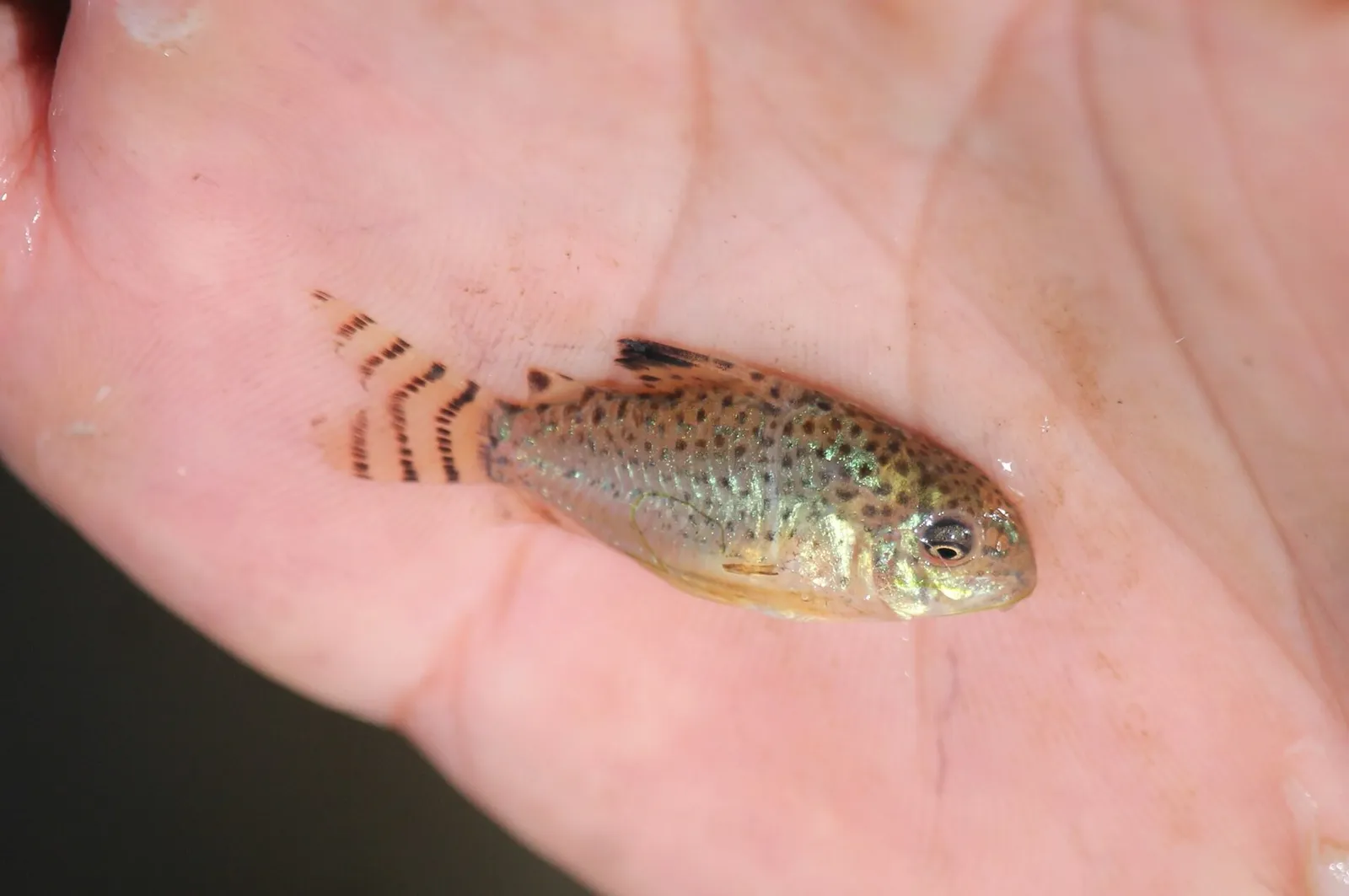
This is a small, short-snouted cory, reaching about 1.5 in in standard length — so a little over 1.5 in in the body, a touch more including the tail. It has the typical Corydoras build: a deep, laterally compressed body sheathed not in scales but in two overlapping rows of bony plates (scutes) running down each flank, a blunt helmeted head, a downturned mouth fringed with three pairs of barbels, and stiff leading spines in the dorsal and pectoral fins.
The colour is unshowy — a pale to greyish-tan ground with darker mottling and a scatter of fine spotting, the sort of cryptic pattern that makes many short-snouted corys from the western Amazon hard to tell apart on looks alone. As in the rest of the genus, the surest external difference is between the sexes rather than between close species: mature females are larger and noticeably broader and higher-bodied, a difference best judged looking down from above.
Habitat
Corydoras cruziensis is a fish of the Bolivian upper Madeira system, the great south-western tributary network of the Amazon. The type locality sits in the lowlands of Santa Cruz Department, and the species appears tied to the Madeira drainage there, with the Mamoré and Beni tributary systems within plausible reach; its precise range is not well documented.
Like most small corys it lives in the quieter, shallower water — stream margins, pools and slow reaches over soft sand or fine sediment, where leaf litter and submerged wood collect. These are warm tropical waters; aquarium guidance places it comfortably around 73–78 °F with a soft, near-neutral to slightly acidic chemistry (about pH 6.0–7.2). As with all members of the family it is a facultative air-breather, periodically darting to the surface to gulp air that it absorbs through a vascularised hindgut, an adaptation for the warm, oxygen-poor shallows these fish favour.
Feeding
The Santa Cruz cory is a benthic omnivore and forager, working the bottom with its barbels to taste out small invertebrates, worms, insect larvae and organic detritus in and on the substrate. It is an opportunist rather than a specialist feeder, which is part of why corys as a group are so adaptable. In the aquarium it readily takes sinking prepared foods — tablets, granules and larger flakes that reach the bottom — along with live or frozen bloodworm, whiteworm, grindal worm, Daphnia and Tubifex, the last especially useful for conditioning a group before spawning. It should never be left to subsist only on what tankmates drop.
Mating
No spawning of Corydoras cruziensis has been formally documented, but there is no reason to expect it to differ from the well-studied Corydoras pattern. These are egg-laying shoalers with no pair bond. When a female is ready, the group becomes active and a male takes up the characteristic 'T-position', placing himself at right angles to her head; she is thought to take his milt, which passes rapidly through her gut to fertilise the few eggs she holds in a basket formed by her clasped pelvic fins. She then carries those eggs to a cleaned surface — a leaf, stone or the glass — and presses them into place, the sequence repeating a few eggs at a time.
Breeding
There is no published breeding report for Corydoras cruziensis, and as an uncommon import it has not been worked over by hobby breeders the way the common corys have. By analogy with its many relatives, spawning would be expected to follow a cool, large water change that mimics the onset of the rainy season, with a group skewed to more males than females. The adhesive eggs would be laid in small batches across firm surfaces and receive no parental care — adults of the genus routinely eat their own eggs — so a breeder would remove either eggs or parents. Eggs of comparable corys hatch in roughly three to five days, and the fry, once the yolk is absorbed, take microworm, baby brine shrimp and powdered foods. None of this is confirmed for this species specifically and should be treated as informed expectation rather than record.
In the aquarium
Corydoras cruziensis is a peaceful, shoaling community fish that should be kept in a group of six or more; like all corys it is genuinely stressed when kept singly or in pairs. Substrate matters more than almost anything else: soft sand is close to mandatory, with rounded, smooth fine gravel an imperfect substitute. Sharp or chipped gravel erodes and infects the barbels the fish uses to feed, leaving the stubby, blunted faces that betray poor husbandry. Border the open feeding area with driftwood and plants, and provide shade from bogwood, rockwork or floating plants to settle the group.
Water should be warm but not hot — around 73–78 °F — soft and slightly acidic to neutral, well filtered and well oxygenated, with regular partial changes. It mixes happily with small, calm tankmates such as tetras, rasboras, pencilfish and dwarf cichlids, and should never be housed with anything large enough to bully it. As with all corys, two practical cautions: the fin spines can snag in a net, so a cup is safer, and a badly stressed cory can release a skin toxin that, in the small volume of a bag or bucket, can kill the whole group — so transport with care. This remains an uncommon, somewhat specialist import rather than a shop staple.
Conservation
The IUCN Red List assessed Corydoras cruziensis as Data Deficient, meaning there is not enough information on its range, population or threats to judge its conservation status. That is a common verdict for narrowly known western-Amazon corys described from a single area. The Bolivian lowland waters it inhabits are subject to the broad pressures on the region — deforestation, agricultural expansion, sedimentation and pollution — but no species-specific threat has been documented, and equally no evidence that it is secure. Because it is an uncommon fish in the trade rather than a mass-bred staple, anything sold is likely wild-collected, which makes a clearer picture of its true distribution all the more worth having.