Taxonomy & naming
The leopard cory was described in 1933 by the influential American ichthyologist George S. Myers, and placed in Corydoras Lacépède, 1803 — the enormous genus of South American armoured catfishes in which it has remained throughout its time in the hobby and the literature. The epithet leopardus is straightforwardly descriptive, from the Latin for 'leopard,' invoking the pattern of discrete dark spots that pepper the fish's flank and head.
With well over 170 species, Corydoras had long been understood as a non-monophyletic catch-all. The 2024 phylogenetic revision by Dias, Tencatt and colleagues split it into several genera — Brochis, Hoplisoma, Gastrodermus, Osteogaster and others — and under that classification the leopard cory falls within the resurrected, broadened genus Brochis, which gathers a number of the longer-snouted lineages. The Catalog of Fishes and FishBase now list the valid combination as Brochis leopardus. Because the change is recent and aquarium usage still says 'Corydoras leopardus,' we keep that heading while recording the current placement honestly. (Hobbyists should also note the long-running confusion between this species and the similarly long-snouted, spotted C. trilineatus and 'julii'-group corys, which are frequently mislabelled for one another in the trade.)
Morphology
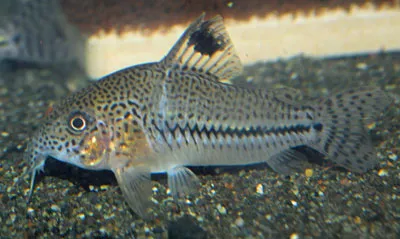
The leopard cory reaches about 2.5 in in standard length and has the comparatively elongate body and pointed, somewhat extended snout of the long-nosed corys, rather than the blunt-faced profile of the bronze-cory group. It is armoured in the family manner: two rows of overlapping bony scutes sheathe each flank and meet along the back, the head is bony-plated, and three pairs of barbels fringe the small ventral mouth.
The colour pattern is the species' signature and the source of its name: a pale, often faintly golden ground scattered with numerous small, rounded dark spots over the body and head, frequently with a darker band or saddle across the nape and a spotted, banded tail. The dorsal and pectoral fins each carry a stiff leading spine, the standard cory defence, which can jab a careless hand and snag in a net. As in the genus generally, mature females tend to be larger and noticeably rounder in the body than males, especially when carrying eggs.
Habitat
Corydoras leopardus is recorded from the western Amazon River basin, in the upper-Amazon drainages of the South American interior. There it lives as a typical cory of quieter water — the shallow, sandy margins of streams, side channels and slow river reaches, over soft substrates strewn with leaf litter and submerged wood.
FishBase characterises its requirements in genus-typical terms: a tropical freshwater, demersal species tolerant of a pH band from about 6.0 to 8.0, soft to moderately hard water, and temperatures of roughly 72–77 °F. Like all callichthyids it is a facultative air-breather, periodically rising to the surface to gulp air and absorb oxygen through a vascularised, modified hindgut — the adaptation that lets corys endure the warm, oxygen-poor shallows and seasonal pools of the Amazon lowlands.
Feeding
The leopard cory is a benthic omnivore and detritivore. It forages continuously over the bottom, driving its snout and barbels into sand and litter to taste out small invertebrates, insect larvae, worms, micro-crustaceans, fallen seeds and the organic detritus film, sieving the cleaned sand out through its gill openings. FishBase places it at a trophic level near 2.9, marking it as a small, opportunistic invertebrate-and-detritus feeder. In the aquarium it readily accepts sinking pellets, frozen bloodworm and brine shrimp, and whatever its tankmates let fall, but it should never be left to live on leftovers alone.
Mating
As an egg-laying cory, the leopard cory is expected to follow the genus's well-studied courtship, even though a detailed account specific to this species is not prominent in the literature. These are shoaling spawners with no pair bond. A ripe female cleans a spawning site, and a male takes the characteristic 'T-position,' aligning at right angles to her head; she appears to take milt directly, the sperm passing rapidly through her gut to fertilise the few eggs she holds in a pelvic-fin basket. She then carries that small batch to the cleaned surface and presses the adhesive eggs into place, the sequence repeating a few eggs at a time until the clutch is complete.
Breeding
The leopard cory has been bred in aquaria, though far less routinely than the bronze and peppered corys, and is generally considered a moderately challenging spawner. In the genus, reproduction is typically triggered by a cool, large water change mimicking the rainy season's arrival, with a group skewed towards more males than females. The adhesive eggs are deposited in small batches on plants, wood and glass, receive no parental care — the adults will eat them, so breeders remove the eggs or the parents — and hatch within a few days. The fry, after absorbing the yolk, take microworm, baby brine shrimp and powdered foods. Precise clutch figures for this species are not well documented, so none are asserted here.
In the aquarium
The leopard cory is a rewarding, good-looking aquarium fish whose needs are those of the genus. It is a shoaling species and is genuinely stressed kept alone or in pairs — keep six or more, and the group rewards you with constant, confident foraging. Provide a soft sand substrate: corys feed by sifting, and coarse or sharp gravel abrades and infects their barbels, producing the stubby, eroded faces that signal poor husbandry.
A group is comfortable in a tank of around 23.5–29.5 in with ample floor area, clean and well-oxygenated water, gentle filtration with some current, regular water changes, and moderate temperatures around 72–77 °F. It is utterly peaceful and an ideal companion for tetras, rasboras, dwarf cichlids and other calm community fish, never with anything large enough to bully it. Two standard cory cautions: the fin spines catch in nets (use a cup), and a badly stressed cory can release a skin toxin that, in the small volume of a bag or bucket, can wipe out the whole group, so transport it carefully.
Conservation
The IUCN Red List assesses Corydoras leopardus as Least Concern (assessed 2020). It is a widely distributed western-Amazon species, traded commercially as an aquarium fish, and no species-specific threat has been identified. Like all Amazonian freshwater fishes it is exposed to the broad regional pressures of deforestation, agricultural and mining run-off, damming and pollution that degrade shallow marginal habitats, but as a species it is currently in no danger. A persistent footnote is taxonomic rather than ecological: because long-snouted spotted corys are routinely confused in the trade, some fish sold as 'leopardus' are other species, which muddies both hobby records and any fine-grained sense of its true commercial range.