Taxonomy & naming
Corydoras virginiae was described in 1993 by the American aquarist-ichthyologist Warren E. Burgess, in the hobby journal Tropical Fish Hobbyist, in a paper naming three new corys (Tropical Fish Hobbyist v. 41, no. 12). The type material came from the Río Ucayali drainage of Peru, to which the species is considered endemic. The epithet honours Virginia Schwartz, wife of the Peruvian ornamental-fish exporter Adolfo Schwartz, whose operation supplied the collection — hence the genitive 'virginiae', 'of Virginia'. It belongs to the family Callichthyidae, subfamily Corydoradinae, and for three decades carried the combination Corydoras virginiae.
The sprawling genus Corydoras — well over 170 species — proved not to be a single natural lineage, and in 2024 Dias, Tencatt and colleagues published a phylogeny and revised classification of the Corydoradinae (DOI 10.1093/zoolinnean/zlae053) that split it into several genera, including Brochis, Hoplisoma, Gastrodermus and Osteogaster. Under that revision the Miguelito cory becomes Brochis virginiae, the combination now carried by FishBase and Eschmeyer's Catalog of Fishes. Because the change is recent and not yet adopted in the trade, we keep 'Corydoras' as the display heading while recording the current combination honestly. The species circulates under several common and trade names — 'Miguelito', 'Sangama' (sometimes 'Zangama') and 'Virginia's catfish' — which can cause confusion on import lists.
Morphology
This is a medium-small cory, reaching roughly 2 in standard length (about 2–2.5 in total), with females growing the larger and broader. The body plan is standard Corydoras: a blunt, short-snouted helmet of a head, a downturned mouth fringed by three pairs of barbels, two overlapping rows of bony scutes down each flank, and stiff leading spines in the dorsal, pectoral and adipose fins.
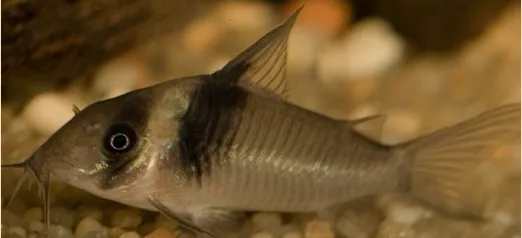
What sets virginiae apart is its colour. The ground is a pale tan to greyish cream, overlaid with a fine dark reticulation or mottling that can coalesce into dark swathes on the upper flank running up into the base of the dorsal fin, and broken by a dark bar or mask through the eye. Over the head and shoulder region many specimens carry a distinctive warm orange-to-coppery flush that intensifies when the fish is settled and well-fed — the feature that makes the Miguelito a sought-after community cory. Pattern intensity varies between individuals and populations, which is part of why the fish travels under several names.
Habitat
Corydoras virginiae is endemic to the Río Ucayali basin in the Loreto/Ucayali region of eastern Peru — a major western-Amazon headwater system. Reported habitat is the quieter water of the lowland floodplain: inland wetlands, slow tributaries, creeks and seasonally flooded margins associated with the Ucayali, over soft substrates with litter and cover rather than open fast current.
This is warm, soft western-Amazon water. Aquarium sources and FishBase put it in the tropical band of roughly 72–82 °F, with a gently acidic to neutral pH (about 6.0–7.5) and soft to moderately hard water (sources cite figures spanning roughly 36–215 ppp / up to the high teens in °dH). As a callichthyid it is a facultative air-breather, surfacing periodically to gulp air and absorb oxygen through a vascularised hindgut — an adaptation suited to the warm, low-oxygen backwaters it inhabits. Honest note: precise field data for this species are limited, and much of the published water-parameter envelope is derived from aquarium practice and from the general ecology of the Ucayali rather than from detailed study of virginiae itself.
Feeding
The Miguelito cory is a foraging benthic omnivore. In nature it works the soft bottom, using barbels and a sifting mouth to taste out small invertebrates, insect larvae, micro-crustaceans, worms and organic detritus from sand and leaf litter, expelling cleaned substrate through the gills. It is an opportunist. In the aquarium it readily accepts sinking dried foods — pellets and tablets — alongside live and frozen items such as bloodworm and Tubifex, and a varied diet brings out the best of its head colour; it should not be left to survive on the leftovers of tankmates above.
Mating
Like other corys, virginiae is an egg-laying shoaler with no pair bond and the genus's characteristic 'T-position' spawning. A ripe female cleans a site — leaf, stone, stem or glass — and the group becomes active; a male positions himself at right angles to her head to form the T while milt is released, and she clasps a few eggs at a time in a basket of her clamped pelvic fins, carrying them to the cleaned surface and pressing them into place. Sperm is thought to travel rapidly along the female's body (or via the gut) to fertilise the eggs. The cycle repeats, a small clutch at a time, the adults scattering adhesive eggs across several surfaces.
Breeding
Captive spawning of C. virginiae is reported but not routine, and detailed, repeatable accounts are scarcer than for common corys; much of the guidance is extrapolated from the genus. Conditioning a mature group on a rich, varied diet and then applying a cool, large water change to imitate rainy-season inflow is the standard trigger, and a sex ratio skewed toward more males improves the odds. The adhesive eggs are laid in small batches on cleaned surfaces and receive no parental care — the adults will eat them, so breeders remove either the eggs or the parents. Eggs typically hatch in three to five days depending on temperature, and the fry take microworm, baby brine shrimp and powdered foods once the yolk sac is absorbed. Honest note: because the literature on this species is thin, breeders should expect to adapt general cory technique and accept some trial and error.
In the aquarium
The Miguelito is a rewarding but properly social cory, and the cardinal rule is to keep it in a group — five or six at an absolute minimum, more if space allows — since isolated corys are stressed and withdrawn. A shoal wants floor area more than height, and a mature, stable, soft-water tank shows the fish at its best.
Substrate matters: use soft sand or very smooth, rounded fine gravel, because corys feed by sifting and coarse or sharp grit abrades and infects their barbels, producing the blunted faces that betray poor husbandry. Keep the bottom clean. Provide warm water (about 72–82 °F, not tropical-hot), soft to moderately hard and gently acidic to neutral, well-filtered and well-oxygenated with gentle flow, plus cover — wood, leaf litter and planting — and subdued lighting for a fish from shaded floodplain habitat; the good colour and the orange head flush develop in settled, well-fed fish. It is wholly peaceful and suits a calm community of tetras, pencilfish, small rasboras and dwarf cichlids, never anything large enough to harass it. The usual cory cautions apply: the fin spines snag in nets, so use a cup, and a severely stressed cory can release skin toxins that may wipe out a whole group in the small volume of a bag or bucket, so move them with care.
Conservation
Corydoras virginiae is assessed by the IUCN as Least Concern. Although it has a comparatively restricted range — endemic to the Río Ucayali drainage — it is found across that lowland system without an identified species-specific threat at present. As an Amazonian floodplain fish it is exposed to the regional pressures of deforestation, agriculture, pollution and hydrological change that degrade wetland and tributary habitats, and a restricted-range endemic warrants more attention to those pressures than a continent-wide species would. Collection for the aquarium trade is modest, and the limited scientific literature on the species means its status would benefit from updated, targeted assessment.