Taxonomy & naming
The false spotted cory was described by Carl Eigenmann and William Ray Allen in 1942, in their monograph 'Fishes of Western South America', from material collected in the Amazonian lowlands of Peru. They placed it in Corydoras Lacépède, 1803, the vast genus of South American armoured catfishes in the family Callichthyidae, and it has carried the name Corydoras leucomelas in the hobby and the literature ever since.
That genus had become unmanageable — well over 170 nominal species — and molecular work showed it was not a single natural lineage. In June 2024 Dias, Tencatt and colleagues published a large phylogenomic revision of the subfamily Corydoradinae (Zoological Journal of the Linnean Society, DOI 10.1093/zoolinnean/zlae053) that split the old Corydoras into several genera, including Brochis, Hoplisoma, Gastrodermus and Osteogaster. Under that scheme the false spotted cory falls in the resurrected, short-bodied, lineage-9 genus Hoplisoma, and Eschmeyer's Catalog of Fishes now lists the valid combination as Hoplisoma leucomelas (Eigenmann & Allen, 1942). The change is recent and not yet universal, and the trade still says 'Corydoras leucomelas', so we keep that as the heading while recording the new combination. The epithet itself is a frequent source of confusion: leucomelas means 'black-and-white', a fair description of the contrasty fish, but it is repeatedly muddled in shops with the genuinely spotted corys it mimics.
Morphology
This is a small, short-bodied cory, reaching only about 2 in in standard length; females grow a little larger and noticeably rounder than males. Like all members of the genus it is armoured rather than scaled — two rows of overlapping bony plates run down each flank, the head is a hard blunt helmet, and three pairs of barbels fringe the downturned mouth for sifting the substrate.
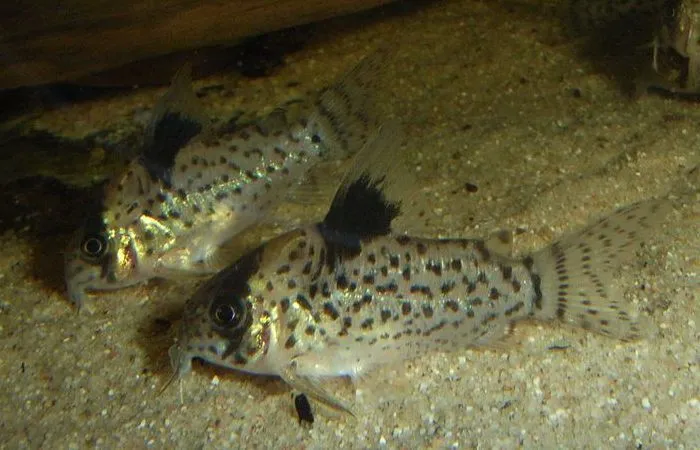
The ground colour is a pale, sandy fawn to greyish-white, finely peppered with small dark speckles that give the fish its 'spotted' look from a distance. Two features set it apart from the true spotted corys it resembles. The first is a bold black blotch occupying much of the dorsal fin, which stands out sharply against the pale body and gives rise to the 'blackfin' trade name. The second is a dark mask: a band of pigment runs through the eye and across the top of the head, breaking up the outline of the face. As in all corys, the dorsal, pectoral and adipose fins each carry a stiff, mildly venomous spine that can jab a careless hand and snag in a net.
Habitat
Corydoras leucomelas is a fish of the western, upper Amazon. The type material came from the Amazonian lowlands of Peru, in the Río Ucayali drainage, and the species is recorded more broadly across the upper Amazon basin, with reports extending into the border waters of Colombia and Ecuador and the adjacent western reaches of Brazil. It lives in quieter water — the shallow, sandy margins of streams and slow rivers, side-channels and pools — over soft sand and mud with leaf litter and submerged wood.
These are warm, soft, often gently acidic to near-neutral waters. Across the range the species sits comfortably in a band of roughly 72–79 °F, a pH around 6.0 to 8.0 and soft to moderately hard water (about 2–25 dH). Like other corys it is a facultative air-breather, darting to the surface to gulp air and absorb oxygen through a vascularised hindgut — an adaptation that lets it cope with the warm, oxygen-poor shallows and shrinking dry-season pools it often occupies.
Feeding
The false spotted cory is a benthic omnivore and detritivore. It works the bottom more or less continuously, burying snout and barbels in soft sand to taste out small invertebrates, insect larvae such as mosquito larvae, tiny worms, crustaceans and the organic film of detritus, and expelling cleaned sand through the gill openings as it feeds. It is an opportunist, not a specialist, and that broad diet is part of its hardiness. In the aquarium it readily takes sinking pellets and tablets formulated for bottom-feeders, along with frozen and live bloodworm, Daphnia and brine shrimp; it should not be left to subsist on whatever tankmates drop, but given its own ration on the substrate.
Mating
Like all corys, the false spotted cory is an egg-laying shoaler with no pair bond and the distinctive, well-studied T-position courtship. When a female is ready she cleans a site — a leaf, a stone, the aquarium glass — and the group becomes active; a male positions himself at right angles to her head in the classic 'T', and she appears to take his milt into her mouth. The sperm is thought to pass rapidly through her gut to fertilise the few eggs she clasps in a basket formed by her pelvic fins, which she then carries to the cleaned surface and presses into place. The sequence repeats, two to four eggs at a time, until something on the order of a hundred sticky eggs are distributed across the chosen surfaces.
Breeding
Corydoras leucomelas can be bred in the aquarium, though it is less prolific and a touch more deliberate than the ubiquitous bronze cory, and it matures comparatively slowly. Condition a group — skewed to more males than females — on varied live and frozen foods, then trigger spawning with a large water change using slightly cooler water, mimicking the cool inflow of the rainy season. The adhesive eggs, laid in small batches to a total around a hundred, receive no parental care; the adults will eat them, so breeders move either the eggs or the parents. Eggs hatch in roughly three to five days depending on temperature, and the fry, once the yolk sac is absorbed, take microworm, newly hatched brine shrimp and powdered foods. They grow steadily rather than fast, and most leucomelas in the trade are commercially bred rather than wild-caught.
In the aquarium
The false spotted cory is an easy, rewarding community fish, but it has the same handful of real requirements as its relatives. First, it is a shoaling species and is genuinely stressed kept alone or in pairs — keep six or more, and the group becomes confident and busy. A group is comfortable in a tank of around 17.5–23.5 in; bottom area and footprint matter more than height.
Second, substrate is not decoration. Provide soft sand or very smooth, rounded fine gravel: corys feed by sifting, and sharp or coarse gravel where waste accumulates erodes and infects their barbels, leaving the stubby, blunted faces that are a classic sign of poor husbandry. Keep the bottom clean. Water should be warm but not hot (about 72–79 °F), well-filtered and well-oxygenated, with gentle current and regular changes; the species tolerates a broad pH and hardness range. It is utterly peaceful and suits tetras, rasboras, pencilfish, dwarf cichlids and other calm community fish, never anything large enough to bully it. Two standing cautions apply to all corys: the fin spines can catch in nets, so a cup is safer; and a badly stressed fish can release skin toxins that, in the small volume of a bag or bucket, may kill the whole group, so transport them with care.
Conservation
Corydoras leucomelas is assessed by the IUCN as Least Concern. It is widespread across the upper Amazon, ecologically flexible and tolerant of a range of marginal habitats, and most fish in trade are commercially captive-bred, so collection pressure on wild stocks is modest. That does not exempt it from the broad pressures on western Amazonian freshwaters — deforestation, agricultural run-off, mining and pollution all degrade the shallow sandy margins it favours — but as a species it is in no immediate danger. A taxonomic footnote is worth keeping in mind: the upper Amazon holds a cluster of similar small spotted corys, and the placement of leucomelas in the redefined genus Hoplisoma is part of an ongoing effort to sort that confusing assemblage into natural groups.