Taxonomy & naming
Natterer's cory was described by the Austrian ichthyologist Franz Steindachner in 1876 (the work is sometimes cited as 1877), from material taken in a tributary of the Rio Paraíba do Sul, inland of Rio de Janeiro, Brazil. The specific epithet honours Johann Natterer (1787–1843), the Austrian naturalist whose long expedition through Brazil produced much of the early collection on which Steindachner worked. For nearly 150 years it has been known as Corydoras nattereri, the name under which it is bred, traded and written about, and the one we keep at the head of this page.
That name is now in transition. The genus Corydoras Lacépède, 1803 had swelled to well over 170 species and molecular work showed it was not a single natural group. In 2024 Dias, Tencatt and colleagues published a large phylogenomic revision of the subfamily Corydoradinae (Zoological Journal of the Linnean Society, DOI 10.1093/zoolinnean/zlae053) that split the old genus into several, resurrecting Brochis, Hoplisoma, Gastrodermus and Osteogaster among others. Under that scheme Natterer's cory becomes Hoplisoma nattereri, and Eschmeyer's Catalog of Fishes now lists Hoplisoma nattereri (Steindachner 1876) as the valid combination, placing it in the large resurrected genus Hoplisoma. Because the epithet honours a person it stays 'nattereri' regardless of the new genus's gender. The change is recent and the hobby still overwhelmingly says 'Corydoras nattereri.' Corydoras juquiae and Corydoras triseriatus are treated as synonyms.
Morphology
This is a small, fairly slender cory, reaching about 2 in in standard length (roughly 2.5 in including the tail); females grow a little larger and noticeably broader than males. Like all corydoradines it is armoured rather than scaled: two overlapping rows of bony plates (scutes) run down each flank and meet in a ridge along the back, the head is a hard blunt helmet, and three pairs of short barbels fringe the downturned mouth.
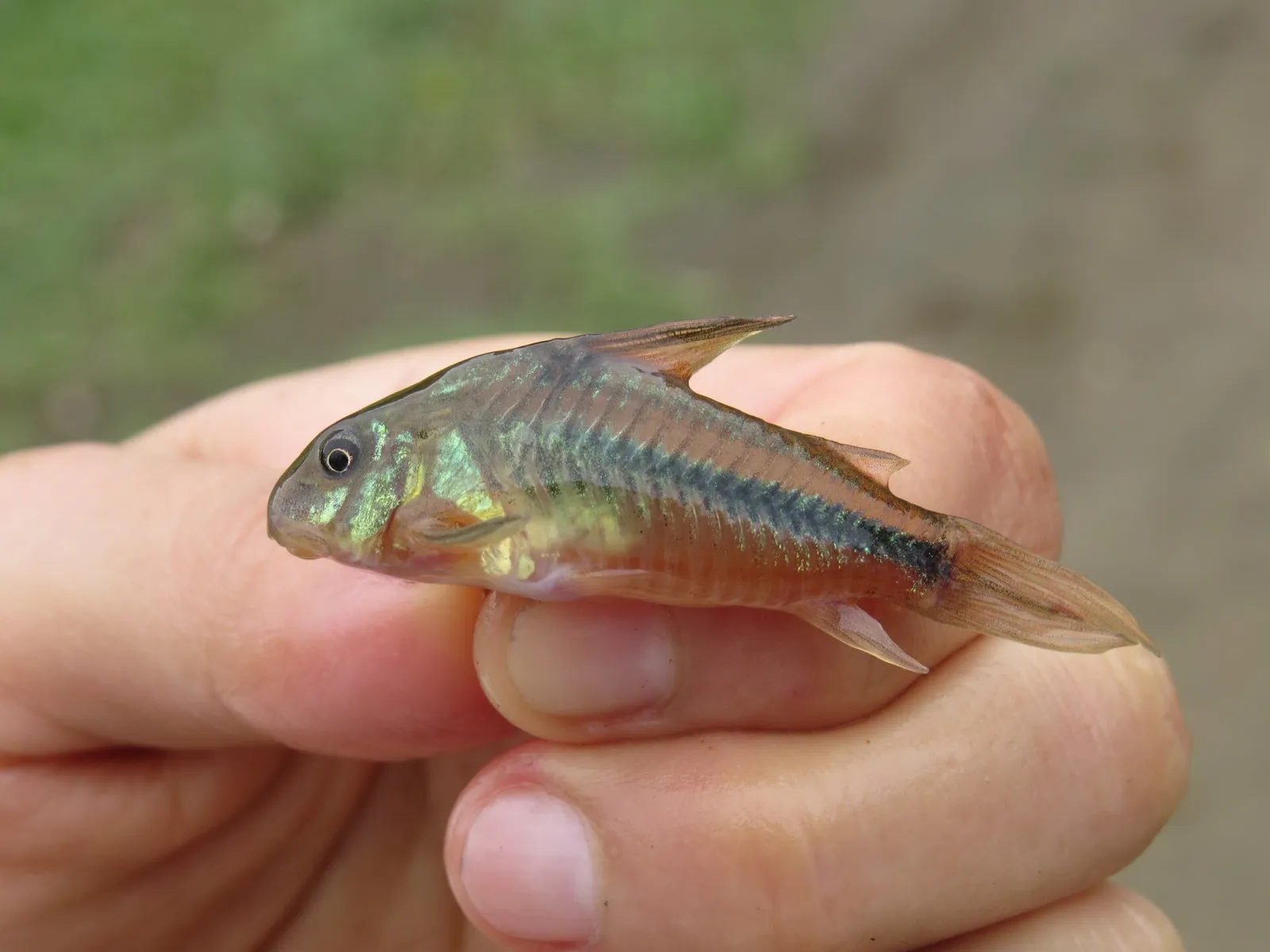
The colour is what sells it. The ground is a pale silvery to pinkish-grey, but the upper flank glows with an iridescent blue-to-green sheen — brightest over the shoulder and gill cover — that gives the fish its 'blue cory' name and lifts beautifully under good light. A single fine, dark lateral stripe runs from behind the gill cover to the base of the tail, the belly is pale to yellowish, and the fins are largely clear. As in all corys the dorsal, pectoral and adipose fins each carry a stiff, mildly venomous spine. The blue-and-stripe pattern is subtle rather than gaudy, and it is at its best on a settled, well-fed group over dark sand.
Habitat
Corydoras nattereri is a fish of the Atlantic coastal drainages of south-east Brazil, recorded from the small rivers and streams running off the coastal range between the states of Espírito Santo and Paraná, including the Rio de Janeiro and São Paulo coastal basins around the type locality on the Rio Paraíba do Sul system. These are short, clear coastal streams rather than great Amazonian rivers.
It lives in quieter water — small tributaries, creeks, the margins of larger rivers, areas of flooded forest and over sand banks — typically over soft sand or fine gravel with leaf litter and submerged wood. Crucially for the aquarist, this is subtropical, not tropical, country: the water is cool, often in the range of about 68–73 °F, soft to moderately hard, and slightly acidic to neutral (around pH 6.0 to 7.6). Like other corys it is a facultative air-breather, darting to the surface to gulp air and absorb oxygen through a vascularised hindgut, which lets it cope with the warm, low-oxygen shallows of the dry season.
Feeding
Natterer's cory is a benthic omnivore. In the wild it works the bottom continuously, sifting sand and leaf litter with its barbels to taste out small invertebrates, insect larvae, worms, crustaceans, fallen seeds and the organic film of detritus, expelling cleaned sand through the gills. It is an opportunist rather than a specialist, and that broad diet is part of its hardiness. In the aquarium it readily takes sinking pellets, tablets and granules, along with live and frozen foods such as bloodworm, Daphnia, Artemia and white or grindal worm — the last especially useful for conditioning a group for spawning. It should never be left to scavenge only what tankmates drop; a deliberate sinking diet keeps it in condition.
Mating
Corydoras are egg-laying shoalers with no pair bond and the distinctive, well-studied courtship shared across the group. When a female is ready she cleans a site — a leaf, a stone, the aquarium glass — and the group becomes animated; a male positions himself at right angles to her head in the classic 'T-position,' and she appears to take his milt into her mouth. Sperm is thought to pass rapidly through her gut to fertilise the few eggs she clasps in a basket formed by her pelvic fins, which she then carries to the cleaned surface and presses into place. The sequence repeats, a few eggs at a time, until a clutch of sticky eggs is distributed across the chosen surfaces.
Breeding
Natterer's cory is bred in the hobby, though less casually than the tropical bronze cory, and its cooler requirements are central to success. Spawning is typically triggered by a large, cool water change that mimics the arrival of subtropical winter rains, dropping the temperature several degrees; a group skewed toward more males than females tends to be most productive. The adhesive eggs are laid in small batches on plants, wood, stones or glass and receive no parental care — the adults will eat them, so breeders move either the eggs or the parents. Eggs hatch in roughly three to five days depending on temperature, and once the fry have absorbed their yolk sacs they take microworm and newly-hatched brine shrimp as first foods. Captive-bred fish are available but this remains less mass-produced than the common tropical corys, so wild-collected stock still appears in the trade.
In the aquarium
This is a rewarding cory for a keeper who can give it what it actually needs, the chief requirement being temperature: it is a subtropical fish and does best around 68–73 °F, cooler than a typical community tank, and it should not be kept in warm tropical water long-term. Within that band it is hardy and undemanding.
Like every cory it is a shoaling species and is genuinely stressed kept alone or in pairs — keep six or more and it rewards you with constant, confident foraging. A group is comfortable in a tank of around 23.5 in or more, where footprint and bottom area matter more than height. Substrate is not optional decoration: provide soft sand or very smooth, rounded fine gravel, because corys feed by sifting and sharp or coarse gravel erodes and infects their barbels, leaving the blunted faces that betray poor husbandry. Border the open foraging area with wood and planting, keep the water well-oxygenated and clean with regular changes, and accept soft to moderately hard, slightly acidic to neutral water. It is utterly peaceful and ideal with other calm, cool-tolerant community fish. Two standing cautions apply to all corys: the fin spines can catch in a net (a cup is safer), and a distressed cory can release skin toxins that, in the confined volume of a bag or bucket, can kill the whole group — so transport them with care.
Conservation
Corydoras nattereri has been assessed for the IUCN Red List as Least Concern. It is reasonably widespread through the coastal drainages of south-east Brazil, ecologically flexible and tolerant of some habitat disturbance, and it does not face range-wide threats severe enough to qualify it for a higher category. That said, the Atlantic coastal streams it inhabits sit in one of the most densely settled and heavily modified parts of Brazil, and deforestation, urban and agricultural run-off, water abstraction and pollution all degrade exactly the shallow, sandy, leaf-littered margins it prefers. As a species it is in no immediate danger, but its habitat is under steady local pressure, and the broad-front move of regional corys into newly resurrected genera means some forms may eventually warrant assessment on their own terms.