Taxonomy & naming
Corydoras eques was described by the Austrian ichthyologist Franz Steindachner in 1877 (sometimes cited 1876), from material collected in the Amazon River at Codajás, in Amazonas, Brazil — still the type locality. The Latin epithet eques means 'horseman,' 'knight' or 'rider,' the source of the common name; it is a noun in apposition and so is invariant, not changing with the gender of the genus. The species has a long taxonomic history: it was placed by Cope in 1894 in the genus Osteogaster, which was later synonymised with Corydoras by Gosline in 1940, and for most of the modern era it has been carried as Corydoras eques within Lacépède's vast genus Corydoras (family Callichthyidae).
That genus had grown unwieldy — well over 170 species — and molecular work showed it was not a single natural group. In 2024 Dias, Tencatt and colleagues published a large phylogenomic revision (Zoological Journal of the Linnean Society) that split Corydoradinae into several genera and, in doing so, resurrected Osteogaster for the 'aeneus group' (the lineage of the bronze cory and its relatives). Under that scheme the horseman cory becomes Osteogaster eques — returning, in effect, to the genus Cope had used for it more than a century earlier. The change is recent and not yet universally adopted, and the hobby still says 'Corydoras eques,' so we keep that as the heading while noting the current combination.
Morphology
This is a small, fairly deep-bodied cory reaching only about 2 in, with females growing larger and rounder than males. It has the standard Corydoras armour — a hard, helmet-like head, a downturned mouth fringed with three pairs of sensory barbels, and two overlapping rows of bony scutes down each flank in place of scales.
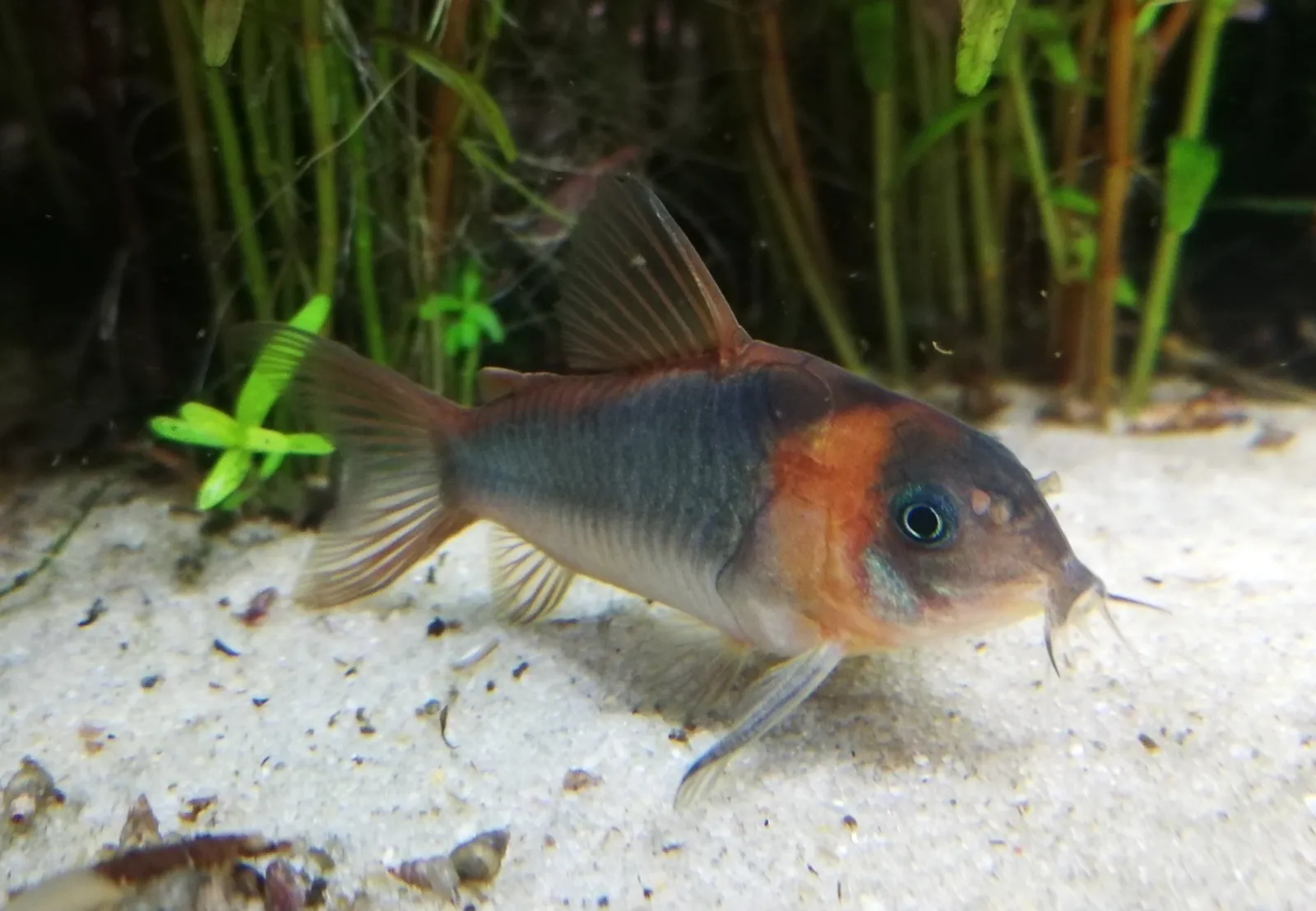
What makes the horseman cory desirable is its colour: a warm coppery-to-orange flush over the head, shoulders and gill region, set off by a bright pale-to-golden stripe running along the top of the back from the head to the dorsal fin, above a darker olive-to-bronze body. The belly is paler and the fins largely clear. As in all corys, the first ray of the dorsal, pectoral and adipose fins is a stiff spine — a mildly venomous defence that can jab a careless hand and snag in a net. It is one of the more vividly coloured small corys, which is why it commands attention despite being uncommon in the trade.
Habitat
The type locality is the Amazon River at Codajás, Amazonas, Brazil — on the central Amazon (Solimões) between Tefé and Manaus. The species is firmly documented from Brazil; similar orange corys are occasionally exported from Peru and the upper Amazon, and the fish is widely sold in the hobby as the 'Napo cory' after the Rio Napo of Ecuador and Peru, though that broader range is not as well established in the literature as the Brazilian record.
It is a fish of quiet, shallow water — the slow margins of streams, side-channels and flooded forest over soft sand with submerged wood and leaf litter. These are warm, soft, often slightly acidic to near-neutral waters. Like other corys it is a facultative air-breather, darting to the surface to gulp air and absorb oxygen across a vascularised hindgut, an adaptation suited to the warm, oxygen-poor shallows it favours.
Feeding
The horseman cory is a benthic omnivore and foraging detritivore. In the wild it works the sandy bottom continuously, burying its snout and barbels to taste out small invertebrates, insect larvae, worms, micro-crustaceans and detritus, sieving cleaned sand back out through the gill openings. It is an opportunist, and that broad diet is part of what makes corys hardy. In the aquarium it readily takes good-quality sinking dried foods alongside small live and frozen items — bloodworm, Tubifex, brine shrimp — and should be offered a varied diet rather than left to subsist on whatever its tankmates drop.
Mating
Corydoras are egg-laying shoalers with no pair bond and a distinctive, well-studied courtship that the horseman cory shares. When a female is ready she cleans a site and the group becomes active; a male positions himself at right angles to her head in the classic 'T-position,' and she appears to take his milt directly. The sperm is thought to pass rapidly through her gut to fertilise the small number of eggs she clasps in a basket formed by her pelvic fins, which she carries to a cleaned surface — a leaf, a stone, the glass, or a spawning mop near the surface — and presses into place, the sequence repeating a few eggs at a time.
Breeding
The horseman cory has been bred in aquaria, though it is not produced on a commercial scale. Spawning follows the standard Corydoras pattern and is typically triggered by a large (50–70%) water change with cooler water and increased oxygenation, mimicking the onset of the rains; breeders generally use a group skewed about two males to each female. The adhesive eggs are deposited on plants, glass and spawning mops, often high in the tank near the surface, and receive no parental care — adults will eat them, so the eggs or parents are removed. Eggs typically hatch in three to four days, the fry taking microworm and baby brine shrimp once the yolk sac is absorbed.
In the aquarium
The horseman cory is a colourful, somewhat uncommon species that rewards a keeper able to give it stable, soft, well-managed water; it is hardy enough for a competent community aquarist but not a throwaway beginner's fish. It is a shoaling species and is genuinely stressed when kept alone or in pairs — keep six or more, and its colour and confidence improve markedly in a group.
Substrate matters: provide soft sand or very smooth, fine rounded gravel, because corys feed by sifting and sharp or coarse gravel erodes and infects their barbels, leaving the stubby, blunted faces that signal poor husbandry. It does best in warm (about 72–79 °F), soft to moderately hard, slightly acidic to neutral water, well-filtered and well-oxygenated with gentle flow and regular changes. It is utterly peaceful and suits a community of small tetras, pencilfish, rasboras, dwarf cichlids and other calm fish — never anything large enough to bully it. Two standard cautions: the fin spines can catch in nets (a cup is safer), and a distressed cory can release a skin toxin that, in the confined volume of a bag, can kill the whole group, so transport with care.
Conservation
Corydoras eques has not been assessed by the IUCN Red List, so it carries no formal conservation status. It is documented from the central Amazon and appears to be naturally uncommon in the trade, and as with other Amazonian fishes the broad pressures on the basin — deforestation, agricultural and mining run-off, damming and changes to water chemistry — could degrade the soft, sandy shallows it depends on. There is no evidence the aquarium trade threatens it, but an attractive, sought-after species with an imperfectly mapped range is the kind of fish whose status would be worth assessing on its own terms rather than assuming it is secure.