Taxonomy & naming
The skunk cory of the aquarium trade had a tangled history. The name C. arcuatus (Elwin, 1938) has long been attached to the 'skunk' pattern, but the fish sold under that name in enormous numbers turned out not to match Elwin's species. In 2019 Luiz Tencatt, Flávio Lima and Marcelo Britto formally described the trade fish as a distinct species, Corydoras granti, in the family Callichthyidae (subfamily Corydoradinae). The epithet honours Steven Grant, an aquarist and amateur ichthyologist who was the first to realise that this widespread 'skunk' fish was distinct from the true C. arcuatus; it is a genitive (eponymous) noun.
The species was caught up in the 2024 phylogenomic revision of the Corydoradinae by Dias, Tencatt and colleagues (Zoological Journal of the Linnean Society), which split the bloated genus Corydoras into several lineages. Under that classification the skunk cory becomes Hoplisoma granti, the combination now carried by Eschmeyer's Catalog of Fishes and FishBase. Because the revision is recent and the hobby still says 'Corydoras granti' (or simply 'skunk cory'), we keep that heading while recording the current valid combination. The practical upshot for hobbyists is that the great majority of 'skunk corydoras' in the trade are this species, H. granti, not the rarer true C. arcuatus.
Morphology
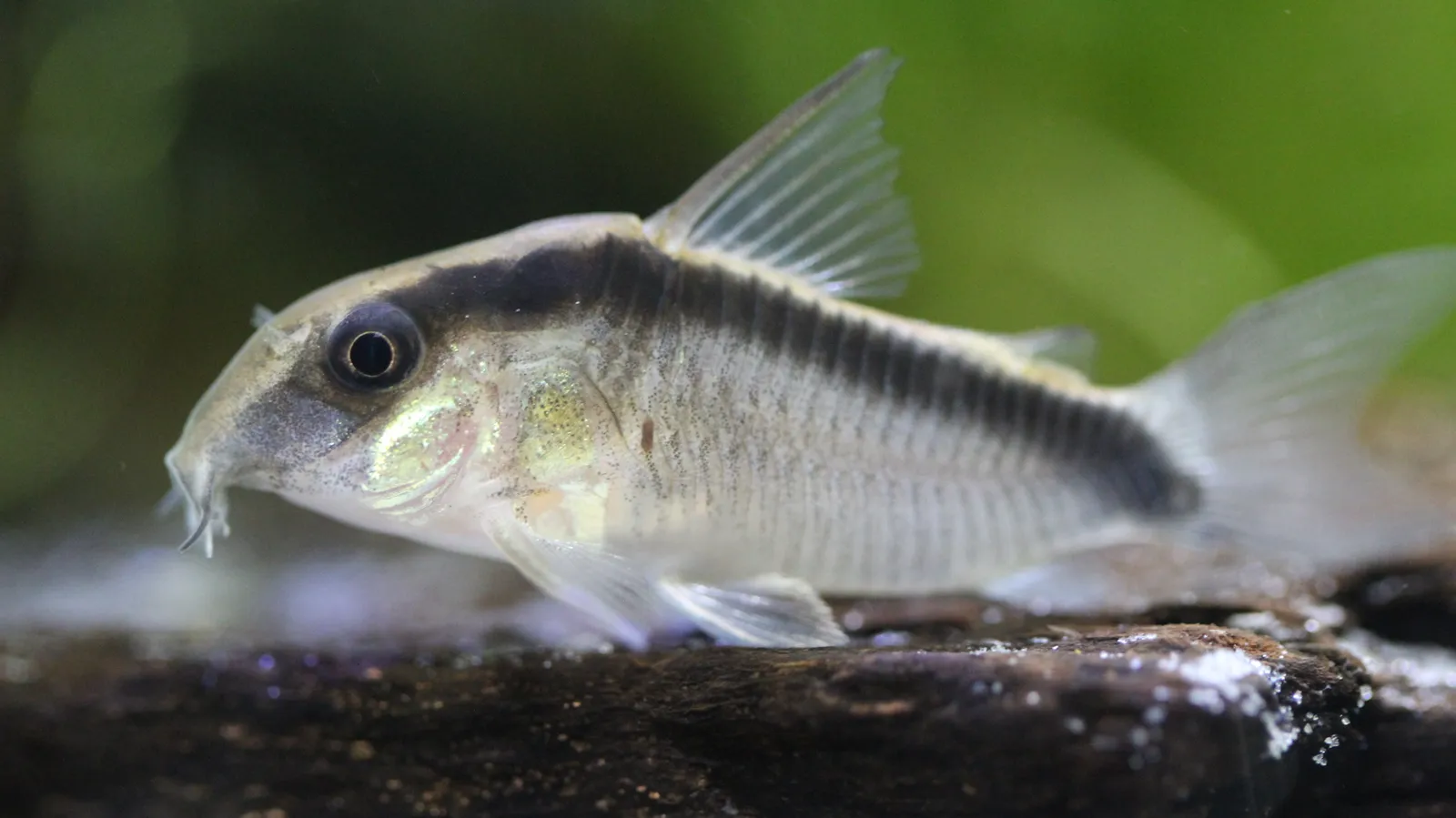
The skunk cory is a slim, fairly elongate cory reaching about 2 in in standard length. It has the usual corydoradine armour — two overlapping rows of bony plates instead of scales — over a comparatively streamlined body, with a rounded, blunt snout (a useful field difference from the longer, more pointed snout of the true C. arcuatus) and the standard barbel-fringed downturned mouth.
The colour pattern is the whole point of the 'skunk' name: a pale tan to cream ground crossed by a single bold black stripe that runs from the snout, up over the eye and along the arched line of the back to the base of the tail, often with a second, lower dark line along the flank. Seen from above, that dorsal racing-stripe is thought to help break up the fish's outline against the substrate. The dorsal, pectoral and adipose fins carry the usual stiff leading spines. Sexing follows the corydoradine rule — mature females are larger and distinctly broader-bodied than males, most obvious from above and in spawning condition.
Habitat
Corydoras granti is widespread in the western Amazon, recorded along the Rio Amazonas–Solimões in Brazil, Colombia, Ecuador and Peru. The original description reports it from blackwater streams, where it lives alongside (syntopically with) the true C. arcuatus at some sites, as well as from more turbid, whitewater-influenced streams elsewhere in its range. At several localities it was found in mixed schools with other corys such as C. ambiacus, C. leucomelas and C. elegans, underscoring how readily these species form multi-species shoals.
This is warm-lowland cory habitat: shallow stream margins and channels over soft substrate with leaf litter and wood, ranging from clear, acidic, tannin-stained blackwater to more sediment-laden water. As a corydoradine it is a facultative air-breather, gulping air at the surface and absorbing oxygen through a modified, vascularised hindgut — the adaptation that lets corys survive in warm, low-oxygen forest streams and pools.
Feeding
Like all corys, the skunk cory is a benthic omnivore and detritivore. It works the bottom continuously, burying its snout and barbels in soft sand to taste out small invertebrates, insect larvae, worms, micro-crustaceans and organic detritus, then expelling cleaned substrate through the gill openings. It is an opportunistic feeder rather than a specialist. In the aquarium it readily takes sinking pellets and granules, frozen and live bloodworm and brine shrimp, and any edible material that reaches the bottom; as with all corys it should be fed deliberately and not expected to live on scraps.
Mating
The skunk cory follows the classic, well-studied corydoradine courtship. These are egg-laying shoalers with no pair bond: when a female is ready she cleans a spawning site, the group becomes active, and a male takes up the 'T-position' at right angles to her head. The female appears to take milt into her mouth, and sperm is thought to pass quickly through her gut to fertilise the few eggs she cradles in a basket formed by her clamped pelvic fins. She carries those eggs to the cleaned surface and presses them into place, and the sequence repeats a few eggs at a time until the clutch is complete.
Breeding
As a popular trade species, the skunk cory is bred in the hobby, though it is regarded as a little more demanding than the easiest corys. Spawning is typically triggered by a large, cooler water change that mimics the rainy season, with the group skewed toward more males than females. The adhesive eggs are laid in small batches and scattered across firm surfaces — glass, plants, stones — and receive no parental care; the adults will eat them, so breeders move either the eggs or the parents. Eggs hatch in roughly three to five days depending on temperature, and the fry, once the yolk sac is absorbed, take microworm, baby brine shrimp and powdered foods. Soft, slightly acidic water in line with its blackwater origins is generally recommended for conditioning and spawning.
In the aquarium
The skunk cory is a well-loved aquarium fish, and the bulk of 'skunk corydoras' offered for sale are this species. It is a shoaling fish that is stressed in ones and twos — keep six or more and it rewards you with active, confident foraging. A group is comfortable in a tank of around 23.5 in / 20 US gal or more, where bottom area matters more than height.
Substrate is functional, not decorative: provide soft sand or very smooth, rounded fine gravel, because corys feed by sifting and sharp or coarse gravel abrades and infects the barbels, leaving the eroded, stubby faces that are a classic sign of poor husbandry. Keep the bottom clean. Water should be warm but not hot (about 72–79 °F), well-filtered and well-oxygenated, with gentle flow and regular changes; soft, slightly acidic water suits it best given its blackwater origins, though it tolerates a reasonable range. It is utterly peaceful and ideal with tetras, small rasboras, dwarf cichlids and other calm community fish — never tankmates large enough to bully it. As with all corys, the fin spines snag in nets, so use a cup to move them, and be aware that a badly stressed cory can release a skin toxin that, in the small volume of a bag or bucket, can kill the whole group in transit.
Conservation
Corydoras granti has not yet been assessed by the IUCN, so it carries no Red List category — unsurprising for a species described only in 2019. The available evidence points to a fairly wide distribution across the upper Amazon–Solimões in four countries, and it is collected for the aquarium trade in some numbers, much of it wild-caught. A broad range is reassuring, but the western Amazon faces steady pressure from deforestation, agriculture and changing land use, and the heavy historical confusion with C. arcuatus means trade and collection records for the two species are entangled. A formal assessment, and clean separation of the two in trade data, would give a clearer picture; for now its status is best described honestly as unevaluated.