Taxonomy & naming
Hypancistrus zebra was described by the Dutch ichthyologists Isaac Isbrücker and Han Nijssen in 1991, in the journal Ichthyological Exploration of Freshwaters (volume 1, number 4, pages 345–350), from specimens collected about one hour upstream of Altamira on the Rio Xingu, Pará State, Brazil. The type locality places it squarely in the middle Xingu, the fast-water canyon reach that would later become the centre of the Belo Monte Dam controversy.
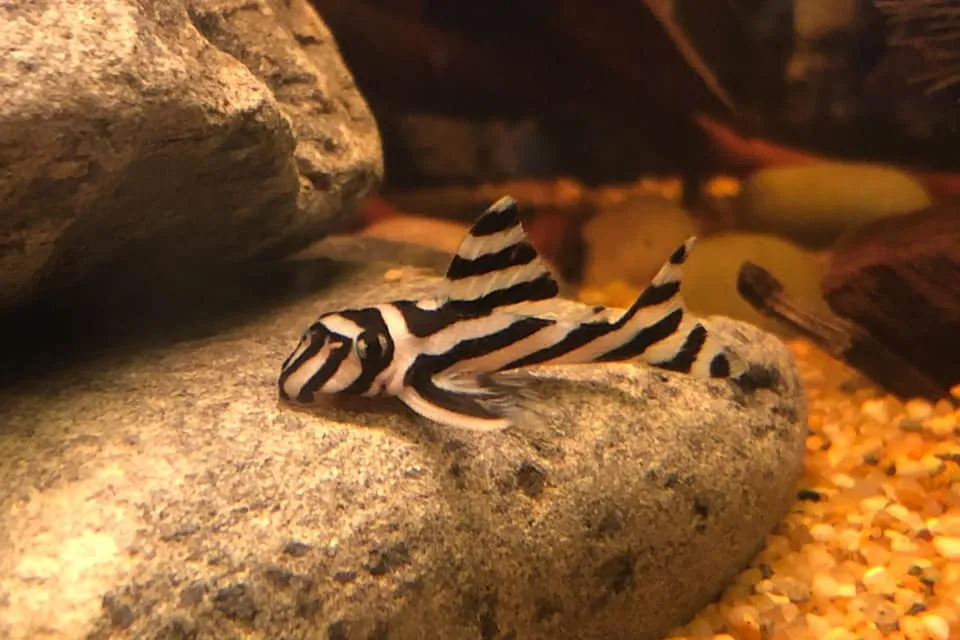
The description simultaneously erected a new genus, Hypancistrus, to accommodate the species. The name is a contraction of Greek hypo ('less than') and Ancistrus, the much larger genus of bristlenose plecos; it refers to the distinctly reduced dentition of Hypancistrus, particularly in the lower jaw, compared with Ancistrus. The species epithet zebra is straightforwardly descriptive: bold alternating white and black bands encircle the body in a pattern reminiscent of a zebra's stripes.
Hypancistrus belongs to subfamily Hypostominae of the family Loricariidae (order Siluriformes). Within Hypostominae, it falls in the large clade sometimes called the 'fancypleco group' or informally the 'L-number plecos,' alongside Peckoltia, Ancistomus, Panaqolus and many others. Molecular phylogenies (Montoya-Burgos et al. 1998 used 12S and 16S mitochondrial rRNA) confirm its placement well within the hypostomines and well away from the algae-scraping Hypostomus lineage.
The L-number system predates the formal description: the fish first appeared in the German hobby magazine DATZ as 'L046' in 1989, before any scientific name existed. The number L098 was briefly applied to the same species from a different collection point before the synonymy was recognised; both designations now refer to H. zebra. Catalog of Fishes (Eschmeyer, CAS) lists the species as valid with no current synonyms.
Morphology
Hypancistrus zebra reaches a maximum total length of approximately 3 in (PlanetCatfish records 3 in SL; FishBase gives 3 in TL with a maximum weight of about 4 g). It is a compact, deep-bodied fish with a broad, flattened head and a large, muscular suction-disc mouth lined with small, spatulate teeth. The body is fully armoured in overlapping bony scutes arranged in longitudinal rows.
The pattern is unmistakable: a brilliant white or cream base is crossed by solid, jet-black bands — typically four to five broad bands encircling the trunk and a corresponding striped dorsal fin, with the pattern extending onto all fins including the caudal. The exact number of bands, their width, and whether they form complete rings or break on the belly can vary between individuals and with the fish's age; the contrast tends to be sharpest in young fish and may soften somewhat as they grow, though adults remain strikingly marked.
Males and females are readily distinguished once sexually mature. Males develop noticeably thicker and longer first pectoral-fin rays armed with recurved odontodes (tiny denticles), and also grow odontodes on the cheeks and rear body flanks. Males typically have a wider, broader head. Females are plumper through the mid-body, especially when gravid, and have much less pronounced odontodes on fin rays and cheeks. The dorsal fin has a single spine and seven soft rays, the anal fin one spine and four soft rays — counts that help distinguish Hypancistrus from the superficially similar Peckoltia species (which usually have more dorsal rays).
Habitat
Hypancistrus zebra is a strict endemic of the Rio Xingu, confined in the wild to the middle Xingu canyon reach between roughly Volta Grande (near Altamira) and the Belo Monte hydroelectric dam — a stretch of fast, highly oxygenated river flowing through exposed bedrock, granite boulders, and tumbled rock formations. This section of the Xingu is famous among ichthyologists and collectors for its remarkable level of fish endemism; H. zebra shares it with dozens of other pleco species found nowhere else on Earth.
The habitat is characterised by high current velocity, very warm water (79–86 °F), and extremely well-oxygenated conditions. The fish shelter in crevices and tight rocky caves in the substrate and on boulder faces, emerging primarily at night or during dim conditions to feed. Water chemistry in the Rio Xingu at this point is soft to moderately soft (low conductivity), near-neutral to slightly acidic, with pH around 6.5–7.5; however, PlanetCatfish notes that in captivity the species has been bred successfully in a wide range of water parameters, including moderately hard and even mildly alkaline conditions, as long as dissolved oxygen is high and temperature remains warm.
Belo Monte Dam, completed in the 2010s, has fundamentally altered the hydrology of the middle Xingu — reducing discharge, modifying the thermal and chemical regime, and inundating or dewatering portions of the rocky habitat. The known wild range of H. zebra is now largely confined to the section downstream of the main dam and impoundment.
Feeding
Unlike the majority of loricariids — particularly the large Pterygoplichthys and Hypostomus species that scrape biofilm and aufwuchs from rocks with broad, multicuspid teeth — Hypancistrus zebra is predominantly carnivorous. PlanetCatfish is explicit on this point: 'Hypancistrus are more carnivores than algae eaters. This is backed up by a small and lightly toothed mouth that indicates they are poor algae scrapers.'
In the wild, the species is presumed to feed on small aquatic invertebrates, insect larvae, worms, and microcrustaceans gleaned from the surfaces of rocks, plus any available organic detritus. The highly oxygenated, current-swept boulders of the middle Xingu are rich in invertebrate life — chironomid larvae, ephemeropteran nymphs, and similar prey — and the small spatulate teeth of Hypancistrus are well suited to picking these from surfaces rather than rasping algae.
In aquaria, zebra plecos should be offered primarily meaty foods: frozen and live bloodworm (Chironomus), brine shrimp, daphnia, chopped earthworm, and high-protein sinking pellets such as discus granules or carnivore sticks. Small quantities of algae wafers or spirulina-based foods can supplement the diet, but a predominantly animal-protein diet is strongly recommended for long-term health. Keepers who feed them only algae-based food find the fish decline slowly.
Mating
Hypancistrus zebra is a cave-spawning species in which a single dominant male monopolises one or more caves or tight rocky crevices within his territory and courts females into them to spawn. Unlike the T-position egg-scattering of corydoradines, mating in Hypancistrus takes place entirely inside the cave.
Males establish and defend territories vigorously; in aquaria, male–male combat can result in torn fins and injury, particularly when caves are in short supply. A mature male will attempt to attract females by occupying a suitable cavity and displaying from the entrance; once a female enters, spawning occurs in private and the male takes over care of the eggs immediately. The female typically departs the cave after egg deposition.
Sexual maturity is reached at roughly 18–24 months under good aquarium conditions, at a size of around 2–2.5 in SL. Females ripen relatively slowly; in well-maintained groups, spawning episodes may be triggered by small water-temperature drops mimicking rainfall events, but H. zebra is less predictably seasonal than some other cave-spawning loricariids.
Breeding
Hypancistrus zebra was first bred in European hobbyist fishrooms in the early 1990s — captive breeding preceded the formal scientific description by only a year or two, and the export ban of 2004 gave the captive-bred industry a sharp upward push. PlanetCatfish lists 53 registered breeding reports; the species is now established in captive breeding facilities in Germany, the Netherlands, the Czech Republic, Japan, Indonesia, and elsewhere.
The male incubates the eggs inside the cave, fanning them vigorously with his pectoral and tail fins to maintain oxygen supply. Clutch sizes are modest by loricariid standards: typically 7–15 pale yellowish eggs are deposited per spawning, laid in a tight cluster at the rear of the cave. Incubation lasts around 5–7 days at 82–86 °F. The fry are large relative to the egg size and emerge with substantial yolk sacs; they remain in or near the cave under the male's protection for a further 5–10 days until the yolk is absorbed and they become free-swimming. At this point they look like tiny adults, already showing the full black-and-white striped pattern.
For captive breeding, the standard approach is a species-specific or near-species tank with multiple narrow ceramic or slate caves (internal diameter just sufficient for an adult), warm well-oxygenated water (82–86 °F), a high-protein diet, and a group skewed toward more males than females to encourage competition. Breeder fish are typically kept in 15–30 US gal tanks. The fry accept microworm, finely crushed carnivore pellets, and baby brine shrimp nauplii from first feeding.
In the aquarium
Hypancistrus zebra is a high-demand specialist fish, emphatically not a beginner's pleco. Several care requirements are non-negotiable. First, oxygen: the species evolved in one of the most turbulent, oxygen-saturated rivers in Amazonia. Stagnant, low-oxygen water is lethal; the aquarium must have vigorous surface agitation and a powerful filter creating a good current. Second, temperature: warm (79–86 °F) is essential; it should never drop below 75 °F for extended periods. Third, diet: primarily meaty foods, not algae wafers.
A dedicated pair or small group can be housed in 20–30 US gal, but a well-planted, well-filtered community is possible provided tankmates are peaceful, not overly large, and do not compete for caves. Small tetras, rasboras, and Corydoras species are appropriate companions. Other Hypancistrus males will fight; multiple females with one male, or a male-female pair, is the standard breeding setup.
Caves and rocky hardscape are essential furnishing — the fish spend almost all daylight hours inside or under cover. Caves can be made from PVC pipe sections, slate plates, terracotta tubes, or commercial ceramic spawning caves. Sand or fine gravel substrate is acceptable, though the fish are not heavy substrate-sifters like corydoradines.
Fishkeepers should be aware of the legal and ethical dimension: wild-caught H. zebra have been protected under Brazilian law since 2004 and the species is on CITES Appendix II. The retail price of a captive-bred individual averages around US$100–200 (Sousa et al. 2021). Any supplier claiming wild-caught Brazilian specimens is likely trading in smuggled fish. Captive-bred fish from reputable breeders are widely available and are the only ethically defensible option.
Conservation
Hypancistrus zebra is assessed as Critically Endangered (CR, criterion A3c) by the IUCN Red List, last evaluated in November 2018. It is one of only a handful of freshwater aquarium fish to reach CR status, and the assessment reflects a projected population decline of more than 80 % over three generations driven primarily by the Belo Monte hydroelectric dam complex and, secondarily, by collection pressure from the ornamental fish trade.
The Belo Monte Dam has transformed the middle Xingu, fundamentally altering the flow regime and physical habitat of the rocky canyon where H. zebra exclusively occurs. Upstream impoundment and changed downstream discharge affect water temperature, oxygen levels, and the sediment dynamics that create the species' rocky-crevice habitat. Biomonitoring surveys after dam construction recorded steep declines in H. zebra densities relative to pre-dam surveys.
Illegal collection and trafficking are the second major threat. Sousa et al. (2021, Global Ecology and Conservation) estimated that approximately 100,000 specimens are trafficked out of Brazil annually — roughly twice the number of legal exports before the 2004 ban. The fish are smuggled primarily via Peru and Colombia, then exported internationally, with China receiving the largest volume. Fishermen are paid as little as US$7–60 per fish while the retail price in importing countries averages around US$155. Law enforcement seizures intercept only a small fraction of this trade.
The export ban has, paradoxically, both raised prices (incentivising more smuggling) and accelerated captive breeding, since legal supply dried up. A 2021 analysis argued that regulated domestic breeding facilities in Brazil — whose legal establishment was still prohibited at the time of writing — could substantially undercut the economic incentive for trafficking while contributing to ex situ conservation. H. zebra is well established in captivity worldwide, with many thousands produced annually by hobby and commercial breeders; it is therefore not at immediate risk of extinction as a species, but its wild population in the Rio Xingu is in serious and ongoing decline.
The species is listed on CITES Appendix II, meaning international trade requires documentation of legal origin. It is not yet on Appendix I (which would prohibit commercial trade entirely), though Brazil has reportedly considered submitting such a proposal.