Taxonomy & naming
Cichla temensis was described in 1821 by Alexander von Humboldt, in the volume on the fishes of equinoctial America that he produced with Achille Valenciennes following his South American expedition. The species name points to the type locality, the Rio Temi in the Orinoco drainage of Venezuela. The genus name Cichla derives from the Greek kichle, a word for wrasse, applied loosely by early naturalists to these large-mouthed predators; Cichla is the type genus on which the whole family Cichlidae is built, which makes temensis something of a flagship for the group.
The genus accumulated a tangle of names over the nineteenth century — Cichla tucunare Heckel 1840, and Cychla flavomaculata and Cychla trifasciata, both of Jardine and Schomburgk 1843, are now treated as synonyms of temensis. The modern framework comes from Sven Kullander and Efrem Ferreira's 2006 review of the genus (Ichthyological Exploration of Freshwaters 17(4): 289–398), which recognized fifteen species and sharply narrowed what counts as true temensis. Several populations once labeled temensis in Brazil are now referred to its close relatives Cichla pinima and Cichla vazzoleri. In the hobby and the sport fishery it travels under many names: tucunaré-açu or tucunaré-paca in Brazil, pavón in Spanish-speaking countries, and speckled or three-barred peacock bass in English.
Morphology
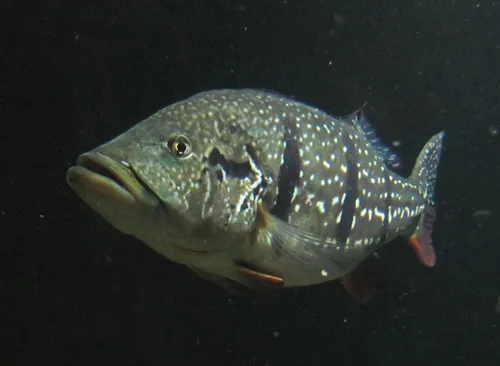
This is a large, elongate, torpedo-shaped cichlid built for the chase. FishBase lists a maximum of 39 in (39 in) total length and 27 lb (12.2 kg), making it the heaviest cichlid in the Western Hemisphere and one of the largest in the world; trophy rod-and-line fish from the Rio Negro routinely run past 20 lb (9 kg). Kullander and Ferreira separate it from congeners by its very small scales — the row above the lateral line carries roughly 98 to 128 scales, usually more than 110, against fewer than 110 in most other Cichla — and by a continuous postorbital band rather than scattered spots. Like all peacock bass it wears an ocellus, a black eye-spot ringed in gold, at the base of the tail.
Its coloration is the genuinely strange part. Reiss, Able, Nunes and Hrbek (2012) tested the long-standing idea that the "speckled" and "barred" forms were different fish, using morphometrics, mitochondrial DNA and a gonadosomatic index. They found a single species: the color difference is a cyclic secondary sexual character that tracks how close an individual is to spawning. Out of season the fish is dark with four rows of small, pale, elongate spots — the speckled "paca" phase. As the gonads ripen it shifts to the high-contrast "açu" pattern, three bold black bars on a tawny-to-green flank. The change runs through both sexes and is gradual, which is why riverside fishers read it as a spawning-readiness signal rather than a fixed trait. Ripe males additionally develop a pronounced nuchal hump on the forehead, the classic breeding marker of a cock Cichla.
Habitat
Cichla temensis is native to the blackwater rivers of northern South America. Its core is the Rio Negro basin of Brazil and Venezuela and the Orinoco basin of Venezuela and Colombia, with records along the Solimões–Amazonas at Tefé, the Rio Puraquequara, the lower Uatumã, Rio Preto da Eva and Lago Saracá, in the Branco drainage, and into the Rio Branco drainage in Guyana — a distribution the IUCN traces straight from Kullander and Ferreira's 2006 revision. Its extent of occurrence is put at roughly 1.66 million km², a genuinely vast range. The fish has been stocked outside its range — into Lake Guri in Venezuela, where it is well established, and experimentally into Florida and Texas, where cold winters killed it off and no population persists.
The defining feature of its habitat is water type. This is a black- and clearwater fish, at home in the tannin-stained, acidic, nutrient-poor rivers that drain the ancient Guiana and Brazilian shields. FishBase records a pH band of 5.5 to 6.5 and temperatures of 81–84 °F. Within those rivers, adults favor deeper littoral zones — the margins of floodplain lagoons, sandy and rocky banks, and the structured edges of the main channel — rather than the open current. Divers working the upper Orinoco and its tributaries (the Río Atabapo, Caño Bocón and Caño Joaquin) report the species there as present but rare, usually seen as scattered half-grown fish among the rocks alongside Cichla orinocensis, a pattern AMAZONAS Magazine documented in its July/August 2021 Guainía survey. Its biology is tightly geared to the Amazonian flood pulse, the annual rise and fall of water that governs when and where it feeds and breeds.
Feeding
Cichla temensis is an apex piscivore and sits near the top of its food web, with a FishBase trophic level around 4.5. Adults eat fish almost exclusively, and stomach-content work on the middle Negro confirms the picture: the prey are mostly small fishes, characids under about 4 in (4 in SL) prominent among them — the same family that includes the tetras and piranhas of the same rivers. The IUCN assessment frames the diet the same way, as feeding mainly on small fish, especially characids measuring under 4 in SL. Juveniles are more catholic, taking shrimp, insects and other invertebrates before graduating to a fish diet as they grow.
This is a visual, daylight hunter. Peacock bass patrol the shallows and lagoon margins by sight, with activity concentrated in the brighter, warmer middle of the day and at the crepuscular edges of dawn and dusk. In the clear, dark water of the Rio Negro, vision and ambush speed do the work that scent-trailing does for catfishes. As a large, abundant top predator, temensis exerts real pressure on the small-fish assemblages of these blackwater systems — part of why introducing Cichla outside its range has repeatedly damaged native communities elsewhere.
Mating
Peacock bass are monogamous, pair-bonding cichlids that court and spawn as a couple rather than in groups. As the dry season wanes a male and female form a pair and stake out a breeding territory, then clean and prepare a hard spawning site — an exposed rock, a sunken log, or a patch of bottom they excavate clear of silt — onto which the female will lay her eggs. The ripening color change is itself part of this courtship signal: the brightest, most strongly barred "açu" fish, the males among them sporting the swollen nuchal hump, are the ones closest to spawning, exactly as Reiss and colleagues showed with their gonadosomatic data.
Reproduction is tuned to the flood pulse rather than the calendar. Spawning peaks at the end of the dry season and into the early rising-water period, when falling-then-rising levels expose firm substrates and concentrate prey for the fry to come, though some breeding can occur across much of the year. The species is non-migratory, so pairs form and breed within their home stretch of river or lagoon.
Breeding
Cichla temensis is an oviparous, biparental substrate spawner — emphatically not a mouthbrooder, a sharp contrast to the African rift-lake cichlids many aquarists meet first. The female deposits her eggs in rows across the cleaned hard surface, the male fertilizes them, and the pair then fan and defend the clutch in place. As in other Cichla, fecundity is high — a large female carries on the order of several thousand eggs — and the eggs hatch into wrigglers that the parents shepherd to pits before the brood becomes free-swimming.
What sets peacock bass apart is the ferocity and duration of the care that follows. Both parents escort the dense school of free-swimming fry through the shallows, herding the cloud of young and driving off intruders far larger than the fry themselves; tending adults become intensely territorial for the weeks the nursery lasts. The contrast with the rest of the life history is striking and, to newcomers, counterintuitive: spawning adults are formidable guardians, yet juveniles are timid and are frequently bullied by other cichlids rather than doing the bullying — a point made consistently in hobby accounts.
In the aquarium
Be honest with yourself before buying one: this is among the most demanding large cichlids in the hobby, and it is not a beginner fish. The reason is simple arithmetic — a fish that reaches 24 in (23.5 in) or more needs a tank measured in feet, not gallons. Specialist keepers and forum veterans converge on a minimum footprint that most hobbyists cannot provide: cichlid-forum regulars argue an 8 ft tank is too small and that 10 ft long by 3–4 ft wide, or frankly an indoor pond, is the realistic floor for an adult. Tropical Fish Hobbyist's account of keeping temensis says much the same, with mature fish housed in tanks 8 to 10 feet long. In practice this is a specialist's or a public-aquarium fish.
Water quality is the second hard truth. Unlike the hardy Malawi and Tanganyika cichlids, Cichla are sensitive to dissolved wastes; experienced keepers report they waste away in hard, alkaline water and demand near-zero nitrate, which on a fish this size means very large, frequent water changes. Aim for soft, acidic, warm water in the upper 70s to low 80s °F (around 79–84 °F). They are obligate piscivores; wild fish often start on live fish but can usually be weaned onto quality pellets, krill and seafood, and feeder fish carry real disease risk. On tankmates, the counterintuitive rule holds — pick robust but not bullying companions that are too large to swallow (roughly two-thirds the bass's length), because juvenile temensis are easily harassed. Wild, true temensis are also export-restricted and pricey, and much of what is sold cheaply as "temensis" from Asian farms is hybridized with other Cichla.
Conservation
Cichla temensis is assessed by the IUCN as Least Concern, in an evaluation by Renata Guimarães Frederico carried out on 5 November 2020 and published in the 2023 Red List (Frederico 2023; reviewed by T.J. Lyons). The rationale is straightforward: despite little information being available on the species, it has a wide range of roughly 1.66 million km² across a still largely pristine region, its population appears common, and no specific threats are documented, though the population trend is formally listed as unknown for want of data. The IUCN records its uses as food and sport fishing rather than the aquarium trade — wild temensis are export-controlled, which limits ornamental-collection pressure on this particular fish.
That low-risk status sits inside a basin under strain, and the two should not be confused. The wider Neotropical cichlid fauna is catalogued in Kullander's checklist of the freshwater fishes of South and Central America (2003), and the Rio Negro's blackwater rivers — temensis's heartland — face the broad Amazonian pressures of deforestation, mining, hydropower and a warming climate. The encouraging counter-case is the ornamental fishery documented by Project Piaba (Chao 2001), which has long argued that a well-managed live-fish trade on the Negro gives riverside communities an economic reason to keep the forest and its waters intact. For temensis specifically, the realistic concerns are habitat change and fishing pressure on a prized gamefish, not population collapse — so the accurate summary is the careful one: a Least Concern species in a basin whose long-term health is far from guaranteed.