Taxonomy & naming
The species was described by the American ichthyologist Carl H. Eigenmann in 1907 as Batrachops scottii, in the Proceedings of the Washington Academy of Sciences, from material collected near Buenos Aires — the type locality is now fixed at Ensenada, Buenos Aires Province, Argentina (Calviño & Waldbillig 2020). The holotype, deposited at Princeton University, is apparently lost; a paratype survives at the California Academy of Sciences (CAS 66891, ex Indiana University). Batrachops was a genus Eigenmann and others used for short-bodied, blunt-toothed pike cichlids, but it has long been subsumed: the fish has been treated as Crenicichla scottii since at least Casciotta (1987), and the combination is followed by every modern authority. Lucena & Kullander (1992) redescribed it in their landmark revision of the Crenicichla of the Uruguai River drainage, providing the diagnosis, description and illustrations that anchor the species today. Molecular biogeography of the broader southern, subtropical Crenicichla lacustris species group (Piálek et al. 2011) has treated scottii within that assemblage alongside Crenicichla lepidota, Crenicichla missioneira, Crenicichla minuano, Crenicichla celidochilus and others, a model system for studies of sympatric speciation in rivers. Konings' Cichlids Yearbook, however, following Lucena & Kullander (1992) and Ploeg (1986, 1991), places scottii in its own morphologically defined 'C. scottii species group,' close to but distinct from the short-snouted, blunt-headed 'Batrachops' lineage (the Crenicichla reticulata group of Ploeg 1991 — Kullander's 1986 'Batrachops' in the wide sense, a 12-species clade within Crenicichla). The two circumscriptions — a molecular lacustris-group placement and an older morphology-based scottii group — are not fully reconciled in the literature we have access to, and readers should treat the group-level affinity as provisional rather than settled. Crenicichla is the most species-rich genus of Neotropical cichlids, with well over a hundred described species. A 2023 revision by Varella and colleagues, using an integrative phylogenetic approach, elevated the pike-cichlid clade to the subtribe Crenicichlina and split the broad genus into subgenera; under that scheme scottii falls within the lacustris-group lineage, but the binomial Crenicichla scottii remains in standard use and is retained here.
Morphology
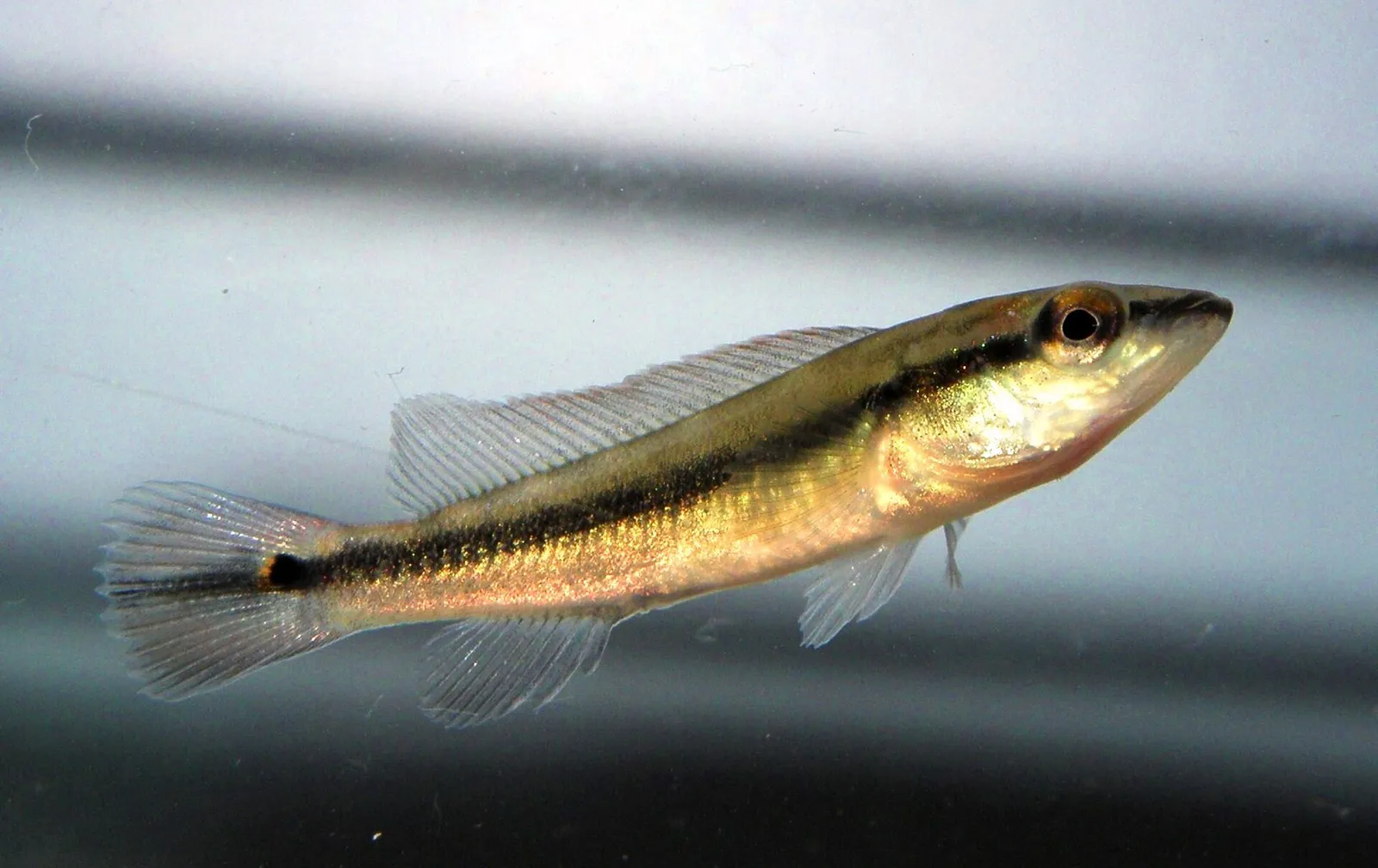
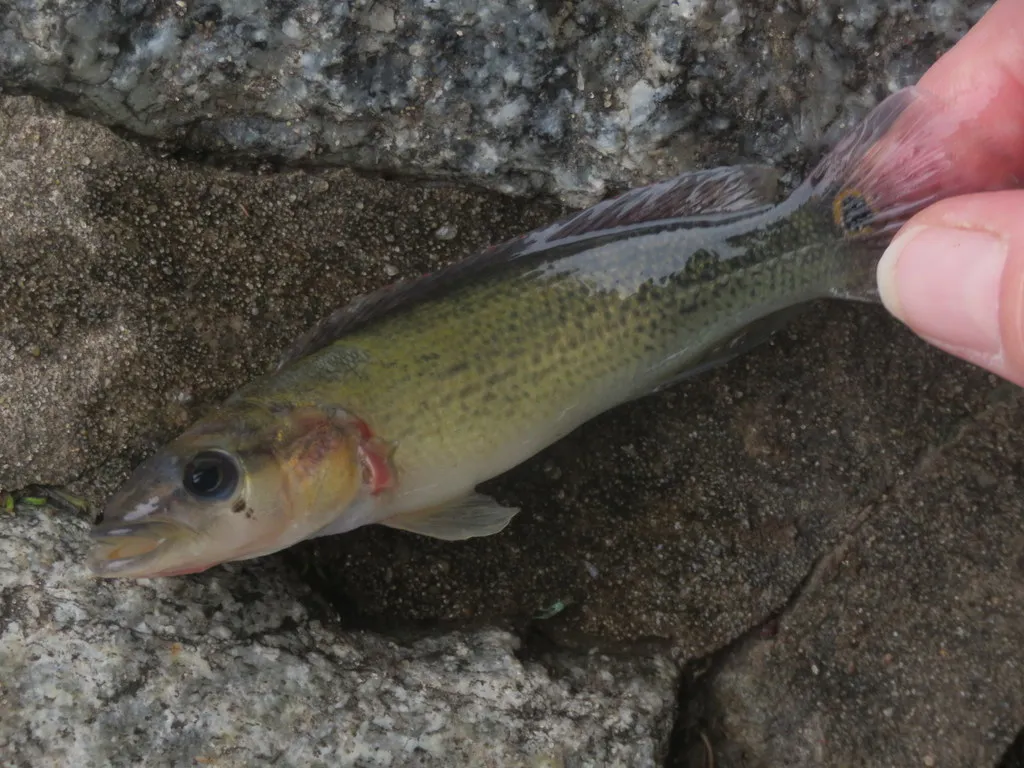
Crenicichla scottii has the classic pike-cichlid bauplan: a long, cylindrical, slightly compressed body, a pointed head and a large mouth with a projecting (prognathous) lower jaw — the build of an ambush predator. It is a comparatively small pike. FishBase lists a maximum of 9.5 in standard length, but field surveys in the Uruguay basin record adults clustering in the 4.5–7 in range typical of the subtropical lacustris group, considerably smaller than the giant Amazonian pikes. The genus name itself points to a diagnostic feature: crenulatus, 'finely notched', refers to the serrated rear margin of the preopercle. Coloration is a muted olive-tan to grey-brown ground, paler below, broken by the dark markings that Lucena & Kullander used to separate the closely similar congeners of the drainage — a suborbital stripe below the eye, vertical bars or blotches along the flank, and small spots in the unpaired fins; a dark caudal ocellus (an eye-spot ringed in pale) sits at the tail base. This suborbital stripe is itself a useful diagnostic against the true, restricted-sense 'Batrachops' (Crenicichla reticulata, C. stocki, C. semifasciata and C. cyanonotus): those four species otherwise resemble scottii closely enough to have shared its old genus placement, but they lack the suborbital stripe on the head that scottii carries. The pattern is subtle and variable, and distinguishing scottii in the field from its sympatric relatives turns on fine details of the lateral band, the lip markings, premaxilla length and pharyngeal-bone shape rather than on bold colour. Sexual dimorphism in the lacustris-group pikes is modest and develops mainly with maturity: ripe females become deeper- and rounder-bodied, while males tend to grow somewhat larger and may carry more extended soft dorsal- and anal-fin tips; females of many pike cichlids also flush a reddish or contrasting belly when in breeding condition.
Habitat
The species is endemic to the Uruguay River basin, occurring through the middle and lower drainage in Argentina (Buenos Aires, Corrientes, Misiones and Entre Ríos provinces), southern Brazil (Rio Grande do Sul and Santa Catarina) and Uruguay. This is subtropical, temperate South America — the La Plata region south of the Amazon's warm-water cichlids — and Eigenmann's original collections near Buenos Aires mark some of the southernmost cichlid records on the continent. The fish is a freshwater, benthopelagic stream-dweller. Detailed field work in the Cuareim (Quaraí) River, a major tributary of the middle Uruguay that drains southern Brazil and northern Uruguay, describes a low-gradient piedmont stream with a diverse fish community, where Crenicichla scottii shares the same rocky reaches with four or five other pike cichlids (Serra et al. 2011; Burress et al. 2013). These pikes hold position among rocks, submerged wood and marginal cover, hunting from ambush. Being a subtropical species, scottii experiences a genuine seasonal temperature cycle with cool winters — the comfortable maintenance band reported for the lacustris-group pikes runs roughly 61–79 °F, distinctly cooler than tropical Amazonian congeners — over near-neutral, moderately soft to medium-hard water (about pH 6.5–7.5). Published in-stream depth data are sparse; like its relatives it occupies the shallow, well-structured littoral and run habitats of small to medium rivers, on the order of the upper few metres of the water column.
Feeding
Crenicichla scottii is a predator, but a measured one. A stable-isotope and gut-content study of the Cuareim River pike-cichlid flock (Burress et al. 2013) placed it as a secondary piscivore: juveniles and small adults feed mainly on aquatic invertebrates — insect larvae, micro- and macrocrustaceans — and the fish switches toward eating other fishes only slowly and incompletely as it grows. Modelled from that work, even the largest Crenicichla scottii take only around 60 % fish in the diet, in contrast to a sympatric congener like Crenicichla celidochilus that becomes almost wholly piscivorous at adult size. This is an ontogenetic diet shift — a change in prey with age and gape — and among these closely related pikes each species shifts at its own rate and to its own degree, a partitioning that lets several similar predators coexist. Across the genus, Crenicichla function as mesopredators rather than apex hunters: important mid-chain links that feed on small fishes, invertebrate larvae, crustaceans and even terrestrial prey that falls in, while themselves being eaten by larger predators. In the temperate Uruguay-basin streams, consumer biomass is supported largely by algal carbon, and the pike cichlids sit a couple of trophic steps above that base. FishBase estimates a trophic level near 3.3 for scottii, consistent with a part-time fish-eater rather than an obligate one.
Mating
Specific courtship observations for Crenicichla scottii in the wild have not been published, so its mating behaviour is read from the well-documented pattern of the genus. Pike cichlids are monogamous, biparental and strongly territorial around spawning. A pair forms after a period of mutual assessment, and once bonded the two fish jointly hold and defend a territory centred on a chosen cave or crevice. Courtship in Crenicichla typically involves the female intensifying in colour — many lacustris-group females develop a contrasting reddish or yellow belly and dark flank markings as they ripen — together with lateral displays, quivering and jaw-to-jaw contact between the partners. Females usually take the lead in initiating spawning and in cleaning the chosen site. Because these are elongate ambush predators with large mouths, pairing can be hazardous: an unready or mismatched partner may be attacked, and in confined settings the larger fish can kill the smaller, so successful pairing depends on the fish choosing each other and on enough space to retreat. Once a compatible bond is established, however, pike cichlids are attentive, cooperative parents.
Breeding
Crenicichla scottii is a biparental substrate and cave spawner, the reproductive mode of the genus, though the wild spawning of this particular species has not been formally documented. In pike cichlids the female deposits a clutch of adhesive eggs on a sheltered surface — the roof or wall of a cave, a rock undercut, a crevice or a hollow among roots and wood — and the pair then guards the brood together, with the female chiefly tending and fanning the eggs while the male patrols and defends the wider territory. Clutch sizes in small-to-medium lacustris-group pikes typically run on the order of a few hundred eggs (genus-typical figure; precise fecundity for scottii is undocumented). The eggs hatch in a few days, after which the parents move the wrigglers to pits and shepherd a tight school of free-swimming fry, defending them vigorously against all comers until the young disperse. This cave-guarding strategy — concealed eggs plus prolonged biparental defence — is highly effective at protecting offspring in the predator-rich, structurally complex streams these fish inhabit. Spawning in the wild is presumed to track the warming water and rising flows of the subtropical spring and summer.
In the aquarium
Crenicichla scottii is an uncommon fish in the hobby — it is not a regular import the way some colourful tropical pikes are, and most aquarium experience comes from the broader pool of lacustris-group 'subtropical pikes' rather than from this species specifically. The husbandry that follows is therefore drawn from keeping its close relatives, and applies to scottii with that caveat. This is a medium-sized, predatory cichlid that needs room: a single fish or a compatible pair wants a tank of at least 47 in length (around 65–80 US gal), longer for a group, with the floor broken up by rock piles, driftwood, slate caves and clear sightline breaks so subordinate fish and a courting partner have places to retreat. The single most important difference from tropical pikes is temperature: as a subtropical, temperate-water fish, scottii should be kept cool — roughly 64–75 °F, with a seasonal dip toward the mid-teens tolerated and arguably beneficial — and it should not be cooked at the high-20s °C that tropical community tanks run. Water chemistry is undemanding: near-neutral pH (about 6.5–7.5) and moderate hardness suit it, with the clean, well-oxygenated, gently flowing conditions of its native streams reproduced through strong filtration and regular water changes. Diet is straightforward for a part-time piscivore: it readily takes meaty frozen and live foods — earthworms, prawn, mussel, chopped fish, insect larvae — and many specimens learn to accept quality sinking pellets, but it is not a vegetable feeder and live feeder-fish are unnecessary and risk introducing disease. The pitfalls are the usual pike-cichlid ones: intraspecific and pair aggression that can turn lethal in cramped quarters, predation on any tankmate small enough to swallow, and the common mistake of keeping a cool-water fish too warm. Choose robust, similarly sized companions that are too large to be eaten and not so boisterous as to bully a lurking predator, and be prepared to separate a pair that fails to bond.
Conservation
The IUCN Red List assesses Crenicichla scottii as Least Concern (assessed 11 November 2020 by R.G. Frederico, published 2023). The species has a reasonably wide distribution across the Uruguay River basin in three countries, and no species-level threats are flagged; it carries no CITES listing. As a habitat generalist within its drainage it is far less exposed than the many narrow-range endemic pikes of individual Misiones and Rio Grande do Sul tributaries, some of which have been described only recently and occupy single small rivers. That said, the subtropical streams of the La Plata system face the familiar regional pressures — dams and run-of-river hydropower that fragment rivers and alter flow and temperature regimes, agricultural runoff and deforestation of riparian zones, and the spread of introduced fishes — and these act on the whole pike-cichlid community even where no single species is yet imperilled. For Crenicichla scottii the present picture is one of a secure, widespread species, read against a basin under steady human pressure.