Taxonomy & naming
Jay Stauffer Jr. and Eva Hert formally described this fish in 1992 as Pseudotropheus callainos, in Ichthyological Exploration of Freshwaters. The holotype is an adult male of 3 in collected at Nkhata Bay, on the western shore of Lake Malawi. The species was already known informally before then: the 1983 rock-cichlid survey by Ribbink and colleagues had catalogued it as Pseudotropheus zebra 'cobalt,' a member of the sprawling 'zebra complex' of mbuna that taxonomists spent decades trying to untangle.
The genus name is where things get unsettled, and it is worth being honest about it. In 1997 Stauffer and co-authors carved a new genus, Metriaclima, out of the Pseudotropheus zebra complex, and most specialist literature — including Ad Konings' work and the IUCN assessment — places the species in Metriaclima callainos. The Catalogue of Fishes and FishBase, however, treat Maylandia (an older name honoring the German ichthyologist Hans-Joachim Mayland) as the valid genus and list the fish as Maylandia callainos, with Metriaclima as a synonym. Hobbyists will see all three combinations — Pseudotropheus, Metriaclima, and Maylandia — on tank labels and price lists; they refer to the same animal. The species epithet is the one point everyone agrees on: callainos comes from the Greek for 'turquoise,' chosen for the blue-green sheen of breeding males. Common trade names include cobalt zebra, cobalt blue zebra, and cobalt blue mbuna; a white-bodied female line is sold as the 'pearl zebra.'
Morphology
This is a small mbuna. FishBase gives a maximum of about 3.1 in (3 in) standard length, while the IUCN assessment quotes a maximum total length near 4 in (4 in) and Konings' field work and malawi.si record robust males to roughly 6 in (6 in) total length; the spread is mostly a matter of whether the tail is included and whether wild or aquarium fish are measured. The body is moderately compact and fusiform, with 17-18 dorsal spines and 8-9 soft rays, three anal spines, and the bicuspid outer / tricuspid inner teeth typical of algae-combing mbuna.
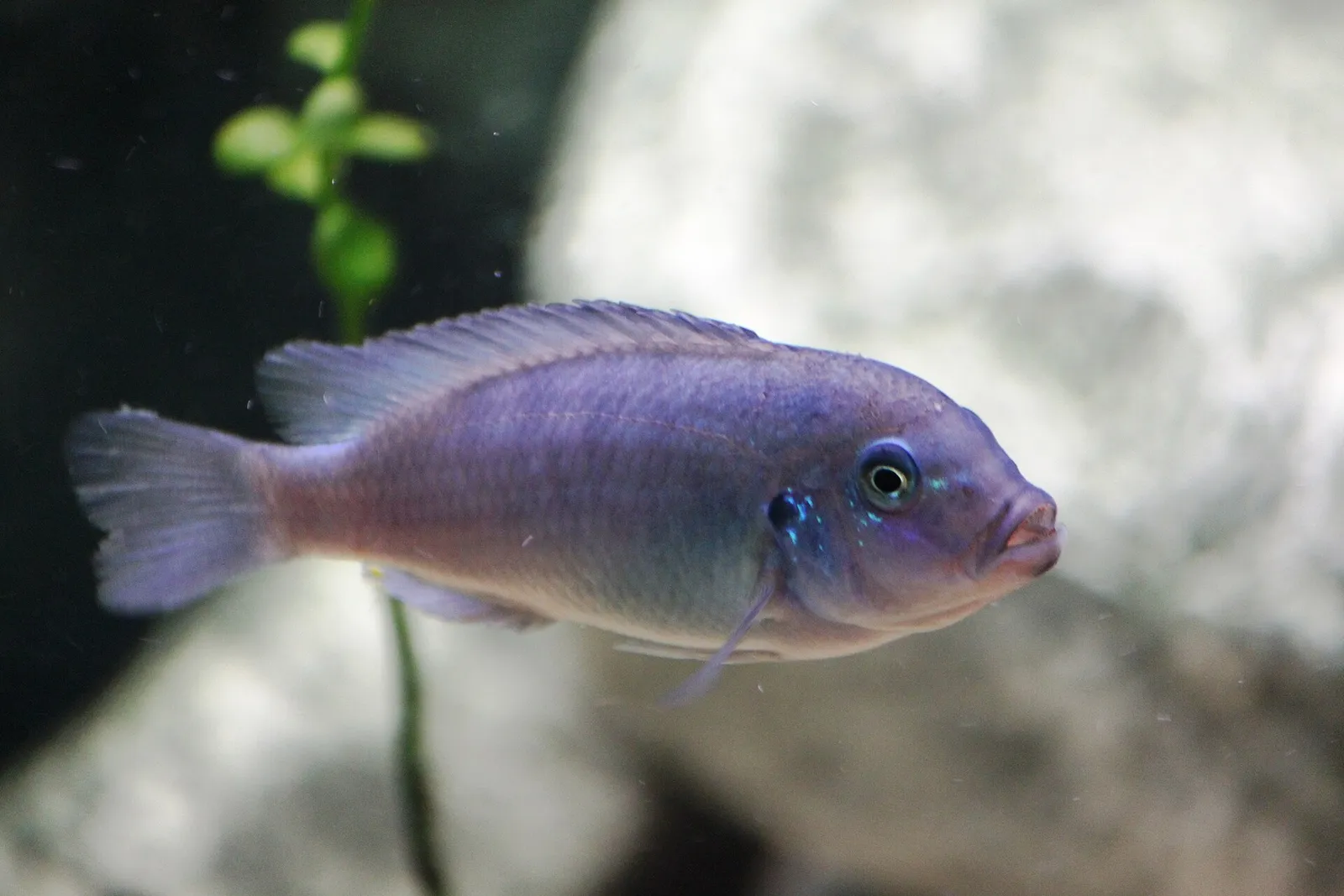
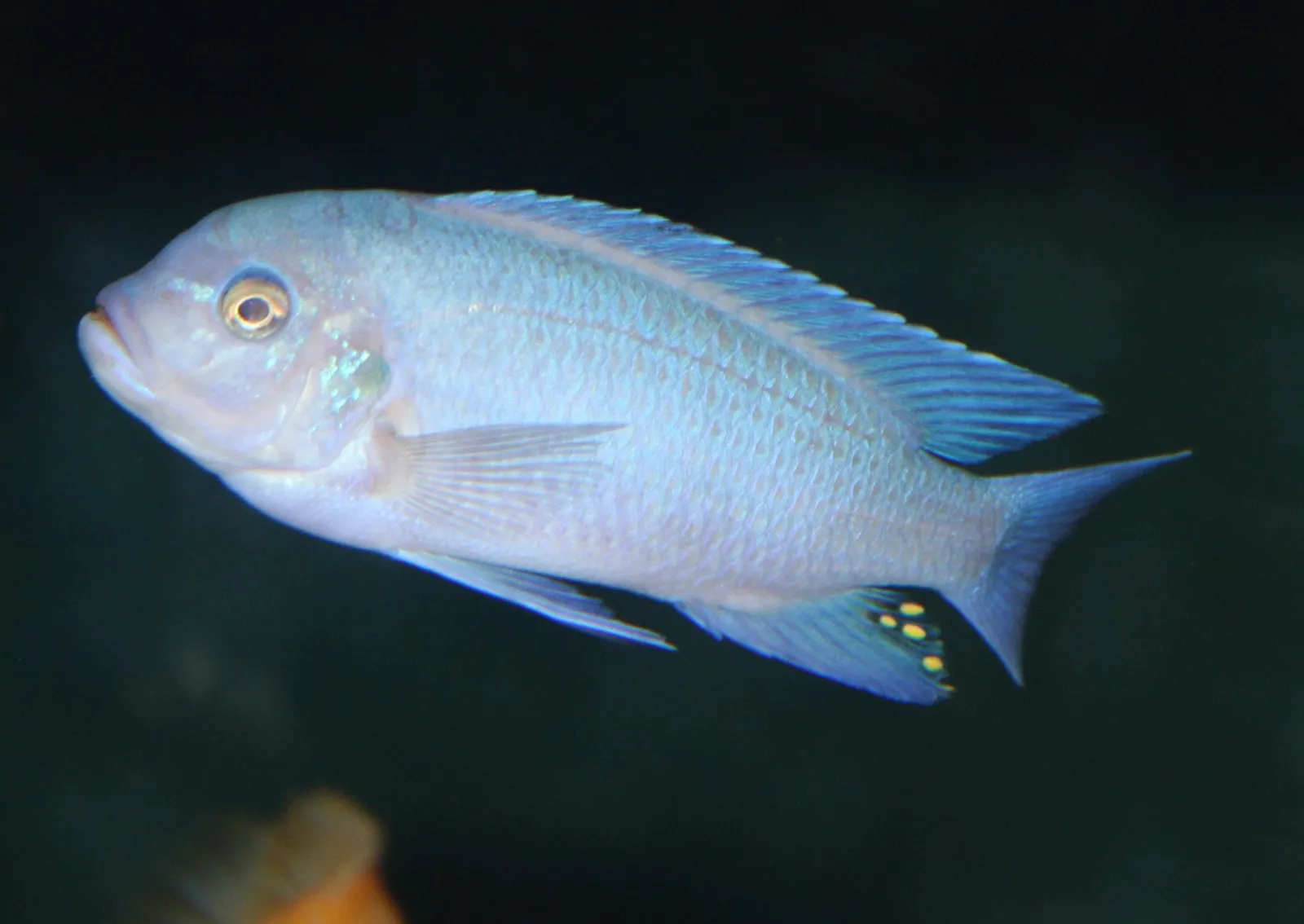
What sets callainos apart from the rest of the zebra complex is the complete absence of vertical bars in both sexes. Territorial males are an even pale-to-cobalt blue, often with green highlights and the small ocellated 'egg spots' on the anal fin that are standard equipment for mouthbrooding cichlids. Females come in two color morphs: a light blue (cobalt) form and a clean white form (the basis of the 'pearl' trade strain). That combination — unbarred blue males plus blue-and-white females — is the field mark that separates it from look-alikes such as the closely related Maylandia benetos, whose females are brown with green highlights. In the tank, dominant males show the most saturated color; subordinate males and females are duller, which routinely confuses keepers trying to sex juveniles.
Habitat
Maylandia callainos is endemic to Lake Malawi. Its original, natural range is narrow — the Nkhata Bay area of the central-western shore — but the IUCN assessment and malawi.si describe a broader present-day distribution across the northern half of the lake, running along the western shore between Kande Island and Ngara and along the eastern (Tanzanian/Mozambican) shore from Puulu to Ikombe. Some of that spread is natural and some is not: the fish was also introduced around the Nankumba Peninsula in the far south — Maleri, Nankoma and Nakantenga islands, and Chidunga Rocks — by people in the aquarium trade decades ago.
Like other mbuna, it is a creature of the rocks. It lives from the surface down to about 80 ft (82 ft), favoring rocky reefs but tolerating intermediate, sediment-influenced zones — for instance at Kande Island and Ngara — better than some of its bar-patterned relatives. The water it inhabits is the alkaline, well-buffered, thermally stable water characteristic of the lake's upper layers: roughly pH 7.7-8.8 and temperatures around 75-82 °F (75–82 °F). Because everything it eats and every cave it spawns in is tied to that rocky shoreline, it is, in the truest sense, a lacustrine rock-shore specialist.
Feeding
Like all members of its genus, the cobalt zebra is an aufwuchs grazer. Aufwuchs is the felt-like turf of filamentous algae, diatoms, and the small invertebrates living within it that coats sunlit rocks; the fish orients itself roughly perpendicular to the rock face and combs strands free with its comb-like rows of teeth. FishBase places it at a low trophic level near 2.3, consistent with a largely herbivorous, periphyton-based diet.
It is not a rigid specialist, though. The original describers and later observers noted that callainos readily leaves the substrate to pick zooplankton out of the water column — but, tellingly, it stays closer to the rocks while doing so than the true zebra (Maylandia zebra) does. That modest flexibility, combed algae supplemented by drifting plankton, lets large numbers of these fish pack onto a single reef. In the dense rocky communities of Malawi, where dozens of mbuna species partition the same few square meters of rock, small differences in feeding posture like this are part of how so many close relatives coexist.
Mating
Socially, callainos runs on the standard mbuna template: a polygynandrous mating system in which territorial males defend small patches of rock and court any receptive female that passes through. In the densest natural populations, male territories sit only about 5 ft (5 ft) apart. Males are aggressive mainly toward their own kind; females gather in loose foraging groups and only become solitary when brooding.
There is a genuinely interesting evolutionary footnote in how the species chooses mates. Behavioral and genetic studies (Schröder 1980; Holzberg 1978) found the unbarred 'cobalt' form to be reproductively isolated from the barred BB zebra in the wild, with cobalt females courted only by cobalt males — one of the early lines of evidence for how Malawi's color forms stay distinct. That isolation is fragile, however: in aquaria the barriers break down and viable hybrids form readily, and Stauffer and Hert documented apparent wild hybrids appearing where the species was transplanted alongside other zebra-complex fish.
Breeding
Reproduction is maternal mouthbrooding. A female lays her eggs on a cleaned surface inside or beside the male's cave, takes them into her mouth almost immediately, and is fertilized as she mouths at the egg-spot markings on the male's anal fin — the classic 'dummy egg' trick. She then broods the developing eggs and larvae in her buccal cavity for around three to four weeks without feeding, hiding among rocks until she releases a small school of fry that shelter together in groups of fewer than two dozen.
As in other mbuna, parental care is the mother's alone: the male's involvement ends at spawning, and the brooding female receives no help defending or feeding the young. Brood sizes are modest — on the order of a few dozen fry per spawn, as is typical for the genus — and a well-conditioned female can spawn repeatedly through the warm season once she has recovered from the long fast of each brooding cycle.
In the aquarium
The cobalt zebra is hardy, colorful, and cheap, which is exactly why beginners get into trouble with it. It is genuinely aggressive — keepers on the cichlid forums repeatedly describe individuals as among the most belligerent fish in a mixed mbuna tank, with males chasing relentlessly, though the aggression tends to be diffuse: a male will harass one fish, give up, and move to the next rather than fixate and kill. That is bearable in a big, crowded tank and disastrous in a small one. A 55-gallon is widely sold as adequate and just as widely reported to fail over time; experienced keepers point toward a six-foot, 120-gallon-plus footprint for a lasting mbuna community, stocked deliberately crowded so no single fish can monopolize the space.
The practical rules are the usual mbuna ones, applied strictly. Keep one male to several females (a 1:3 or 1:4 ratio is the common recommendation) to spread out the male's relentless courting; lone or paired females get worn down, and keepers have reported females dying from overnight harassment at poor ratios. Provide alkaline, well-buffered water and abundant rockwork with caves, and feed a vegetable-based diet — spirulina-rich flakes and pellets, blanched greens — because, as a periphyton grazer, this fish is prone to bloat on too much protein. The biggest avoidable mistake is hybridization: callainos interbreeds freely with red zebra (Maylandia estherae), other Metriaclima, and similar barred zebras, and is constantly confused with them at the point of sale, so a responsible keeper either runs a single-species group or pairs it only with visually distinct, non-congeneric tankmates such as yellow labs (Labidochromis caeruleus), which forum keepers consistently report it ignores.
Conservation
On its own account, Maylandia callainos is in good shape. The IUCN Red List assesses it as Least Concern (assessed 2018, by Ad Konings), an upgrade from the Vulnerable status it carried in earlier assessments — the reassessment reflects its now-wide distribution across the northern lake and the absence of any major species-specific threat. It is described as a very common cichlid of rocky habitats, with an unknown but apparently stable population trend. Collection for the ornamental trade is real and long-running — the Cichlid Room Companion notes historical export rates exceeding 20,000 'cobalt zebra' a year — yet the assessment records no detectable population decline after four decades of extraction, and treats trade as only a potential, not an active, threat.
That said, a Least Concern species is not a problem-free one when its lake is under strain, and Lake Malawi is. The basin review by Chavula and colleagues (2023) catalogs the pressures bearing down on the whole system: heavy over-fishing — most visibly the collapse of the chambo (Oreochromis) fishery — sediment and nutrient loading washing off deforested catchments, roughly 33 °F of warming in the shallow waters that strengthens stratification and suppresses the mixing that fuels lake productivity, and the looming risk of invasive species. The most direct of these for callainos is sedimentation, which the IUCN flags by name as a threat: a fish whose entire food supply is the algal turf on sunlit rock is exactly the kind of animal that suffers when silt smothers reefs and shades out the aufwuchs. There is also a subtler, self-inflicted irony worth stating plainly — this species is itself a documented agent of one of the lake's conservation worries. The translocations that expanded its range, made by aquarium collectors, are the same kind of intra-lake transplantation that erodes the geographic isolation underpinning Malawi's extraordinary cichlid diversity, and the describers' own conclusion was a sharp warning against the practice. So the honest summary is this: the cobalt zebra itself is secure, but it lives in, and quietly contributes to, a lake whose endemic richness is not.