Taxonomy & naming
Maylandia sp. "Kingsizei Lupingu" has no describing author, no year of publication, and no FishBase entry. It circulates under the informal trade name "kingsizei" — an allusion to unusually large adult size for a member of the genus — combined with its own recorded locality, Lupingu, to distinguish it from other "kingsizei" populations reported at different sites along the lake. Maylandia (the "zebra mbuna", also placed by some authors in Metriaclima) is a large radiation in which body size otherwise varies comparatively little between species, making a genuinely oversized population a notable enough field observation to earn its own trade name. No formal taxonomic study has established the relationship between the various "kingsizei" populations reported at different Malawi and Tanzanian localities, and this form should not be assumed identical to any of them.
Morphology
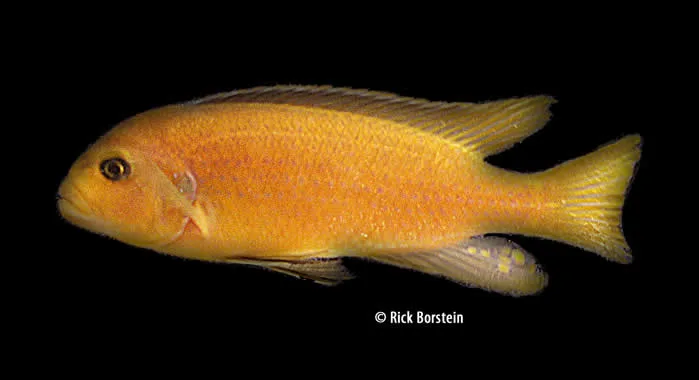
The defining trait recorded in this form's trade name is size: field and hobby accounts describe "kingsizei" populations as notably large for the genus, plausibly exceeding the roughly 4–4.5 in typical of most Maylandia. Beyond that size claim, no detailed published colour or pattern account exists specifically for the Lupingu population, and no confirmed measurements have been recorded. This article does not attach a specific colour description to this form beyond what its name indicates, to avoid inventing detail that has not been documented.
Habitat
This form is recorded from Cape Kaiser and Lupingu, both on the Tanzanian shore of Lake Malawi, in the stretch of rocky coast along Tanzania's portion of the lake. Like other Maylandia, it is expected to occupy rocky reef habitat around the boulder-strewn shoreline typical of this coast. Water conditions follow Lake Malawi's typical rocky-habitat envelope: warm, alkaline, and well-buffered, at the moderate depths characteristic of rocky mbuna reefs.
Feeding
Maylandia is, genus-wide, an aufwuchs grazer, rasping algae, diatoms, and associated micro-organisms from rock surfaces with specialised bicuspid teeth. No feeding study specific to "Kingsizei Lupingu" has been published, but this dietary pattern is close to universal across the genus and is a reasonable expectation for this form as well; its reportedly larger size may simply reflect greater growth potential on the same general diet rather than a different feeding strategy.
Mating
Male mbuna of the Maylandia zebra complex are territorial rock-holders, defending a patch of reef against rivals and displaying to passing females with no lasting pair bond. A larger-bodied male, if the "kingsizei" size claim holds for this population, might plausibly hold and defend a larger territory than average, but this has not been documented, and its courtship behaviour is presented here as genus-typical rather than independently confirmed.
Breeding
As with every Lake Malawi cichlid, Maylandia sp. "Kingsizei Lupingu" is presumed to be a maternal mouthbrooder: the female lays eggs, takes them into her mouth, and is drawn to the egg-spot markings on the male's anal fin, whose pursuit causes her to take in milt that fertilises the clutch already in her buccal cavity. She then broods the eggs and fry for roughly three weeks before releasing free-swimming young, with no male or post-release parental care. No clutch size has been documented for this specific form; a larger-bodied female might plausibly carry a larger-than-average clutch for the genus, but this has not been confirmed.
In the aquarium
Maylandia sp. "Kingsizei Lupingu" is a specialist form with limited hobbyist documentation. Keepers should follow standard Maylandia husbandry: a large rockwork structure with plenty of caves and broken sightlines, fine sand substrate, and alkaline, well-buffered water in the range of roughly 75–82 °F and pH 7.7–8.6. If its reported larger adult size holds true in captivity, a correspondingly larger tank footprint than the genus minimum is a sensible precaution. Diet should lean heavily plant-based — spirulina flake, algae wafers, and blanched vegetables — with meaty foods limited to occasional supplements, since chronic high-protein feeding predisposes mbuna to bloat. A single male with several females is the standard, lowest-stress social arrangement.
Conservation
Maylandia sp. "Kingsizei Lupingu" has no IUCN Red List assessment, since formal evaluation requires a validly published scientific name and none exists for this form. As a rock-restricted population apparently confined to a small stretch of the Tanzanian shore, it shares the general pressures documented across Lake Malawi's rocky-habitat mbuna — localised habitat disturbance, sedimentation, and ornamental collecting — but no population-specific data exist to characterise its status beyond that general context.