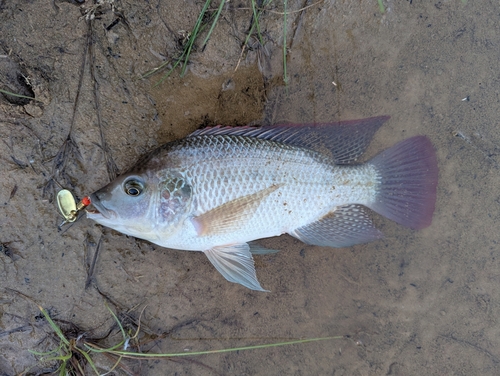
Taxonomy & naming
Oreochromis andersonii was described by the French naturalist Francis de Laporte de Castelnau in 1861. The species epithet honors the Swedish explorer Charles John Andersson (Karl Johan Andersson, 1827-1867), who travelled widely in what is now Namibia in the mid-19th century. The genus name blends the Greek oreos (of the mountains) with chromis, an old name for a perch-like fish, coined for the genus around its type species Oreochromis hunteri from the slopes of Mt. Kilimanjaro. Boulenger's Tilapia kafuensis (1912), named for the Kafue River, is a junior synonym, which is why the fish is still often called the Kafue bream.
The species sits in the tribe Oreochromini of the cichlid subfamily Pseudocrenilabrinae — the substrate-nesting, maternal-mouthbrooding tilapias, a lineage quite distinct from the dazzling rock-dwelling haplochromine flock that makes Lake Malawi famous. Trewavas' 1983 monograph on the tilapiine genera Sarotherodon, Oreochromis and Danakilia remains the standard taxonomic treatment. Common names vary by region and language: three-spot tilapia or threespot bream in English, driekolkurper in Afrikaans, njinji in Lozi, and simply 'three-spot' or 'Kafue bream' among anglers and fish farmers.
Morphology
This is a large, deep-bodied tilapia. FishBase records a maximum length of about 24 in (24 in) total length and a published weight near 10.4 lb (4.7 kg), with a reported lifespan of up to 11-13 years — a serious food fish, not an ornamental. The body is fusiform and laterally compressed, its depth roughly 40-50% of standard length. Fin counts run to 15-18 dorsal spines and 11-15 soft rays, three anal spines, and 30-32 vertebrae; the lateral-line series carries 31-35 scales.
The name points to the diagnostic feature: non-breeding fish and females carry three or four conspicuous dark blotches along the mid-flank, set off by red margins on the dorsal and caudal fins. Breeding males transform, taking on a dark, iridescent purplish-brown over the head, back and flanks that all but masks the spots, while the red fin margins broaden and brighten. The pectoral fins are notably long in adults (34-43% of standard length), and breeding males develop enlarged jaws — useful pointers for separating andersonii from the several other tilapias it shares its rivers with, such as the greenhead Oreochromis macrochir.
Habitat
Oreochromis andersonii is a southern and south-central African floodplain-river fish. Its natural range covers the upper Zambezi, the Kafue, the Okavango and Ngami basins, and the Cunene River into Angola, with occasional records from the middle Zambezi (including Lake Kariba and Cahora Bassa) following dam construction. The IUCN lists it as native and extant across Angola, Botswana, Namibia, Zambia and Zimbabwe. It is a lowland, warm-water species — FishBase gives a thermal range of about 64-91 °F (64–91 °F) and a depth band of roughly 0-33 ft (0–33 ft), usually 10-20 ft (10–20 ft).
It favors fairly deep, quiet or slow-flowing water with some weed cover; adults hold in deeper pools and main river channels, with hippo pools a favored retreat, while juveniles and sub-adults spread through floodplain lagoons, large open swamps and inshore vegetation, and only rarely into small tributaries. The fish is hardy and tolerant of brackish conditions up to around 20 ppt. None of this describes Lake Malawi, and that distinction matters: andersonii is not a Malawi endemic and does not naturally occur in the lake. Where it touches the Malawi story at all is as a regional aquaculture species that, like other farmed tilapias, can be moved into catchments where it does not belong.
Feeding
Three-spot tilapia is a low-trophic-level feeder — FishBase places it around trophic level 2.1 — and functions chiefly as a diurnal detritivore and microphage. Its diet centers on fine particulate matter: detritus, attached and suspended algae, diatoms and zooplankton, gathered as it grazes and filters its way over soft bottoms. Larger individuals broaden the menu to include insects and other invertebrates, and the species is opportunistic, shifting its intake with whatever food the season makes available on a floodplain that swells and drains each year.
Ecologically it is a schooling, mid-water-to-bottom generalist of productive lowland waters rather than a niche specialist. That generalist, fast-growing, warm-water-loving profile is exactly what makes it a good aquaculture candidate — and, conversely, what makes its close relative the Nile tilapia such an effective invader when introduced into the same kinds of habitat.
Mating
Like other Oreochromis, andersonii is an arena-breeding, lekking tilapia in which the males do the building and the displaying. A territorial male excavates a large, saucer-shaped nest — a simple circular depression that can reach about 30 in (29.5 in) across and 12 in (12 in) deep — in sandy substrate at the center of a defended territory, typically in water 3-10 ft (3–10 ft) deep, uprooting vegetation with the mouth as he digs. Nests can cluster densely, with up to 40 reported close together in classic lek fashion, and males display from these bowers to attract passing females.
Spawning is temperature-gated: it does not occur below about 70 °F (70 °F), and in the wild it is concentrated in the warmer months. Notably, pond trials in Zambia found that andersonii begins breeding earlier and at lower temperatures than introduced Nile tilapia, an advantage at the higher, cooler altitudes of its native range. The male's role ends essentially at fertilization — he contributes the nest, the courtship and the genes, but no parental care.
Breeding
Oreochromis andersonii is a maternal mouthbrooder, and the female is the sole caregiver. She lays her eggs in the hollow of the male's nest; he fertilizes them, and she immediately takes them up into her mouth to incubate. From there she shelters the developing eggs, larvae and fry inside her buccal cavity, and continues to guard the free-swimming young for the first weeks after hatching, gathering them back into her mouth when danger threatens.
Multiple broods are raised across a single warm season, so a successful female may cycle through several mouthbrooding bouts between spring and autumn. This maternal-mouthbrooding strategy — a defended nest for spawning, then full incubation and brood care carried entirely by the female — is the hallmark of the genus Oreochromis and sets these tilapias apart from the substrate-guarding, biparental cichlids elsewhere in the family.
In the aquarium
Honest framing first: Oreochromis andersonii is essentially never kept as an ornamental aquarium fish, and there is no real hobbyist care literature for it the way there is for Malawi mbuna or peacocks. It is a food and sport fish — a 'fine angling and table species,' in FishBase's words, and an IGFA-record gamefish — and where people 'keep' it, they keep it in ponds for aquaculture, not in glass tanks for display.
The practical knowledge that exists is aquaculture knowledge, and it is genuinely useful for understanding the animal. It reaches a foot or two in length, so any tank capable of holding an adult would be enormous; it is a digger that will rearrange substrate and uproot plants when building nests; and males are territorial nest-holders. In Zambian pond polyculture it is run alongside Oreochromis macrochir and Coptodon (Tilapia) rendalli to exploit different feeding niches, and farm trials report it tolerating cool weather and low-protein manure-fertilized conditions better than Nile tilapia, with growers often noting better taste and color. The one keeping lesson that transfers cleanly to hobbyists is a conservation one: tilapias hybridize readily, so andersonii should never be mixed, released, or allowed to escape where other Oreochromis live.
Conservation
The IUCN Red List assesses Oreochromis andersonii as Vulnerable under criterion A3e (version 3.1), in an assessment by D. Tweddle and B.E. Marshall dated 1 March 2007, published in 2007 and flagged as needing updating; the population trend is listed as decreasing. Two pressures drive that status. The first is fishing: stocks on the Barotse floodplain of the upper Zambezi are thought to have fallen sharply since the 1960s under heavy, small-mesh netting, with floodplain lagoons no longer providing refuge because they are all intensively seine-netted, and a commercial gillnet fishery targets the species in the Okavango Panhandle. The second, and the one the assessors weighted most heavily, is genetic and competitive swamping by introduced Nile tilapia (Oreochromis niloticus), spread through the region by aquaculture. Where Nile tilapia invades — it has already driven Oreochromis esculentus and Oreochromis variabilis to extinction in Lake Victoria, replaced Oreochromis mortimeri in Lake Kariba, and is displacing Oreochromis mossambicus in the Limpopo — the assessment projects local declines of up to 100%, which is why the species would rate Critically Endangered in Zambia alone but is buffered globally by less-invaded populations such as the Cunene.
This is exactly where the species intersects with Lake Malawi, even though it is not a Malawi fish. The basin review by Chavula and colleagues (Journal of Great Lakes Research, 2023; DOI 10.1016/j.jglr.2023.102241) identifies the same cluster of stresses on the Malawi/Niassa/Nyasa system: over-fishing and the well-documented collapse of the chambo (the lake's own endemic Oreochromis tilapias); sediment and nutrient loading washing off deforested catchments; roughly +33 °F of warming in the shallow water column, which strengthens stratification and starves the productive surface layer of deep nutrients; and the looming risk of invasive species, with Nile tilapia introductions into the Malawi catchment singled out as a threat to native biodiversity. The lesson cuts both ways. Andersonii itself is a victim of farmed Nile tilapia in its own rivers, and were it ever moved into the Malawi basin for culture it would become just another non-native tilapia capable of hybridizing with and displacing the lake's endemics. The careful statement is this: Oreochromis andersonii is Vulnerable but stable in parts of its native range, the Malawi basin is under serious and growing strain, and the thread connecting the two is the unmanaged spread of aquaculture tilapias — a threat to indigenous fish whether the indigenous fish is andersonii on the Zambezi or chambo in Lake Malawi.