Taxonomy & naming
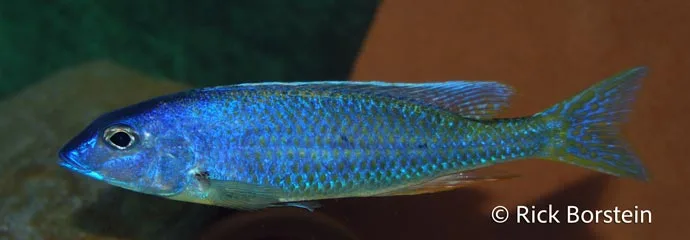
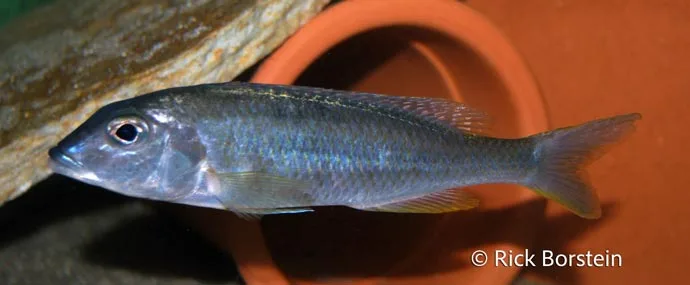
Otopharynx sp. "Silver Torpedo" has no describing author, no publication date, and no entry under a validated name in Eschmeyer's Catalog of Fishes; it is an informal trade name, not a scientific one. The name is purely descriptive, referring to a slender, streamlined, fusiform body shape — the "torpedo" build — combined with a plain silvery ground colour, distinguishing this form from the deeper-bodied, more strongly patterned Otopharynx typical of the genus. The genus Otopharynx, raised by Regan in 1920, spans a range of body shapes tied to different habits, from deep-bodied benthic species to more elongate, open-water forms, and no published study has established which described species, if any, this streamlined Senga Bay population is most closely allied to.
Morphology
As implied by its trade name, this form is described as slender and streamlined — a torpedo-shaped, fusiform body rather than the deeper, more laterally compressed outline typical of most other Otopharynx — combined with a plain silvery ground colour rather than the strong blue-and-yellow breeding patterns seen elsewhere in the genus. Beyond that documented profile, detailed morphometrics have not been published for this population. Genus-typical size for mid-sized Otopharynx runs to roughly 4.5–6 in total length; no validated maximum has been recorded specifically for this form. A slender, silvery build of this kind is often associated in Malawi haplochromines with a more open-water, actively swimming lifestyle rather than a sedentary, rock- or sand-bound one.
Habitat
The form is recorded from a single point at Senga Bay, a well-known central-western Malawian locality near Salima that mixes sandy shoreline with scattered rock. A slender, silvery, torpedo-shaped build is generally associated with fish that spend more time cruising open water above the substrate rather than sheltering tight to rock or sand, and this population is presumed to favour a similarly open habitat around Senga Bay, though the precise depth range and microhabitat used by this specific form have not been documented.
Feeding
Otopharynx species span a range of feeding strategies, from open-water zooplankton feeders to more benthic invertivores. A slender, streamlined body of the kind implied by this form's trade name is more consistent with an active, open-water feeding style — chasing zooplankton or small prey items through the water column — than with picking invertebrates from sand or scraping algae from rock, though no dedicated feeding study has confirmed this for Otopharynx sp. "Silver Torpedo" specifically.
Mating
Breeding behaviour has not been documented specifically for this form. By analogy with other Otopharynx and the wider Lake Malawi haplochromine assemblage, males are expected to hold a breeding territory and display breeding colour to attract passing females, following the general haplochromine courtship pattern built around egg-spot markings on the male's anal fin. No field account of courtship exists specifically for this form, and its comparatively plain silvery colouration may make any breeding-colour changes subtler than in more strongly patterned Otopharynx.
Breeding
As in all Lake Malawi haplochromines, reproduction is by maternal mouthbrooding: the female carries the fertilised eggs and subsequent fry in her mouth, without normal feeding, for several weeks until they are large enough to be released as independent, free-swimming young. The male takes no further role after spawning. Clutch size and brooding duration have not been documented for this specific form; genus-typical figures for mid-sized Otopharynx suggest a modest clutch and a brooding period of roughly three to four weeks.
In the aquarium
Otopharynx sp. "Silver Torpedo" is an uncommon fish in the hobby, generally reaching keepers through specialist Malawi cichlid importers rather than general retail. A tank for it should provide generous open swimming space, reflecting its likely active, open-water habits, with a sand substrate and modest rockwork rather than the dense cave structure suited to mbuna. Water chemistry should follow the Lake Malawi standard — alkaline and well-buffered, pH roughly 7.7 to 8.6, temperature 75–82 °F. Otopharynx species are generally less aggressive than rock-dwelling mbuna and are usually kept successfully alongside other calm, similarly sized Malawi haplochromines. Diet should include a quality cichlid pellet supplemented with small live or frozen invertebrates such as brine shrimp and mysis.
Conservation
Otopharynx sp. "Silver Torpedo" has not been evaluated by the IUCN and, as an undescribed form, has no Red List status of any kind. Its documented range is limited to a single point at Senga Bay, an accessible and reasonably well-surveyed part of the Malawian shore, but no population assessment or targeted study has been published for this specific form. In the absence of that data, the honest position is that it is unassessed, and that a form known from only one locality warrants the same general caution applied to other narrow-range Malawi endemics.