Taxonomy & naming
Petrotilapia nigra was described by A. C. Marsh in 1983, in a short taxonomic revision of the genus published in the Ichthyological Bulletin of the J. L. B. Smith Institute of Ichthyology (No. 48). The holotype is held at the Natural History Museum, London (BMNH 1981.2.2.206), with paratypes split among London, the South African Institute for Aquatic Biodiversity, and the Smithsonian. Eschmeyer's Catalog of Fishes and FishBase both list it as a valid species, and that status has held through every subsequent treatment of the genus.
The genus name joins the Latin petra, "stone" or "rock," with a Bantu (Bechuana) word for fish — a fitting label for a lineage glued to rocky habitat. The epithet nigra is simply Latin for "black," a nod to the dark coloration of dominant males. Marsh split it off, alongside Petrotilapia genalutea, from what had been a single-species genus built around Trewavas's 1935 Petrotilapia tridentiger. The genus has grown steadily since — Petrotilapia chrysos (1996), Petrotilapia microgalana (2006), five species from Lundeba, Stauffer and Konings in 2011, and Petrotilapia kitrinos in 2026 — to roughly eleven valid species plus a string of undescribed forms. Within that flock, Petrotilapia nigra lends its name to one of the three habitat-based species groups the cichlid specialist Ad Konings recognized (the others anchored on Petrotilapia tridentiger and Petrotilapia genalutea), whose members share female coloration and a preferred depth band on the rocks.
Morphology
This is a stocky, deep-bodied mbuna of modest size; the largest recorded specimen measured about 4.8 in (5 in) standard length, so a wild adult is a hand-sized fish rather than a large one. The dorsal fin carries roughly 17 to 19 spines, in line with its congeners.
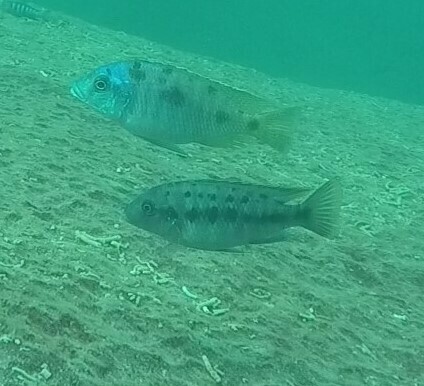
Dominant males are unmistakable within the genus: predominantly blue-black, overlaid with seven to ten gray-to-brown vertical bars, with a dark blue cheek and a black throat — the dark cast that gives the species its name. That combination separates Petrotilapia nigra from look-alikes: Petrotilapia genalutea males wear an orange-yellow cheek over a duller gray-blue body, Petrotilapia microgalana males are a brighter blue with a yellow throat, and Petrotilapia pyroscelos males show fiery pelvic fins and a purple cheek. Females and non-territorial males are far plainer — a beige to yellowish ground color on the flank — which is itself a useful field mark, since females of some relatives (such as Petrotilapia pyroscelos) are instead brown to gray. As in nearly all mbuna, sexual dimorphism is strong and tied to dominance: only breeding males develop the full black livery, and a subordinate male can look much like a female. Coloration alone is a notoriously slippery guide across Petrotilapia, which is part of why the genus has needed repeated revision.
Habitat
Petrotilapia nigra is endemic to Lake Malawi and, within that vast lake, to a relatively short run of the southwestern rocky coast. The IUCN assessment records it from at least nine localities — Chia, Nkhomo Reef, Mumbo Island, Otter Point, Thumbi West Island, Zimbawe Rock, Domwe Island, Tsano Rock, and Monkey Bay — spanning a combined rocky shoreline of more than 25 mi. Tellingly, it is absent from the intervening islands (Mbenji, Namalenje, and the Maleri group), a patchiness typical of mbuna, whose populations are isolated wherever stretches of open sand break the rock into islands they will not cross.
It is strictly a rock-dweller. Divers have found it from the extreme shallows down to about 115 ft (115 ft), but the sexes sort themselves by depth: territorial males concentrate around 20 to 33 ft (20–33 ft), while females are most numerous in the shallowest water. The water it lives in is the warm, alkaline, well-buffered, well-oxygenated upper layer of Lake Malawi — broadly pH around 7.7 to 8.8 and temperatures in the high 70s Fahrenheit (mid-20s Celsius) — the same biotope that has driven the explosive radiation of the lake's rock cichlids.
Feeding
Petrotilapia are specialist grazers of aufwuchs — the dense felt of algae, diatoms, and the small invertebrates living within it that coats every sunlit rock surface in the lake. The genus's signature adaptation is its dentition: broad, fleshy lips densely covered with rows of long, slender, flexible, mostly tricuspid teeth. Rather than rasping rock the way some mbuna do, the fish brushes these movable teeth through the algal turf, combing loose the diatoms and filamentous strands that catch between teeth and lips. FishBase notes that Petrotilapia nigra feeds from the sediment-free biocover on the rocks, taking the minute diatoms that use the algal strands as a substrate, and that in deeper water it works the vertical rock faces.
Its diet is not purely vegetable. The IUCN account lists aufwuchs together with benthic invertebrates and plankton, and FishBase places the species at a trophic level around 3.4 — consistent with an omnivorous grazer that takes animal matter along with the algae it combs. In the broader community it is one link in the crowded mbuna guild, dozens of algae-grazing species partitioning the same rocky reefs by depth, microhabitat, and exactly how each one harvests the turf.
Mating
The depth segregation of the sexes points to a polygynous mating system in which territorial males hold and defend space on the rocks while females range more widely — the pattern documented across the Lake Malawi rock-cichlid flock. In Petrotilapia nigra, dominant males concentrate in the 20-to-33-foot band and develop the full blue-black livery, dark blue cheek, and black throat that signal breeding condition, while females stay shallower and remain a plain beige to yellowish; a male's claim to a patch of reef is what gives him access to passing females.
The behavioral headline, for anyone who keeps them, is aggression. Petrotilapia are widely regarded among the more pugnacious mbuna genera; in keeper discussions of the lake's most aggressive cichlids, "any Petrotilapia species" is a recurring nomination alongside Melanochromis and Tropheus. Territorial males in the wild defend substantial patches of reef, and that drive — which underwrites the whole mating system — does not switch off in glass. Treat reports of tameness with suspicion: the consistent signal from people who have kept the genus is that the males are demanding tenants.
Breeding
Like all Lake Malawi mbuna, Petrotilapia nigra is a maternal mouthbrooder. After spawning over a male's territory, the female takes the fertilized eggs into her buccal cavity (the mouth and throat) and carries them, and then the developing fry, through development — releasing free-swimming young only once they can fend for themselves. It is a strategy that trades large clutches for heavily protected, well-developed offspring, and one reason mbuna are such persistent breeders: clutch sizes in this group typically run on the order of a few dozen eggs, and the female alone provides all the care.
No brood-specific counts have been published for Petrotilapia nigra, so any figure is genus-typical rather than measured for this species; the broad mbuna pattern is small clutches of large, yolk-rich eggs and a brooding period of roughly three weeks before the female spits out independent juveniles. Males contribute no parental care beyond defending the spawning site.
In the aquarium
Petrotilapia nigra is not a beginner's mbuna, and it is uncommon in the trade compared with the standard Pseudotropheus and Metriaclima offerings. It reaches a fair size for an mbuna and combines that with genuine aggression, so the realistic starting point is a long tank — think a 4-foot footprint at the very minimum and a 6-foot tank for a serious group, measured in footprint rather than gallons because floor space and lines of sight are what actually defuse fighting. The standard mbuna playbook applies: aquascape with a lot of stacked rock to create territories and visual breaks, and stock at a density that spreads aggression rather than letting one male fixate on a single target.
Water should mirror the lake — alkaline, well-buffered (pH roughly 7.8 to 8.6), and warm (about 76 to 82 °F / 75–82 °F), with the strong filtration and disciplined water changes that a heavily fed, messy mbuna tank demands. Because the wild fish is an aufwuchs grazer, lean toward a spirulina- and vegetable-based diet; an overly rich, protein-heavy feeding regime is a common mistake with algae-combing mbuna and can cause digestive trouble. Tankmates should be other robust, similarly assertive Malawi rock cichlids, never timid community fish, and not close congeners or look-alikes that would hybridize or compound the aggression. The honest summary: a striking, behaviorally interesting fish for an experienced rift-lake keeper with the room and the temperament to manage it — and a poor choice for anyone wanting a peaceful or compact setup.
Conservation
The IUCN Red List assesses Petrotilapia nigra as Least Concern (assessed 2018; assessor Ad Konings), an upgrade from the Vulnerable status it carried in the 2006 assessment. The reasoning is straightforward: it is a very common fish across at least six localities on more than 25 mi of rocky shoreline, its population is considered stable, and — crucially — roughly 95% of its range falls inside the Lake Malawi National Park, a World Heritage site, with the assessment noting that 91–100% of the population sits within protected areas. It is neither targeted by the ornamental trade nor taken by subsistence fishers, so collection pressure on this particular species is minimal. The one threat flagged in its own assessment is sedimentation.
That single word ties the species to the lake's wider trouble. Basin-scale reviews of Lake Malawi/Niassa/Nyasa (Chavula et al., 2023, Journal of Great Lakes Research) describe a system under mounting strain: heavy over-fishing and the collapse of the prized chambo tilapia fishery; sediment and nutrient loading off deforested, eroding catchments; roughly +33 °F of warming in the shallow layer that strengthens stratification, slows mixing, and trims productivity; and the risk of invasive species. For a shallow rocky-shore grazer, sedimentation is the most direct of these — silt smothers the very aufwuchs-coated rock the fish feeds from, degrading both food and spawning habitat, which is exactly why catchment erosion is the threat singled out in its assessment. The honest reading is the careful one: Petrotilapia nigra itself is not currently threatened, buffered by abundance and a national park, but the lake it depends on is not in robust health, and a narrow-range endemic with no second home has little margin if those basin pressures reach its reefs.