Taxonomy & naming
Few cichlids have a more tangled nomenclatural history than this one. The fish was first named by Linnaeus in the landmark tenth edition of Systema Naturae (1758) as Sparus saxatilis — placed, like so many early teleosts, in a genus it has nothing to do with. Over the following century it was redescribed under a string of other names by authors working from Guianan material: Gronovius listed it as Scarus (or Sparus) rufescens in 1763, Bloch added Perca saxatilis and Perca brasiliensis in 1792, and Jardine & Schomburgk christened it Cychla rutilans in 1843. When Johann Jakob Heckel erected the genus Crenicichla in 1840, the older Linnaean epithet eventually took priority, and the fish settled — for most of the twentieth century — as Crenicichla saxatilis (Linnaeus, 1758), namesake of the 'saxatilis group' of mid-sized spangled pikes.
That stability was deceptive. Because the species had been described so early and so loosely, nearly every spangled pike from the Orinoco to the Amazon to the Río de la Plata was for decades filed under the name, so that 'Crenicichla saxatilis' came to denote a continent-spanning grab-bag rather than a real biological species. The cleanup began with Ploeg's revision of the saxatilis group and was carried furthest by Kullander & Nijssen's monograph 'The Cichlids of Surinam' (1989), which restricted the type locality to Surinam — Carolina Creek, in the Suriname River system — and pruned the species back to a recognizable Guianan fish. Most of the far-flung 'saxatilis' populations have since been split off as their own species (Saxatilia albopunctata, Lugubria multispinosa, Lugubria johanna, and many others). Most recently, Varella, Kullander, Menezes, Oliveira & López-Fernández (2023), in an integrative phylogenetic revision of the pike cichlids, broke the unwieldy old Crenicichla apart and transferred the saxatilis group — about 23 species — into a new genus Saxatilia, with Sparus saxatilis as its type. Under that classification the correct combination is Saxatilia saxatilis. The change is recent and not yet universally adopted by the aquarium trade or every database, where the long-familiar Crenicichla saxatilis persists.
Morphology
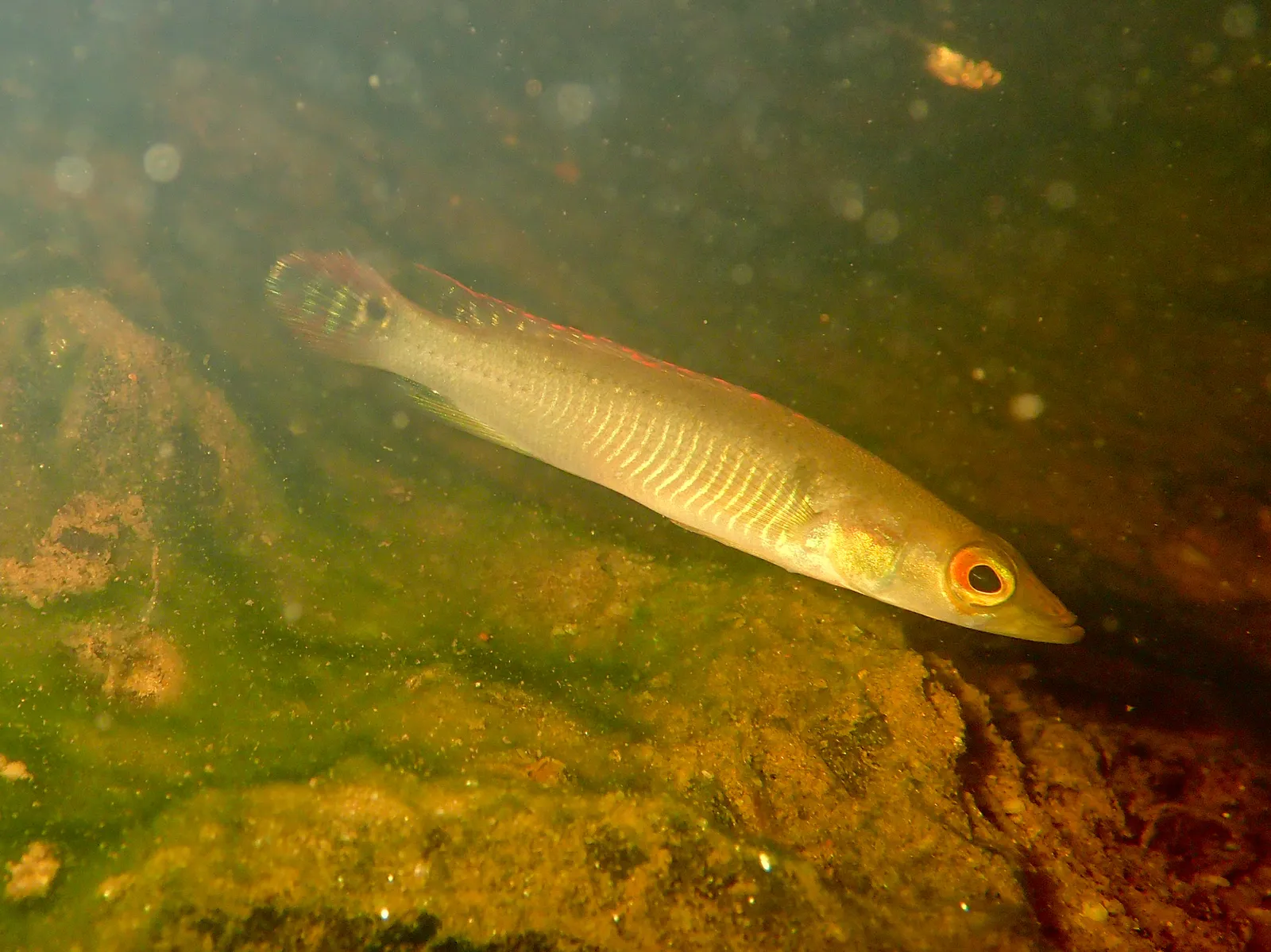
Saxatilia saxatilis has the classic pike-cichlid build: an elongate, cylindrical, only slightly compressed body, a long head with a large terminal mouth, and the dorsal and anal fins set far back so that the fish presents a streamlined profile well suited to lurking and lunging. It is a medium-sized member of the genus — FishBase gives a maximum of about 8 in standard length, and the revisionary material examined by Ploeg ran to 5 in SL (about 6 in total length) across 25 specimens, with the largest individuals reported near 7 in total length. Reports of pike 'over 18 inches' attached to the saxatilis name in older hobby literature refer to the broad old species concept, not this restricted Guianan fish.
Coloration is muted but handsome: the flanks are brown to olive-grey, often paler below, and in good condition males in particular are dusted with rows of small pale pearlescent spots ('spangling') and pinkish to yellow dots on the upper sides. A row of darker blotches runs along the lateral lines from the gill cover back toward the tail, and there is a dark humeral blotch behind the operculum plus the usual pike facial markings — preorbital, postorbital and suborbital dark stripes radiating from the eye. The diagnostic feature, and the source of the common name, is a single black, light-ringed (ocellated) spot set low on the base of the caudal fin, just above the end of the lower lateral line — the 'ring' on the tail. Counts that help separate it from its relatives include roughly 15–20 dorsal spines, 13–15 soft dorsal rays, and 21–25 scales in the first lateral-line series. Sexual dimorphism is real but moderate, and clearest in breeding condition: males grow larger, carry most of the spangling and the brightest dot-work, and develop more pointed unpaired fins, while ripe females are rounder-bodied. On the dorsal fin specifically, Konings (Enjoying Cichlids) draws a direct contrast between the two main Crenicichla lineages of the Guianas: in the short-snouted 'Batrachops' group, breeding females carry a red or orange-red band along the dorsal fin, while in the S. saxatilis group — the group this species belongs to and gives its name to — breeding females instead show conspicuous markings or round blotches on the dorsal fin. That correction should be read as replacing any earlier claim that this species' females lack dorsal-fin markings altogether; they do show them, just not as a red-banded ocellus in the Batrachops-group style.
Habitat
Once the inflated old range is stripped away, Saxatilia saxatilis is a fish of the Guiana Shield littoral: the Atlantic-coast drainages of Suriname, French Guiana and Guyana, extending into eastern Venezuela and onto the island of Trinidad, with FishBase and the IUCN assessment also listing adjacent northern Brazil. Reports of the species from the Orinoco and the Amazon proper generally trace back to the old over-broad concept or to closely related saxatilis-group pikes now recognized as distinct. Kullander & Nijssen note that in Surinam and French Guiana the fish occupies the coastal river systems and their tributaries rather than the deep interior.
It is most typical of smaller flowing waters. FishBase summarizes it as 'often found in creeks, but sometimes captured in rivers, especially during the dry season,' when shrinking pools concentrate fish in the larger channels. The habitat is benthopelagic — the pike holds station near the bottom and among cover (submerged wood, root tangles, leaf litter, marginal vegetation and undercut banks) from which it ambushes prey. Published in-situ chemistry is sparse, but the Guianan coastal streams it favours are warm and run from soft and acidic blackwater to more neutral, moderately mineralized clearwater; FishBase records a representative pH around 7 and hardness near 10 dGH, with a tropical temperature range of roughly 77–86 °F. These are shallow-water habitats — creeks and the margins of rivers, on the order of the uppermost metre or two of the water column rather than open deep water — though no precise depth band has been published for the species.
Feeding
Saxatilia saxatilis is a carnivorous ambush predator, and FishBase does not mince words in calling it 'a formidable predator.' Its trophic level is estimated at about 3.3, squarely in the middle-predator range. Examination of wild diet shows it is less single-mindedly piscivorous than its torpedo shape suggests: the fish 'consumes essentially aquatic insects, fish and plant material,' so the bulk of the everyday diet is made up of aquatic insect larvae and other small invertebrates taken from the substrate and cover, supplemented by small fish and incidental plant matter. Like other pikes it hunts by stalking and a sudden short rush, the large mouth and backward-set fins giving it the acceleration to snap up prey at close range. In the Guianan creek community it functions as a mid-sized predator on invertebrates and smaller fishes, an important regulator of the small-fish fauna of the shallow margins it patrols.
Mating
As with the rest of the genus, reproduction in Saxatilia saxatilis is built around a monogamous pair bond and a defended territory. Pikes pair off and become markedly territorial as spawning approaches, the pair jointly excluding other fish from the area around their chosen nest site. Pair formation can be fraught — pikes are notoriously intolerant of an ill-matched partner, and an unreceptive or mismatched fish may be harassed or killed — so in the wild, as in captivity, a settled pair represents a real social achievement. Hobbyist accounts of the saxatilis group note that spawning males tend to run noticeably larger than their mates (Lowe-McConnell recorded breeding males of Saxatilia saxatilis roughly 15% larger than the females), a size disparity that probably helps establish and stabilize the bond. Courtship involves the usual cichlid repertoire of lateral displays, fin-spreading and quivering, with the spangled, dot-marked males showing their brightest colours; once the pair is committed they clean and guard a concealed spawning surface together.
Breeding
Saxatilia saxatilis is a biparental cave (substrate) spawner, the reproductive mode shared across the genus, and by Konings' assessment the S. saxatilis group — this species' own group — is one of the more reliably breedable lineages within Crenicichla, alongside the Batrachops group, in clear contrast to the large predatory pikes of the genus, which have mostly resisted captive breeding altogether. The female deposits a clutch of adhesive eggs on the ceiling of a cave near the bottom — in nature a rock crevice, an undercut bank, a hollow under a submerged root or log, often enlarged by the female's own excavating — where the eggs stick fast and are hidden from open-water predators. Specific clutch counts for wild Saxatilia saxatilis are not well documented; saxatilis-group and related medium-sized pikes typically lay on the order of a few hundred eggs (congeners such as Saxatilia proteus have been recorded depositing roughly 300–400 eggs in a single cave spawning), so a genus-typical figure of about 200–400 eggs is a reasonable expectation for this species. Water chemistry matters directly to egg survival: per Konings, pH should be kept below 7 to prevent the eggs deteriorating, and if a clutch fails to develop into larvae the male can turn destructive, an aggression risk worth anticipating rather than a fault in the fish. Care is shared in the usual pike division of labour: the female tends the clutch directly — fanning the eggs to keep them oxygenated and picking off any that fungus — while the male patrols and defends the wider territory. After hatching, the wrigglers are guarded in or near the cave and then the free-swimming fry are shepherded by both parents as a tight school, retreating into cover at any disturbance. The fry take small live foods as they grow and are defended vigorously until they approach independence.
In the aquarium
The ringtail pike has a long but low-key history in the hobby: it appears in shipments of mixed Guyanese and Surinamese fishes and is kept by pike-cichlid specialists, but it has never been a mainstream aquarium fish — FishBase bluntly notes it is 'not very popular among aquarists because of its aggressive behavior.' It is best regarded as an intermediate-to-advanced fish: not delicate once settled, but demanding in space and temperament.
A single adult or a bonded pair needs a long tank — a footprint of roughly 4 feet or more (on the order of 250–300+ litres) — aquascaped for a territorial ambush predator. That means plenty of structure: driftwood, root tangles, rockwork and at least one or two genuine caves (a length of pipe, a rock overhang, an inverted flowerpot with a chipped entrance) to serve as refuges and potential spawning sites. Sand or fine gravel suits its bottom-oriented habits, and subdued lighting with some floating cover encourages it to come out and behave naturally rather than skulk. A secure, well-fitted lid is essential: like all pikes, this is an accomplished jumper.
Water should be warm and clean — about 77–86 °F, pH from the mid-6s to the mid-7s, soft to moderately hard — and well filtered, since a predator on a meaty diet produces a heavy waste load; generous regular water changes keep it in condition. Note the cautionary thread that runs through the hobby literature on freshly imported Guyanese saxatilis-group pikes: they often arrive stressed and prone to disease, so careful quarantine and prompt treatment of new wild stock pays off. Feeding is straightforward once the fish is settled, though one common assumption needs correcting: despite being piscivorous, Crenicichla do not need live fish and, per Konings, do not do well on flake or pelleted food at all — it is not recommended for the genus. Frozen and fresh meaty foods are the reliable staple instead: whole or minced frozen fish, shrimp or a shrimp mix, mosquito larvae, mysis and other crustaceans, plus earthworms, prawn and mussel pieces, offered both at mid-water (where this species often hunts) and on the bottom. Feeder fish are unnecessary and best avoided on disease grounds.
Tankmates are the crux. Outside breeding the ringtail pike is moderately predatory rather than relentlessly murderous, but it will eat anything small enough to swallow and will not tolerate close competitors in its territory, so companions should be robust, similarly sized fish kept in a tank large enough to spread out — larger characins, robust catfish and the like. The hardest pairing is with its own kind: getting two pikes to bond without one killing the other is the classic challenge, and a common trick borrowed from breeders of the group is to keep a 'target' third fish on which a forming pair can vent aggression. For all but experienced keepers, a single specimen in a large, well-furnished tank is the most reliable way to enjoy this elegant predator.
Conservation
The IUCN Red List assesses Saxatilia saxatilis as Least Concern (assessed 28 October 2020 by C. Lasso; published 2023). The species is widespread across the Guianan and adjacent coastal drainages of Brazil, French Guiana, Guyana, Suriname, Trinidad and Tobago, and Venezuela, occupies a range of creek and river habitats, and faces no known range-wide threat; it carries no CITES listing. It is collected for the ornamental trade but at a level the assessment does not flag as a population concern. As with the wider Guiana Shield freshwater fauna, the relevant background pressures are habitat-level rather than species-specific — deforestation, gold-mining and the mercury contamination that accompanies it, and the degradation of coastal-river water quality — none of which is documented as a present danger to this adaptable and broadly distributed pike. One taxonomic caveat is worth noting for anyone tracking its status: because the old Saxatilia saxatilis concept was so broad, conservation and occurrence records published under that name may refer to several now-distinct species, so range-wide statements should be read against the modern, restricted definition of the fish.