Taxonomy & naming
Aulonocara hueseri was described in 1987 by the German workers Manfred K. Meyer, Rüdiger Riehl and H. Zetzsche, in a revision of the genus Aulonocara (Regan, 1922) published in Courier Forschungsinstitut Senckenberg that simultaneously introduced six new species. The name has been treated as valid ever since (Eccles & Trewavas 1989; Maréchal 1991; Konings 2016) and has never been moved to another genus. The holotype (SMF 21138) and nine paratypes (SMF 21139) are held at the Senckenberg Museum in Frankfurt; the type locality is the east coast of Likoma Island, in the Malawian sector of the lake. Within the genus the Cichlid Room Companion places it in the stuartgranti species group — the assemblage of small, sand-associated 'peacocks' whose males wear blue. It is most closely allied to Aulonocara korneliae of neighbouring Chizumulu Island, which grows somewhat larger, is a touch deeper-bodied, and shows an orange shoulder patch in breeding males. Worth flagging for the careful reader: although the species is universally recognised in the hobby, Konings notes it was never given a rigorous diagnostic separation from its relatives, and is distinguished mainly by a combination of male coloration, body proportions and geographic isolation rather than by a single clean morphological character. The fish reaches the trade under several labels — 'Night aulonocara,' 'Midnight' or 'Midnight Blue,' and occasionally 'Aulonocara sp. White Top' — and is usually sold tagged to its collection point, most often 'Likoma' or 'Mbamba.'
Morphology
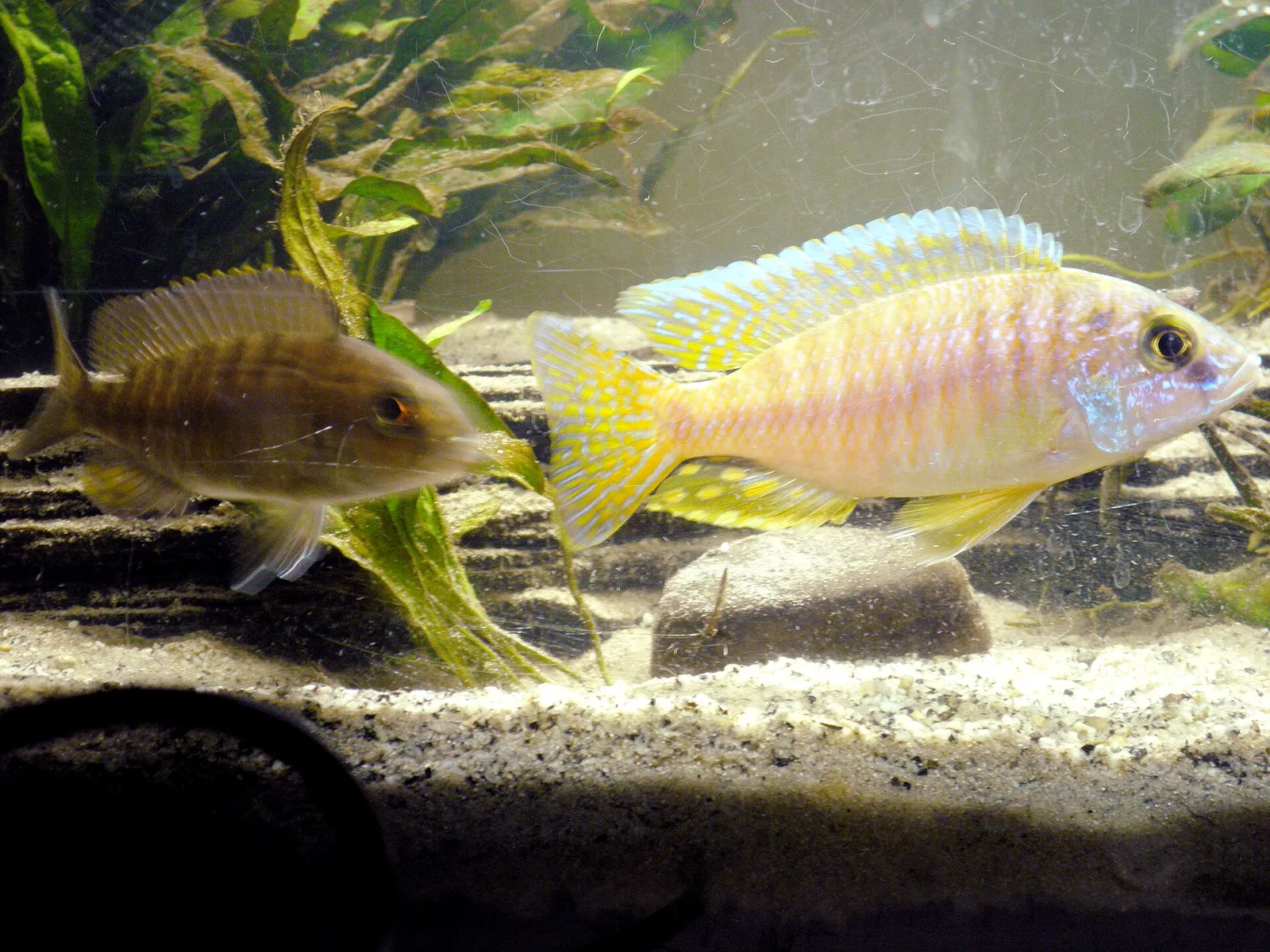
This is a small peacock. FishBase records a maximum of 3 in standard length (the snout-to-tail-base measure) for preserved material, while field and aquarium sources that quote total length put males at around 4.5 in and females at about 3.5 in; the apparent disagreement is largely the SL-versus-TL distinction plus the fact that well-fed captive fish outgrow wild ones. The body is the moderately elongate, gently arched peacock shape, built for hovering over open bottom rather than squeezing through rock. Sexual dimorphism is pronounced. A mature male develops a deep metallic-blue sheen over the head and back, dark navy-to-black dorsal and pelvic fins, and a dorsal fin neatly edged in white; the flanks flush yellow toward sexual maturity and yellow streaking appears in the tail. That dark-finned, blue-bodied look is the source of the 'night' and 'midnight' names. Females and immature fish are a plain grey-brown carrying a series of faint vertical bars — the same bars ghosted in the males — which makes them genuinely difficult to tell apart from the females of other blue Aulonocara, a confusion with real consequences for keepers (see In the aquarium). The diagnostic genus feature is internal: like all Aulonocara, hueseri carries conspicuously enlarged cephalic lateral-line canals and pores across the lower head, the sensory apparatus that gives the genus its name and its hunting style.
Habitat
Aulonocara hueseri is a Lake Malawi endemic, and the sources disagree about how far it ranges. Konings and the malawi.si database treat it as restricted to Likoma Island; the IUCN assessment likewise describes it as occurring at a single island. FishBase and the CLOFFA checklist, by contrast, list additional records from Domwe and Thumbi West Islands, Monkey Bay, Nankumba and Nkhata Bay, far to the south and on the opposite shore. Because the females and sub-adults are so easily confused with those of other blue peacocks, the conservative reading — and the one followed here — is that the Likoma population is the firmly established one and the scattered far-field records may involve look-alike congeners. It lives in the lake's intermediate zone, the transitional habitat where sand meets scattered rock rather than continuous reef, and is most abundant at depths of roughly 16–49 ft, with an average around 26 ft. The water is the warm, alkaline envelope typical of Malawi: surface temperatures of about 75–79 °F over the species' depth band and a pH that sits high (field and aquarium figures cluster around 7.7-8.4). These are stable, well-buffered conditions, and the fish is adapted to them rather than to the soft acidic water of many other aquarium cichlids.
Feeding
The peacocks are sand-sifting ambush invertivores, and hueseri is a textbook example. It hovers a short distance above open sand, holding still while the enlarged lateral-line pores on its lower jaw pick up the faint movements of small animals buried just beneath the surface; when it registers prey it tilts down and lunges, taking a mouthful of sand and sorting the edible from the grains. The wild diet is accordingly small benthic invertebrates and micro-crustaceans living in and on the sand. FishBase places the species at a trophic level of about 3.5, consistent with a carnivore of small animal prey rather than an algae-grazer or a piscivore. In the community it occupies the same guild as the lake's other sand-associated peacocks and the small Lethrinops sandsifters, partitioning the open-bottom invertebrate resource. The genus's sensory specialisation is the key to that role: it lets these fish exploit prey they cannot see, in habitat that offers little cover, which is exactly why the peacocks have radiated so successfully across Malawi's sand and intermediate zones.
Mating
Outside breeding, hueseri is a mild, gregarious fish; females in particular move in loose foraging groups over the sand. Reproduction restructures this around territorial males. A ready male takes up a small territory in the narrow spaces between flat rocks and sand, often excavating a shallow scrape or cave beneath a rock as a spawning site, and defends it against rival males. Crucially for the lake's ecology and for the aquarist, these territories are typically packed close together and held at short range rather than spread far apart — a lek-like arrangement in which males display side by side and females travel through to choose. Aggression is otherwise low: this is a peaceful species that competes poorly with pushier cichlids, and territorial behaviour is largely confined to breeding males. Courtship follows the standard Aulonocara pattern, the male flaring his blue flanks and dark, white-edged dorsal to lead a receptive female down to his cleaned site.
Breeding
Aulonocara hueseri is a maternal (ovophilic) mouthbrooder, the reproductive mode shared by the great majority of Lake Malawi's haplochromine cichlids. Spawning is the classic peacock sequence: the female lays a small clutch of eggs on the male's cleaned spawning surface and immediately takes them up into her mouth, then nuzzles the egg-spots on the male's anal fin, prompting him to release milt that fertilises the eggs already in her buccal cavity. She alone then incubates, carrying and oxygenating the developing eggs and larvae in her mouth without feeding for roughly three weeks before releasing free-swimming fry; the male provides no parental care. Clutches are modest — in keeping with the fish's small size, on the order of a few dozen eggs rather than the hundreds a large hap might produce — and exact wild fecundity has not been carefully documented. In aquaria the species breeds readily for a peacock: keepers report that a cool, large water change after a conditioning period on rich foods reliably triggers spawning, after which the brooding female can be left to release her fry or, by more experienced hands, stripped and the fry reared separately on newly hatched brine shrimp and powdered foods.
In the aquarium
Aulonocara hueseri is not among the most commonly kept peacocks — the ubiquitous OB morphs and the showier stuartgranti variants dominate the trade — but it has a committed following, and it is a manageable species for anyone already experienced with Lake Malawi cichlids. A single male and a harem of three or more females can be accommodated in a tank of 30 US gal (about 31.5 in) at a minimum, though 40–55 US gal gives noticeably better outcomes by allowing the male to spread his display away from the females without constant stress. Longer footprints are more useful than taller tanks; the fish live in the lower and middle zones. Water must replicate the Malawi envelope: 75–79 °F, pH 7.7–8.4, and meaningful carbonate hardness (150–300 mg/L GH or equivalent dH). If your tap water is soft, the standard approach is a modest crushed-coral substrate or a small bag of coral gravel in the filter to buffer the pH upward; the species is not especially sensitive to small fluctuations within that range, but it will not thrive — and will not colour up reliably — in soft or acidic water.
Substrate and decor are important to this fish's behaviour. Aulonocara hueseri evolved for open-sand hunting: a fine sand layer of at least 2 in allows males and females alike to sift and hover in the way their lateral-line system demands, and it is far kinder to their undersides than gravel. Rockwork belongs toward the back and sides of the tank, creating cave openings and ledges that give the territorial male a boundary to defend and a spawning site to clean; the front two-thirds of the floor should be kept clear. Dense planting is not part of the Malawi aesthetic and is largely irrelevant to hueseri's foraging biology, though hardy Vallisneria rooted along the back wall can soften a tank and does not conflict with the fish's needs.
Tankmate selection requires care. Peaceful haplochromines and utaka — Copadichromis, Placidochromis, and the larger Lethrinops sandsifters — make broadly compatible community partners provided the tank is large enough. What to avoid is worth stating plainly. Mbuna (the rock-dwelling cichlids of genera such as Pseudotropheus, Labeotropheus, and Melanochromis) are typically too aggressive for a fish as mild as hueseri, and they will monopolise food and territory to the peacock's detriment. The more subtle problem is other Aulonocara species: peacocks hybridise readily in captivity, and because the females of different blue stuartgranti-group species are nearly identical in appearance, mixed-peacock tanks almost guarantee unwanted crosses. If you are keeping hueseri seriously — for the species' own sake, or because you are obtaining the fish from a known Likoma collection and want to maintain a recognisable strain — keep it as the only Aulonocara in the tank. Introducing a second peacock species is the single most common mistake keepers make, and the hybrid offspring are not hueseri.
A 1:3 or 1:4 male-to-female ratio is the workable social structure. A lone male with one female will over-harass her; two or more males in most hobbyist-sized tanks creates persistent fighting. Females are better kept in a group, which distributes the male's attention. The male will display persistently to his harem; provided the females have enough room to move away and the decor breaks line of sight, this is normal rather than harmful. Conditioning on frozen Mysis, Daphnia, or small bloodworm, and a periodic large (30–40%) cool water change, reliably triggers spawning attempts. The brooding female will hold her eggs for roughly three weeks; she can be left to release the fry into the main tank if there are enough hiding places, or she can be moved to a dedicated brooding vessel and either allowed to complete the hold naturally or gently stripped at the two-week mark and the fry reared on fine powder foods and newly hatched Artemia nauplii.
Difficulty is best described as intermediate: not as demanding as highly territorial or polygamous cichlids, but not a beginner fish either, because the water chemistry requirements are non-negotiable, the hybridisation risk is a real husbandry constraint, and getting males into their best colour takes stable conditions, a good diet, and the right social structure. The species rewards careful management with genuinely striking males and — unlike some Aulonocara — a relatively peaceful community tank that can be enjoyed without constant intervention.
Conservation
The IUCN Red List currently assesses Aulonocara hueseri as Least Concern, in an assessment by Ad Konings dated 23 May 2018 and published in the 2019 Lake Malawi/Nyasa/Niassa catchment review; the rationale is that although the species occupies a single, very restricted area around Likoma Island, there are no significant threats acting on the population. This is a recent revision worth being precise about: an earlier (2006) assessment listed the fish as Vulnerable on the strength of its restricted range alone, and several hobby references — including the Cichlid Room Companion species page and the malawi.si profile — still carry that older 'Vulnerable' designation. Konings, who authored both the Red List assessment and much of the field literature, explicitly judged the restricted distribution not to constitute a real threat, which is why the current category is Least Concern. The species itself is therefore not considered at risk, but a single-island endemic of the shallow intermediate zone has no margin for error, and it sits inside a lake under genuine basin-wide strain. Reviews of the Lake Malawi/Nyasa/Niassa system (Chavula and colleagues, 2023; the IUCN catchment assessment) document heavy overfishing and the collapse of the endemic chambo (Oreochromis) flock, rising sedimentation and nutrient loading from catchment deforestation and agriculture, and the early signatures of climate-driven warming and reduced mixing. None of these is documented as a present danger to hueseri specifically, but sedimentation and shoreline disturbance bear directly on exactly the shallow sand-and-rock habitat it depends on — the reason a narrowly endemic shallow-water fish deserves continued monitoring even when its formal status is reassuring.