Taxonomy & naming
The red zebra was a familiar aquarium fish for two decades before it had a name. Imported from Lake Malawi in the early 1970s and long passed off as a colour morph of the zebra mbuna, Pseudotropheus (now Maylandia) zebra, it was finally given a formal description by Ad Konings in 1995, in the May issue of Tropical Fish Hobbyist, as Pseudotropheus estherae. Eschmeyer's Catalog of Fishes records the holotype as MRAC 94-56-P-1 (with ten paratypes, MRAC 94-56-P-2-11) in the Royal Museum for Central Africa at Tervuren, and gives the type locality as Minos Reef, Miluluka, Lake Malawi, Mozambique. Because the species was later moved out of Pseudotropheus, the authority is written in parentheses: estherae (Konings, 1995). Which genus it belongs in is, however, genuinely contested. The species sits in the zebra complex, a tight cluster of barred and unbarred rock-dwellers that most workers agree warrant their own genus apart from Pseudotropheus. The dispute is over the genus's name. Meyer & Foerster coined Maylandia in 1984 and Stauffer and colleagues erected Metriaclima for essentially the same group in 1997, regarding Maylandia as a nomen nudum (a name published without a valid diagnosis); the priority and availability questions have been argued back and forth ever since and remain unsettled, with recent analyses still defending Metriaclima as the valid name. The practical result is that the same fish appears in the literature as Maylandia estherae, Metriaclima estherae, and Pseudotropheus estherae. The Catalog of Fishes currently lists it as Maylandia estherae, the name used here, while the IUCN and Konings's own recent books use Metriaclima estherae — all three refer to the identical fish, and the disagreement is purely nomenclatural.
Morphology
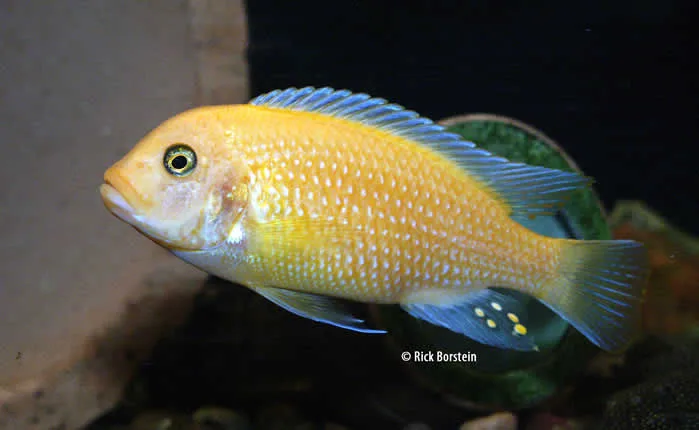
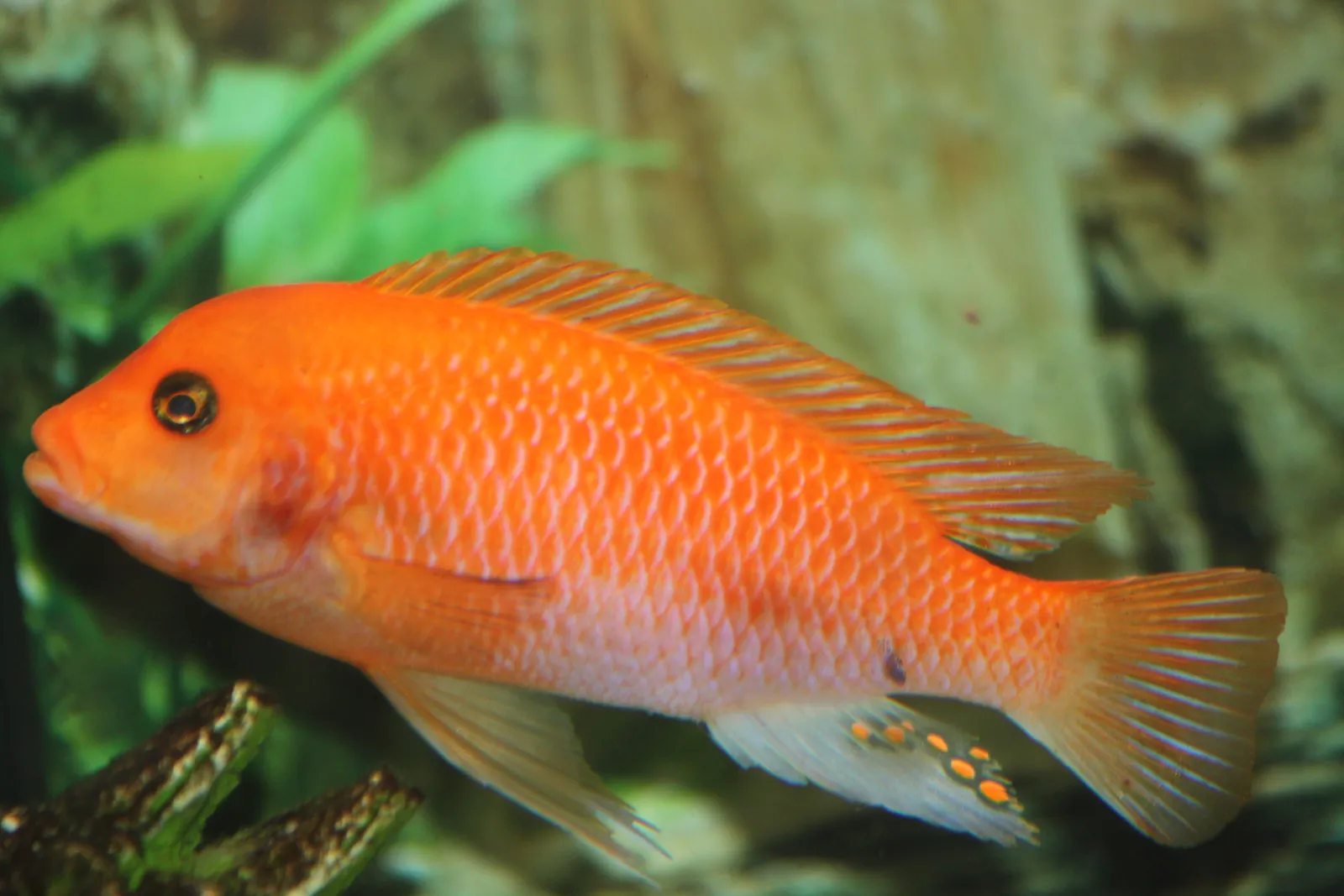
This is a small, robustly built mbuna with the deep, laterally compressed body and steeply sloped forehead typical of the zebra group; the fin counts run to 16–17 dorsal spines, 9–10 dorsal soft rays and three anal spines. Size reports vary with sex and with how length is measured. FishBase, following the original description, gives a maximum of 3 in standard length for males and 2.5 in SL for females; malawi.si records wild females reaching about 3 in and males about 4 in total length, and the IUCN notes the largest measured individual at 4 in TL. In aquaria, where food is abundant and growth unchecked, males commonly exceed these figures and may reach roughly 5–6.5 in. The diagnostic feature is the absence of the bold vertical bars that mark its relative the zebra mbuna — red zebras are essentially barless. Colour, though, is the headline. At and near the type locality, mature males are a plain light to cobalt blue, and at Minos Reef itself they carry yellow ocellated spots in the soft dorsal fin (a marking absent in populations further north, and a useful field clue where two zebra-type species share a reef). Females are the famous warm orange to orange-red, though the genus's broader colour polymorphism also produces yellow females, orange-blotched (OB) females mottled with black, and — rarely — orange or OB males. Where the sexes share a colour, they are told apart by size and by the egg-spots (ocelli) on the anal fin, which are larger and more numerous in males.
Habitat
Maylandia estherae is endemic to Lake Malawi and confined to the lake's eastern, largely Mozambican shore. The IUCN range description places it on the eastern coast between Metangula (Chilucha Reef) and Nkhungu Point, and again between Meponda and the Nsinje River, a substantial but discontinuous strip; the type locality, Minos Reef, lies off Meluluca about 9.3 mi south of Metangula and forms part of the Miluluka reef system. It is a fish of sediment-free upper rocky habitat — the clean, algae-covered rock that mbuna depend on — and is most abundant in shallow water, typically no deeper than about 26–33 ft, with population density falling off below that. At Minos Reef it is common around small rock groups scattered on sand, with breeding males staying closer to the larger rock formations. In-situ chemistry for this exact spot has not been published separately, but it sits within Lake Malawi's well-characterised surface envelope: warm, alkaline and well-buffered, with temperatures broadly in the mid-20s Celsius and a pH around 7.7 to 8.8. As a shallow rocky-shore endemic it is, like other mbuna, effectively confined to its home reef — the intervening stretches of open sand are barriers its rock-bound lifestyle does not cross, which is why isolated populations diverge in colour.
Feeding
The red zebra is an aufwuchs grazer. Aufwuchs is the felt-like mat of filamentous algae, diatoms and the small invertebrates living among it that coats Malawi's rocks, and it is the foundation of the entire mbuna community. Maylandia estherae works this mat by combing loose algal strands and diatoms from the rock surface with a wide, terminal mouth, striking repeatedly at the substrate; the IUCN assessment specifically notes it feeds on algae from the rock at an angle of about 90 degrees to the surface. It is therefore a grazer of the loose, easily detached component of the aufwuchs rather than a specialist that scrapes the tightly attached algal base the way a Labeotropheus does, and FishBase places it low on the food web at a trophic level near 2.0. In the aquarium it readily takes prepared foods, but a strongly plant-based diet — spirulina and other algal items — matters: these fish have a long herbivore gut, are prone to obesity and to the digestive disorder "Malawi bloat" when overfed on rich animal protein, so beefheart and similar meats should be avoided.
Mating
Like the rest of its genus, the red zebra is a polygynous, lek-style breeder with no pair bond. Males are territorial, defending a patch of rock roughly a metre across centred on a cave or crevice that serves as the spawning site; the IUCN notes territories of about that diameter. A male in breeding condition intensifies his colour and displays at the boundary of his patch, working to lead receptive females in. It is moderately aggressive by mbuna standards — robust rather than exceptionally belligerent — and most of that aggression is directed at conspecific males and at look-alike species, which is the practical reason keepers crowd them and keep a single male per group. One quirk recorded both in the wild literature and by keepers: in the absence of a male, a dominant female can take on male colour and run through the courtship motions toward other females, without of course being able to fertilise anything. The colour system itself appears to be under sexual and social selection — work by Allender and colleagues (2003) found the Minos Reef population near-fixed for orange females, and read the parallel orange/OB radiations across the zebra complex as evidence of divergent selection driving incipient speciation.
Breeding
Maylandia estherae is a maternal (ovophilous) mouthbrooder, and an easy and prolific one — part of why it is such a common beginner's cichlid. After courtship the female follows the male into his cave and lays a small clutch on the rock; she immediately takes the eggs into her mouth, then nuzzles the egg-spots on the male's anal fin, drawing in milt that fertilises the clutch already in her buccal cavity. Spawning happens inside the cave and is rarely visible from outside. She then broods the eggs and larvae in her mouth for roughly three to four weeks, fasting through much of that time and hiding among rocks, before releasing free-swimming fry; there is no further parental care and no male involvement after spawning. Clutch sizes are modest for a fish this size — on the order of a couple of dozen up to perhaps fifty or so eggs in the genus, with larger females carrying more. Fry are large enough at release to take brine-shrimp nauplii and powdered foods straight away. One genetically important detail: a red (orange) female's brood can include both orange and brown offspring, and juveniles generally show the adult female pattern — the substrate on which the lake's colour polymorphism is maintained generation to generation.
In the aquarium
The red zebra is one of the most accessible mbuna in the hobby — hardy, bold, visually rewarding, and willing to breed readily in ordinary hard-water conditions — but it still demands an honest commitment to space, water quality, and dietary discipline. A sensible minimum for a single-male group is a tank in the 47 in (roughly 300-litre) range; experienced keepers regularly run them in 59–71 in setups to defuse territorial pressure and give the dominant male somewhere to be without constantly driving every other fish into a corner. The bottom two-thirds of the tank should be filled with stacked rockwork — piles of smooth river stones or lake-shore slate arranged to create a labyrinth of caves and narrow passages rather than a neat backdrop. This is not decoration; mbuna organise their social lives around rock terrain, and females and subordinate males need visual barriers to escape line-of-sight aggression from the dominant male. Sand or fine gravel substrate suits the species, though no special texture is required since they spend most of their time on or around the rocks rather than in the open sand.
Water chemistry should closely mirror Lake Malawi's surface envelope. Target a temperature of 75–79 °F (upper end acceptable for breeding activity), a pH in the range 7.8–8.5, and general hardness of roughly 10–25 dH. Many municipal supplies are already hard enough; where they are not, crushed coral or aragonite gravel will buffer pH upward naturally. Efficient filtration is non-negotiable — Malawi cichlids are messy eaters and their bioload in a crowded system is substantial — and regular water changes of around 20–30 percent weekly are strongly recommended to keep nitrates in check. Deteriorating water quality is a common precursor to Malawi bloat, the digestive and systemic condition that kills mbuna kept in less-than-ideal conditions.
Diet is where many keepers slip up. Maylandia estherae is an aufwuchs grazer with a long herbivore gut, and feeding it a high-protein regime — beef heart, worm-based pellets, heavy live food — is a reliable route to the bloating and rapid internal infection that constitutes Malawi bloat. The staple should be a quality spirulina- or algae-based flake or pellet, supplemented with blanched spinach or lettuce and the occasional small feed of brine shrimp or daphnia for variety. Rich protein foods such as bloodworm, tubifex, or mammalian flesh products should be offered sparingly or avoided entirely. Feeding small amounts twice a day rather than one large meal reduces digestive stress.
Tankmate selection requires care. The red zebra is moderately aggressive and holds its ground easily against similar-sized mbuna; compatible species are other mbuna of roughly equal size and temperament — Labidochromis caeruleus, Pseudotropheus demasoni in numbers, various Cynotilapia — ideally chosen to minimise visual similarity. Keeping more than one male Maylandia estherae in a tank smaller than about 78.5 in is generally inadvisable, and mixing it with other barless blue or orange-dominant mbuna invites hybridisation: Maylandia estherae will readily cross with closely related Maylandia and Metriaclima species, and hybrids are common in the trade. Non-mbuna from different ecological guilds — Aulonocara, Copadichromis, and other open-water Malawi species — can work in larger setups as long as the tank is not overcrowded and hiding space is generous, but delicate or timid fish do not fare well in the company of active mbuna.
Breeding in captivity happens without special prompting once a well-conditioned female is ready. The male courts with intensified colour and lateral displays, the pair spawns briefly in a cave, and the female retreats to hold her brood for three to four weeks, eating little or nothing. She is best left in the main tank through the brooding period unless heavy harassment puts her at risk; a dedicated brooding tank is an option but the transfer itself can cause the female to spit the clutch prematurely. Fry are released at a functional size and can take powdered foods and newly hatched brine shrimp from the outset. The female should be fed well and rested between spawns; females pushed to spawn again before they have recovered condition decline quickly. One note for buyers and keepers: the commercial "red zebra" trade is substantially composed of line-bred variants and, frequently, hybrids with other orange or OB mbuna, meaning the fish sold under this name is not always a true Maylandia estherae. Hobbyists seeking the genuine species should look for locality-labelled stock from trusted Malawi specialist breeders.
Conservation
The IUCN Red List assesses the red zebra as Least Concern, assessed on 20 June 2018 by Ad Konings with Jos Snoeks as reviewer — an upgrade from the Vulnerable listing it carried in 2006 and 2017. (The Red List files the species under Metriaclima estherae, reflecting the genus dispute.) The justification is straightforward: it is endemic to Lake Malawi but occupies a relatively large area along the eastern shore, is a common mbuna within that range — denser in the north — and faces no major threats. The assessment flags two potential pressures specific to it: sedimentation, which smothers the clean rock its aufwuchs grazing depends on, and collection for the aquarium trade, in which it is a regular and long-established export. Neither is judged a population-level threat at present. That comparatively comfortable status nonetheless sits inside a lake under real and worsening strain. Lake Malawi holds one of the planet's richest freshwater fish faunas — on the order of 800-plus cichlid species — and a basin-scale review by Chavula and colleagues (2023) documents mounting sediment and nutrient loading, shoreline degradation, warming surface waters and reduced mixing, alongside heavy inshore fishing pressure. For a shallow, rock-bound, sediment-sensitive endemic, soil erosion and sedimentation from a deforesting catchment are precisely the kind of pressure that matters most, even where the species itself remains, for now, secure.