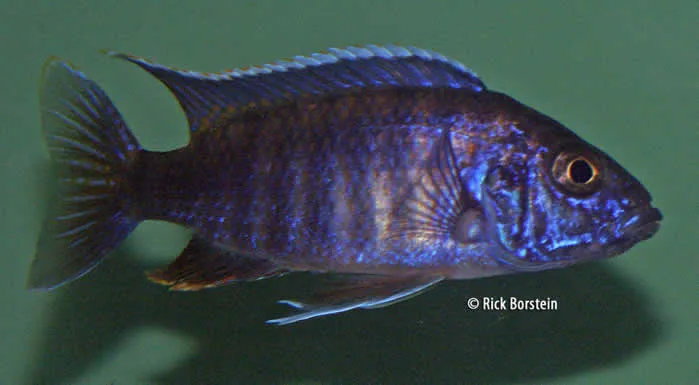
Taxonomy & naming
Aulonocara sp. "Walteri" is a provisional, informal name applied to a Malawi peacock that has not been scientifically described. It is treated here in the convention used by Ad Konings and other Lake Malawi field workers, who give such unnamed populations a working tag — genus, the abbreviation "sp.", and a trade or locality epithet in quotation marks — precisely to flag that the taxon is not yet formal. The form is best understood as allied to the Aulonocara stuartgranti / "jacobfreibergi"-grade complex of yellow-flanked, blue-faced peacocks from the lake's shallower rock-and-sand interface, but the affinity is stated honestly as a similarity, not a determination: "Walteri" may ultimately prove to be a colour population of an already-described peacock, a distinct undescribed species, or a hybrid-influenced aquarium line. Because no description exists, there is no holotype, no type locality fixed in the literature, no authority, and no year. Any catalogue entry, FishBase number, or IUCN status attached to this name elsewhere should be treated with suspicion — none has been validly established. The genus Aulonocara Regan, 1922 itself is well founded, diagnosed by the conspicuously enlarged cephalic lateral-line canals and sensory pores that the whole peacock group shares; "Walteri" sits within that genus on morphology, but its species-level identity remains open.
The epithet "Walteri" is a hobby designation and has no nomenclatural standing. It is not italicised in formal usage, takes no authority and no date, and would gain neither until and unless a worker publishes a description fixing a type specimen and diagnosis under the rules of the International Code of Zoological Nomenclature. Within the Lake Malawi peacock literature, names of this kind accumulate around visually distinctive populations that exporters and aquarists need to refer to before science catches up; many such tags — for sand-dwelling and rock-associated Aulonocara alike — have persisted for decades in Konings's photographic guides and on collector data sheets without ever being formalised. "Walteri" is one of these. It is grouped with the yellow members of the Aulonocara stuartgranti assemblage on the basis of male nuptial colour and head shape, but the grouping is provisional. Until a revision treats it, the responsible course — and the one taken here — is to use the quoted informal name, withhold any invented author or year, and describe what is observed rather than assert a rank the taxon has not been given.
Morphology
In overall build, Aulonocara sp. "Walteri" is a typical small-to-medium peacock: a moderately deep, laterally compressed haplochromine body in the size range usual for the stuartgranti-grade forms, with mature males running larger than females. The diagnostic genus feature is plain on the head — the lateral-line canals of the face are widened into a system of enlarged sensory pores, the apparatus the fish uses to detect buried prey. Sexual dichromatism is marked, as in the peacock radiation generally: dominant, territorial males carry saturated nuptial colour — yellow to gold flanks crossed by metallic blue on the face and the unpaired fins — while females and non-territorial males are far plainer, smaller and silvery-brown with cryptic barring. Precise meristic and morphometric data are not available because no formal description has been published; figures such as a fixed maximum length or fin-ray counts should not be cited as established for this name. What can be said reliably is qualitative: it presents as a yellow-and-blue peacock of the stuartgranti type, with the genus's hallmark enlarged head pores and the strong male/female colour split that the group is known for.
Habitat
Aulonocara sp. "Walteri" is reported from the south-western sector of Lake Malawi, in the broad Maleri Islands region — an area of shallow rocky reefs grading into open sand that hosts a dense cluster of related yellow peacocks. The form occupies the classic Aulonocara intermediate zone: scattered rocks and rubble standing on a sandy floor rather than continuous rock or pure sand, at the moderate depths typical of the shallower peacocks (broadly the upper rock-sand interface, on the order of several metres to around 49–66 ft, the depth band these stuartgranti-grade forms favour). The water is Lake Malawi's warm, alkaline medium throughout the upper column: temperatures of roughly 75–82 °F, pH in the alkaline 7.7–8.6 range, and steady carbonate buffering. Because the name is informal and no field assessment has fixed its distribution, the locality given here should be read as the region with which the form is associated in hobby and collector usage, not as a formally delimited range.
Feeding
Like all peacocks, Aulonocara sp. "Walteri" is a sand-sifting micro-invertivore that locates prey via the ampullary and enlarged lateral-line pores of the head. It hovers just above the substrate, holding station while the cephalic sensory system registers the faint movements of invertebrates buried in the sand; when prey is detected it darts down, takes a mouthful of sediment, and sifts edible items from the grains, expelling the spent sand through the gills and mouth. This is a benthic hunting strategy rather than algae grazing, and it ties the fish to clean, invertebrate-rich sand between and around the rocks of its habitat. In captivity the implication is the same as for its described relatives: a fine sand bed that permits natural sifting (coarse gravel inhibits the behaviour and can abrade the gills), plus a varied diet of fine prepared foods and small live or frozen invertebrates such as chironomid larvae and brine shrimp.
Mating
As a Lake Malawi haplochromine, Aulonocara sp. "Walteri" is expected to follow the polygynous, lek-like social pattern of the peacock radiation, with no pair bond. Males in nuptial colour establish and defend small territories on the sand or at the base of rocks, each typically centred on an excavated pit or a sheltered spot beneath rubble; females are non-territorial and move singly or in loose groups across the habitat, visiting displaying males. Courtship is brief and conventional for the genus: a ripe female approaches a colour-flashing male at his site and spawning follows directly. Because dominant males of these stuartgranti-grade peacocks tend to hold colour for extended periods rather than only at a brief seasonal peak, the lek is effectively active across much of the year. In the aquarium the practical corollary is well known for the group — a single male with several females avoids the relentless aggression that surplus males direct at rivals and at similarly patterned tankmates.
Breeding
Aulonocara sp. "Walteri" is, like every member of the genus, a maternal (ovophilous) mouthbrooder. After courtship draws a willing female to the male's spawning site, she lays a small batch of eggs and immediately takes them into her mouth; drawn to the egg-spot markings on the male's anal fin, she mouths at these and takes in milt that fertilises the clutch already held in her buccal cavity. Aulonocara clutches are modest — typically a few dozen eggs in this size class — and the female broods them in her mouth for roughly three to four weeks, feeding little or not at all, before releasing free-swimming fry. There is no biparental care and no further investment once the brooding female releases her young; the fry can take brine shrimp nauplii after any remaining yolk is absorbed. As with related undescribed peacocks, the species is expected to breed readily in captivity, which is one reason such forms circulate in the hobby ahead of any formal description — and a reason keepers should take care to maintain them as clean, unhybridised lines.
In the aquarium
Aulonocara sp. "Walteri" is kept and traded as one of the many yellow-and-blue peacocks in the hobby, and — as with all informal forms — the single most important husbandry caution is provenance. Because the name carries no formal definition and the stuartgranti-grade peacocks are notoriously easy to confuse and to cross, fish sold under this tag vary in origin and purity. A keeper who wants the form as a distinct entity should buy from a specialist breeder who keeps records and does not mix related peacocks, and should avoid the casual "all-male peacock tank" if the goal is ever to breed true, since mixed males plus later-added females are a recipe for hybridisation.
A single colony of one male with three or four females is the natural and recommended arrangement. Males in permanent nuptial colour are perpetually ready to spawn and will harass unreceptive females in a bare tank, so provide a footprint of at least 47 in with generous open swimming space, a fine sand bed at least 2 in deep to support sifting behaviour, and a background of stacked rock giving broken sightlines and refuges. Dense planting is neither required nor natural; most keepers omit plants to preserve alkaline hardness, though Vallisneria and Anubias tolerate these conditions if wanted.
Water chemistry should mirror Lake Malawi's upper column: temperature about 75–82 °F, pH 7.7–8.6, and well-buffered water. The fish is not fussy about exact numbers within that window, but soft or acidic water causes chronic problems. Weekly partial water changes of 20–30 % matter because the nitrate that accumulates in a Malawi setup stresses the fish even when ammonia and nitrite read zero. Diet is straightforward: a quality cichlid pellet or flake staple, supplemented with frozen or live chironomid larvae, brine shrimp and daphnia, fed over a fine bed that lets the fish display its natural hovering-and-dart sifting. Avoid high-fat foods, which predispose Malawi cichlids to bloat; spirulina-enriched foods are a sensible regular addition. Breeding follows the standard peacock routine and usually needs no intervention beyond optionally moving a clearly carrying female to a holding tank.
Conservation
No IUCN Red List assessment exists for Aulonocara sp. "Walteri", and none can, because the form has not been formally described — the Red List evaluates validly named taxa. Its conservation standing is therefore genuinely unknown, and no status, category, or assessment year should be attributed to it. What can be said is contextual rather than specific: the shallower yellow peacocks of Lake Malawi's south-western rock-and-sand reefs are, as a group, exposed to ornamental-trade collection pressure, and several validly named members of the stuartgranti assemblage have drawn conservation concern where their ranges are narrow. Whether "Walteri" represents a distinct, narrowly distributed population at similar risk, or merely a colour variant of a more widespread described species, cannot be resolved until the taxonomy is. The honest position is that this is an unevaluated, informally named form whose very identity is unsettled; responsible keepers should favour captive-bred, record-kept stock and avoid contributing demand for wild-collected fish of uncertain provenance.