Taxonomy & naming
Haplochromis phytophagus was described by the British ichthyologist Peter Humphry Greenwood in 1966, in the Annals and Magazine of Natural History (series 13, volume 8, the issue dated for 1965 — hence the year is sometimes cited as 1965). Greenwood erected it not under Haplochromis but as the type species of a new subgenus, Xystichromis (Xyster, a surgeon's scraper, from Greek), and the original combination is properly written Haplochromis (Xystichromis) phytophagus. The holotype (BMNH 1965.8.6.6) and a long series of paratypes are held at the Natural History Museum in London; the type locality is Kisumu, at the Kenyan (Nyanza Gulf) corner of Lake Victoria. The name remains valid as Haplochromis phytophagus, and the Catalog of Fishes, FishBase and the ETYFish Project all retain the conservative Haplochromis heading used here. In much of the hobby and in several phylogenetic studies the fish is nonetheless treated under the resurrected genus Xystichromis, and some workers have alternatively allied it with the modern Lake Victoria haplochromines placed in Astatotilapia. This instability is endemic to the Victoria flock: its hundreds of cichlids radiated so recently and so explosively that genus limits within the so-called Haplochromis assemblage are still genuinely unsettled, and a single binomial in the literature can shuttle between Haplochromis, Xystichromis and Astatotilapia depending on the author.
Morphology
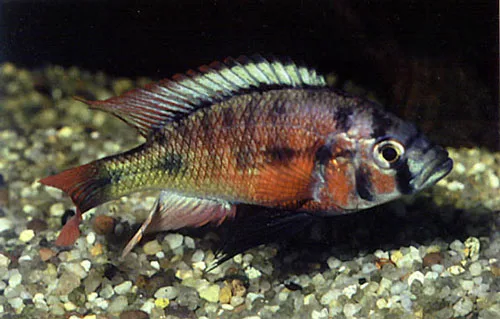
This is a small, robustly built haplochromine. FishBase records a maximum of 3.5 in standard length from the original material, while aquarium and field observers report larger fish — Lee Newman, writing for the Cichlid Room Companion, gives males reaching roughly 4.5 inches total length, with females staying somewhat smaller. The species is strongly sexually dimorphic in colour, which is the origin of its hobby name, the 'Christmas fulu' ('fulu' being a Swahili catch-all for these small haplochromines). Sexually active and dominant males develop a vivid breeding dress of green flanks overlaid with red, a combination evocative enough to earn the festive nickname; the anal fin carries the bright ocellated 'egg-spots' typical of the lineage. Females and subordinate or non-breeding males are a plain, cryptic silver. As with many Victorian haplochromines, very old, large males in captivity tend to darken, sometimes becoming almost uniformly black. Body shape is the generalised deep-bodied haplochromine form; the dentition reflects a browsing habit rather than the elongate jaws of the flock's piscivores.
Habitat
Haplochromis phytophagus is endemic to the Lake Victoria basin in East Africa, lying within roughly 1°N to 3°S. Greenwood's material came from the shallow littoral zone, where the bottom is sandy and lies near fairly dense strands of rooted aquatic plants — a vegetated inshore biotope rather than open water or rocky reef. The fish is essentially absent from the main body of Lake Victoria today and is now encountered chiefly in the lake's associated 'satellite' waters, above all Lake Kanyaboli in the Yala Swamp of western Kenya, a papyrus-fringed wetland lake that has served as a refuge for several Victoria-basin haplochromines lost from the open lake. In-situ water chemistry measured during fieldwork in the Yala Swamp (Loiselle, 1996) ran alkaline and well buffered: pH about 7.5 to 8.2, carbonate hardness around 6–7 dKH, and a wide daily temperature span of roughly 77–91 °F in these shallow, sun-warmed swamp margins. No depth range is published for the species; consistent with its littoral, plant-associated habitat it is a shallow-water fish, so the habitat band is given here as roughly 0–10 ft with that caveat rather than left blank.
Feeding
The epithet phytophagus means 'plant-eater', and the gut contents bear that out at first glance: Greenwood found the stomach and intestine packed end to end with fragments of phanerogam (flowering-plant) leaf tissue, along with large numbers of epiphytic diatoms and colonial blue-green algae. The deeper story, recognised both by Greenwood and by later field observers, is more interesting. The leaf tissue passes through the fish largely intact and undigested; what the fish actually assimilates is the microscopic film of diatoms, algae and associated micro-organisms growing on and within the decaying vegetation. In the Yala Swamp it was observed taking decomposing papyrus and sedge leaves, again apparently harvesting the rich epiphytic and detrital community on that material rather than the cellulose itself. FishBase accordingly places it at a low trophic level of about 2.0. Functionally, then, it is best described as a vegetation-associated grazer and detritus/aufwuchs feeder — a member of the Victoria flock's herbivore-detritivore guild — rather than a true folivore digesting macrophytes. Tellingly, in aquaria it readily abandons plant-grazing for flake, pellet and animal foods, taking bloodworm, chopped earthworm and small shrimp with enthusiasm.
Mating
Like the great majority of the Lake Victoria flock, Haplochromis phytophagus is a polygamous maternal mouthbrooder with no lasting pair bond, and its social system is built around male territoriality. Within a group a single dominant male establishes himself quickly, advertised by an intensification of his green-and-red colours; he excavates a courtship and spawning pit in front of a rock or other landmark and drives other males and unripe females away from it. Subordinate males, denied territory, fade to the drab female-like pattern and keep clear. The dominant male courts ripe females (recognisable by a visibly distended abdomen) with lateral displays over the pit. Aggression is real but moderate by haplochromine standards, and is most easily managed by keeping the sexes at a female-skewed ratio and by providing dense cover — in the wild, the surrounding beds of rooted plants; in captivity, hornwort thickets and bogwood — so that brooding and subordinate fish can break the dominant male's line of sight and find refuge.
Breeding
Spawning follows the classic Victorian haplochromine pattern. A ripe female enters the male's pit; the male presses his splayed anal fin, with its bright egg-spots, against the substrate to entice her, and as she lays a few eggs at a time she immediately turns to take them into her mouth. When she nuzzles the dummy egg-spots on the male's fin he releases sperm, fertilising the clutch already in her buccal cavity. A spawning bout runs some 30–45 minutes. Clutch size is modest and scales with female size: roughly 30 eggs from a young female up to about 70 from a large one (the genus-typical small-clutch range for these little mouthbrooders). The female then withdraws to brood the eggs and larvae in her mouth for about 14–16 days, fasting throughout, while the male moves on to court the next female. At release the fry are mobile and ready to feed; they grow quickly on newly hatched brine shrimp and crushed flake, and begin showing colour — and, in precocious males, courting behaviour — while still small. Parental care is entirely maternal and ends at release; there is no biparental brood defence.
In the aquarium
The Christmas fulu was for a time among the most popular Lake Victoria cichlids in the hobby, and deservedly so: it is hardy, colourful, easy to breed and only moderately aggressive, making it a sensible introduction to the Victorian haplochromines. A small breeding colony can be kept in a tank of about 30–40 US gallons, though larger is markedly better; the Vancouver Aquarium's conservation-programme colonies used 270-litre (~72-gallon) tanks holding two males and as many as eight females with little excess aggression. The single most important rule is a female-skewed sex ratio (one or two males to five or more females) combined with abundant cover — bogwood, rock, and dense plant growth such as hornwort (Ceratophyllum) — arranged to interrupt sight lines so that a dominant male cannot dominate the whole tank and brooding females can hide.
Water chemistry is forgiving. The species comes from alkaline, well-buffered swamp water (pH ~7.5–8.2, KH ~6–7 dKH, 77–91 °F) and does well under those conditions, but it has also bred readily in soft, near-neutral water, so alkaline, buffered water is preferable but not strictly required; aim for roughly pH 7.2–8.5 and 73–82 °F in maintenance. The real husbandry pitfall is water quality, not chemistry: these are exuberant feeders that produce a heavy waste load and are notably sensitive to nitrate accumulation, so generous filtration, weekly partial water changes and good maintenance are essential. Feeding is easy — they take all prepared foods — but because they are grazers in nature, a staple flake or pellet containing Spirulina or other vegetable matter is worth including, both for condition and to curb nibbling of soft-leaved plants.
Tankmates should suit a peaceful Victorian community. Other similarly sized, non-predatory haplochromines, the dwarf mouthbrooder Pseudocrenilabrus multicolor victoriae, open-water characins such as Brycinus sadleri and modest Synodontis catfish all make appropriate companions; large predators — big Clarias catfish, lungfish, and of course Nile perch — are to be excluded. The chief caution is hybridisation: kept alongside other Haplochromis-group cichlids they will interbreed freely, so a single-species tank (or careful single-haplochromine stocking) is strongly advised for anyone wishing to keep the line pure.
Conservation
The IUCN Red List assesses Haplochromis phytophagus as Data Deficient (assessed 31 March 2010 by F. Witte and M.P. de Zeeuw), reflecting genuine uncertainty about its present distribution and population rather than confirmed safety. That uncertainty sits against a stark backdrop. Lake Victoria once held one of the most spectacular vertebrate radiations on Earth — several hundred endemic haplochromine cichlids — and from the late 1970s onward a large fraction of that flock collapsed under the combined weight of the introduced, predatory Nile perch (Lates niloticus), eutrophication and the loss of water clarity that erased the visual cues these fish use to recognise mates, and intensified fishing. Haplochromis phytophagus is widely reported to have disappeared from the open lake during this collapse, persisting in satellite refugia — most importantly Lake Kanyaboli and the wider Yala Swamp — where Nile perch are absent and native cichlids have hung on. Those wetland refuges are themselves under pressure from drainage, agricultural conversion and papyrus clearance, which makes them precarious arks. For this reason the species has been a focus of ex-situ conservation: it featured in the Lake Victoria Species Survival Plan of North American public aquariums and has been promoted in the hobby precisely so that establishing it in captivity might buffer it against extinction in the wild. Its Data Deficient listing should be read in that light — not as reassurance, but as a flag that a fish already lost from its namesake lake has not been adequately re-surveyed.