Taxonomy & naming
Haplochromis pundamilia was described by Ole Seehausen and Niels Bouton in 1998, in a landmark monograph by Seehausen, Lippitsch, Bouton and Zwennes that erected three new genera and fifteen new species of the rock-dwelling cichlids of Lake Victoria (the 'mbipi'). The type series was collected at Makobe Island in the Speke Gulf, Tanzania, at about one metre depth; the holotype (RMNH 33365) and an extensive paratype series are held in the Naturalis collection at Leiden (RMNH) and at the Tanzania Fisheries Research Institute (TAFIRI). In that same work the authors made pundamilia the type species of a brand-new genus, Pundamilia, and Eschmeyer's Catalog of Fishes today lists the fish as valid under the combination Pundamilia pundamilia Seehausen & Bouton, 1998. FishBase, by contrast, deliberately keeps all of the lacustrine and riverine haplochromines of the Lake Victoria catchment in the catch-all genus Haplochromis Hilgendorf, 1888, following Van Oijen et al. (1996), pending a complete taxonomic revision of the flock — which is why this page is headed Haplochromis pundamilia even though the modern genus is Pundamilia. The species sits within the explosively young Lake Victoria haplochromine radiation, a flock of several hundred species that diverged largely within the last 15,000 years, and pundamilia together with its red sister-form P. nyererei has become one of the most intensively studied pairs in all of speciation research.
Morphology
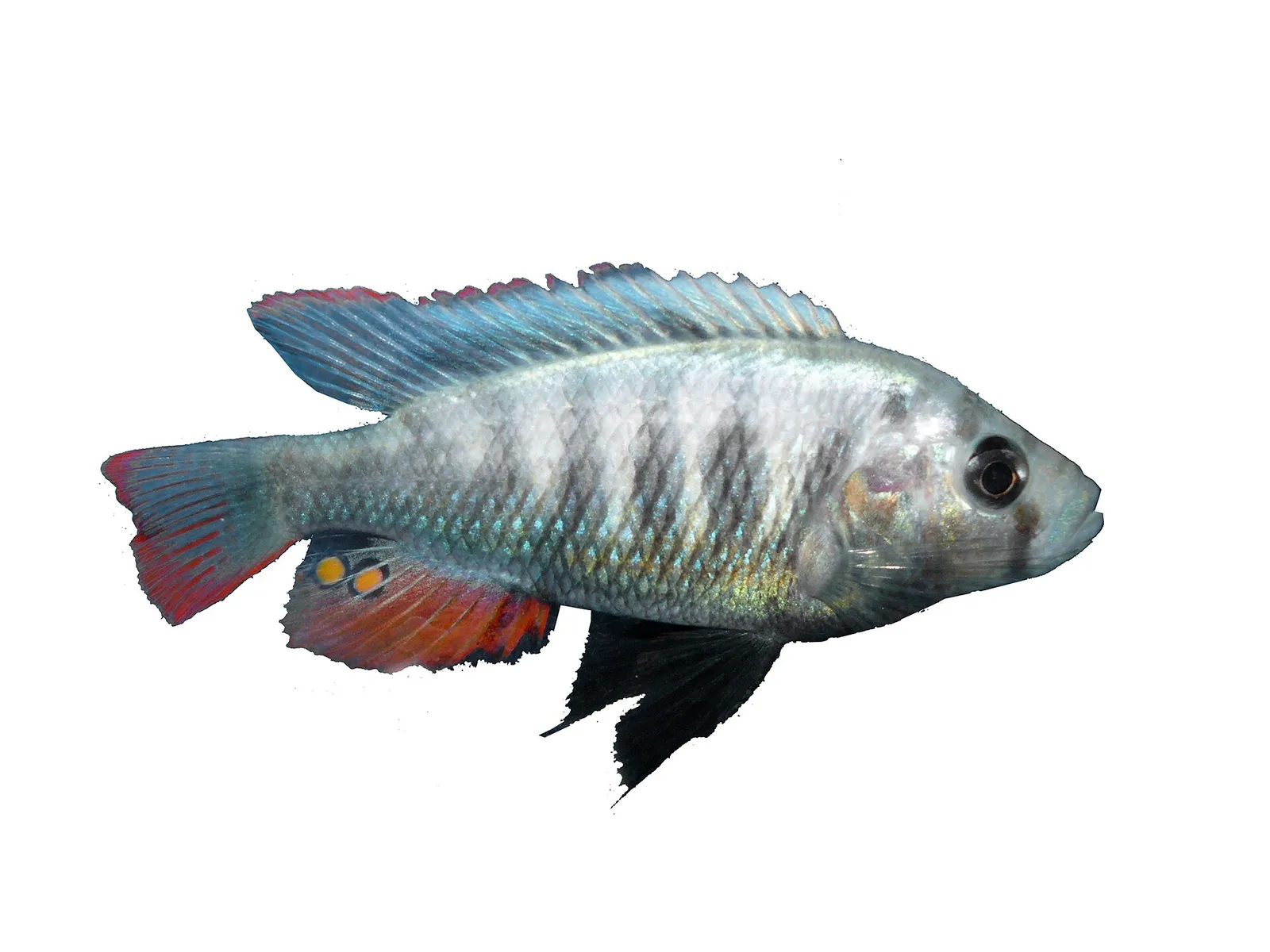
This is a small, fusiform haplochromine, reaching about 5 in in standard length, with the deep-bodied but streamlined profile typical of crevice-dwelling mbipi. The fin counts given in the original description run to 15-16 dorsal spines and 8-10 dorsal soft rays, three anal spines and 8-9 anal soft rays, over 28-30 vertebrae. Its fame, however, rests entirely on male colour. Sexually active Pundamilia pundamilia males turn a metallic blue-grey to silvery-blue over the flank and dorsum, with dark vertical bars and a comparatively plain, blue-tinged dorsal fin — strikingly different from the brilliant crimson-and-yellow nuptial dress of the closely related P. nyererei male, with which it co-occurs. Females and non-breeding fish of both species are a drab, cryptic yellow-brown and are very difficult to tell apart in the field, so the species are diagnosed chiefly by adult male hue. Sexual dimorphism is therefore pronounced: only males develop the species-defining nuptial colour (plus the egg-spot-bearing anal fin used in spawning), while females remain camouflaged. The blue 'side' of the pair is so consistent across Lake Victoria that 'blue' versus 'red' has become shorthand for two of the recurring male colour morphs found throughout the rock-cichlid flock.
Habitat
Haplochromis pundamilia is endemic to Lake Victoria, the largest tropical lake in the world (roughly 68,800 km2) shared by Tanzania, Uganda and Kenya; the species is documented from rocky islands of the Tanzanian waters such as Makobe Island and Python Islands in the Speke and Mwanza gulfs. It is a strict rock-dweller: a cryptic fish of moderately steep to steep boulder shores, living in large crevices between rocks and in pools within emergent rocky reefs, predominantly in shallow water. Depth is itself part of the speciation story — at clear-water sites such as Makobe the blue Pundamilia pundamilia males breed in the shallowest, best-lit water (roughly the top one to three metres), while red P. nyererei males breed deeper, a microhabitat segregation that reinforces the colour-based reproductive barrier. Lake Victoria is warm, well-buffered equatorial water: inshore temperatures typically sit around 23-27 degrees Celsius and surface pH is distinctly alkaline, generally in the range of about 7.2 to 9.0 with moderate conductivity. The critical environmental variable for this fish is not chemistry but clarity: the gradient from clear offshore reefs to turbid, eutrophied inshore bays governs how well the blue and red signals can be seen, and therefore how well the two species stay apart.
Feeding
Despite its prominence in evolutionary biology, Pundamilia pundamilia is an unremarkable feeder ecologically — a generalist insectivore of the rocky littoral. FishBase records that it feeds mainly on benthic insect larvae, especially mayfly nymphs (Ephemeroptera), and occasionally takes zooplankton, small fish and bryozoans, giving it an estimated trophic level around 3.7. It forages over and within the boulder substrate, picking invertebrate prey from rock surfaces and crevices rather than sifting open sand. This diet is broadly shared with its red sister-species, and the considerable overlap in feeding ecology between Pundamilia pundamilia and P. nyererei is part of why the pair is so interesting: because the two are not strongly partitioned by diet, the reproductive isolation that keeps them distinct is carried disproportionately by mating behaviour and colour rather than by trophic divergence.
Mating
The mating system is the whole point of this fish. Like nearly all Lake Victoria haplochromines, Pundamilia pundamilia is polygynous: territorial nuptial-coloured males defend small display sites among the rocks and court any ripe female that passes, while females roam and choose. At sympatric clear-water sites blue Pundamilia pundamilia and red P. nyererei interbreed freely in captivity and are fully fertile, yet in the wild they remain largely separate species — held apart almost entirely by female mate choice for male colour. In the classic experiments of Seehausen and van Alphen, females given a choice under normal lighting strongly preferred conspecific-coloured males (blue females choosing blue, red females choosing red), but under monochromatic orange light that masked the colour difference, the same females mated indiscriminately and the reproductive barrier vanished. This is direct evidence that colour-based mate choice, not hybrid inviability, is what maintains the two species. The depth-related light environment, divergence in the females' visual pigments (opsins tuned to the local light), and even parasite-mediated selection have all been shown to reinforce the preference, making the pundamilia/nyererei pair a flagship example of speciation by sensory drive.
Breeding
Haplochromis pundamilia is a maternal mouthbrooder with no paternal care, the standard reproductive mode of the Lake Victoria haplochromine flock. After a male's courtship, the female lays a small clutch of eggs and immediately takes them into her mouth; the male's anal-fin egg-spots lure her to nip at his vent, where she takes up the milt that fertilises the clutch she is already carrying. She then broods the developing embryos and larvae orally for roughly two to three weeks, releasing free-swimming fry that she may continue to shelter in her mouth when threatened. No formal wild clutch count is published specifically for pundamilia, but congeneric and confamilial Victoria haplochromines of this size typically carry on the order of a few dozen eggs per brood (genus-typical, generally well under a hundred) — small clutches being the rule for mouthbrooders, which trade fecundity for the protection of oral incubation. Because females and broods are cryptic and the species is rarely bred deliberately, most reproductive knowledge comes from the laboratory mate-choice colonies maintained for speciation research rather than from hobby spawning.
In the aquarium
Haplochromis pundamilia is essentially never offered in the general aquarium trade and is rarely kept; the fish people encounter are almost always in university research colonies rather than home tanks. There is consequently no established hobby husbandry tradition for the species, and the honest position is that it is a specialist's fish kept mainly for science. That said, its needs can be inferred reliably from its biology and from the many Lake Victoria mbipi that are kept. It is an alkaline-water cichlid: target a pH around 7.5-8.5 and temperatures of about 24-27 degrees Celsius, with the buffered water typical of the Rift and Victoria lakes. A rocky aquascape with abundant crevices and caves is essential for this crevice-dweller, and because males are aggressively territorial the tank should be generously sized with broken sightlines and a surplus of females per male to spread male attention — the standard recipe for keeping Victoria haplochromines without bloodshed. The single most important caveat is conservation-driven: the entire scientific value of this species rests on the integrity of the colour-based species barrier, so it must never be housed where it can hybridise with P. nyererei or other 'blue/red' Victoria haplochromines. Mixed Victoria-cichlid tanks readily produce fertile hybrids and erase exactly the distinctness that makes pundamilia important; keeping it (if at all) means keeping it pure.
Conservation
The IUCN Red List assesses Haplochromis pundamilia as Least Concern (assessed 1 April 2010 by Witte, de Zeeuw and Brooks; published 2016), reflecting its continued presence at a number of rocky sites within Lake Victoria. That status, however, sits against one of the most catastrophic recent histories of any freshwater fish community. The Lake Victoria haplochromine flock — once several hundred species — was devastated from the 1980s onward by the introduced Nile perch (Lates niloticus) and by accelerating eutrophication; many endemics went extinct or collapsed, and the rock-dwelling mbipi survived best precisely because rocky refuges are hard for Nile perch to hunt. For Pundamilia pundamilia specifically, the more insidious threat is loss of water clarity. The same field and experimental work that made this species famous showed that where nutrient pollution turns the water turbid, females can no longer discriminate blue from red males, assortative mating breaks down, and previously distinct species merge back into hybrid swarms — a documented, ongoing reversal of speciation. The blue Pundamilia is thus a conservation parable as much as a fish: its persistence as a distinct species depends not only on protecting its habitat but on keeping the water of Lake Victoria clear enough for it to recognise its own kind.