Taxonomy & naming
Lugubria percna was described by the Swedish ichthyologist Sven O. Kullander in 1991, together with its Xingu neighbour Crenicichla phaiospilus, in a paper titled "Crenicichla phaiospilus and Crenicichla percna, two new species of pike cichlids (Teleostei: Cichlidae) from the Rio Xingu, Brazil" (Ichthyological Exploration of Freshwaters 1(4): 351–360). The holotype (MZUSP 36880) was collected at Cachoeira do Espelho, the type locality, in the Rio Xingu drainage of Pará State; additional material came from near Altamira and is held at the Museu de Zoologia da Universidade de São Paulo and the Zoologische Staatssammlung München. Before its formal description the fish already circulated in the hobby as "Crenicichla sp. Xingu IV," one of a set of large, undescribed Xingu pikes (Xingu I–IV) that Frank Warzel documented for aquarists in The Cichlids Yearbook Vol. 2 — a reminder of how closely aquarium collectors and taxonomists tracked the same wave of fishes coming out of the Tocantins–Xingu system in the early 1990s.
Within the genus, Kullander's 1991 description placed percna among the pointed-snout species — grouped with C. multispinosa, C. ternetzi, C. tigrina, C. phaiospilus and C. acutirostris — which he distinguished from the blunt-nosed, robustly built lugubris-group pikes (C. lugubris, C. lenticulata, C. marmorata, C. johanna, C. strigata and C. cincta). That morphological grouping does not necessarily track the genus-level split that followed: in a 2023 integrative revision, Varella and colleagues partitioned the old, sprawling Crenicichla using combined molecular and morphological evidence and erected the genus Lugubria, and the Catalog of Fishes and FishBase now list the species as Lugubria percna. How Kullander's pointed-snout grouping squares with a genus built around the blunt-nosed lugubris assemblage is not something we can resolve from the sources at hand — the two classifications use different evidence and need not agree — so we note both rather than assume one supersedes the other. The long-established name Crenicichla percna remains by far the more familiar usage among aquarists and in most of the literature; the atlas follows the Catalog of Fishes in using Lugubria percna.
Morphology
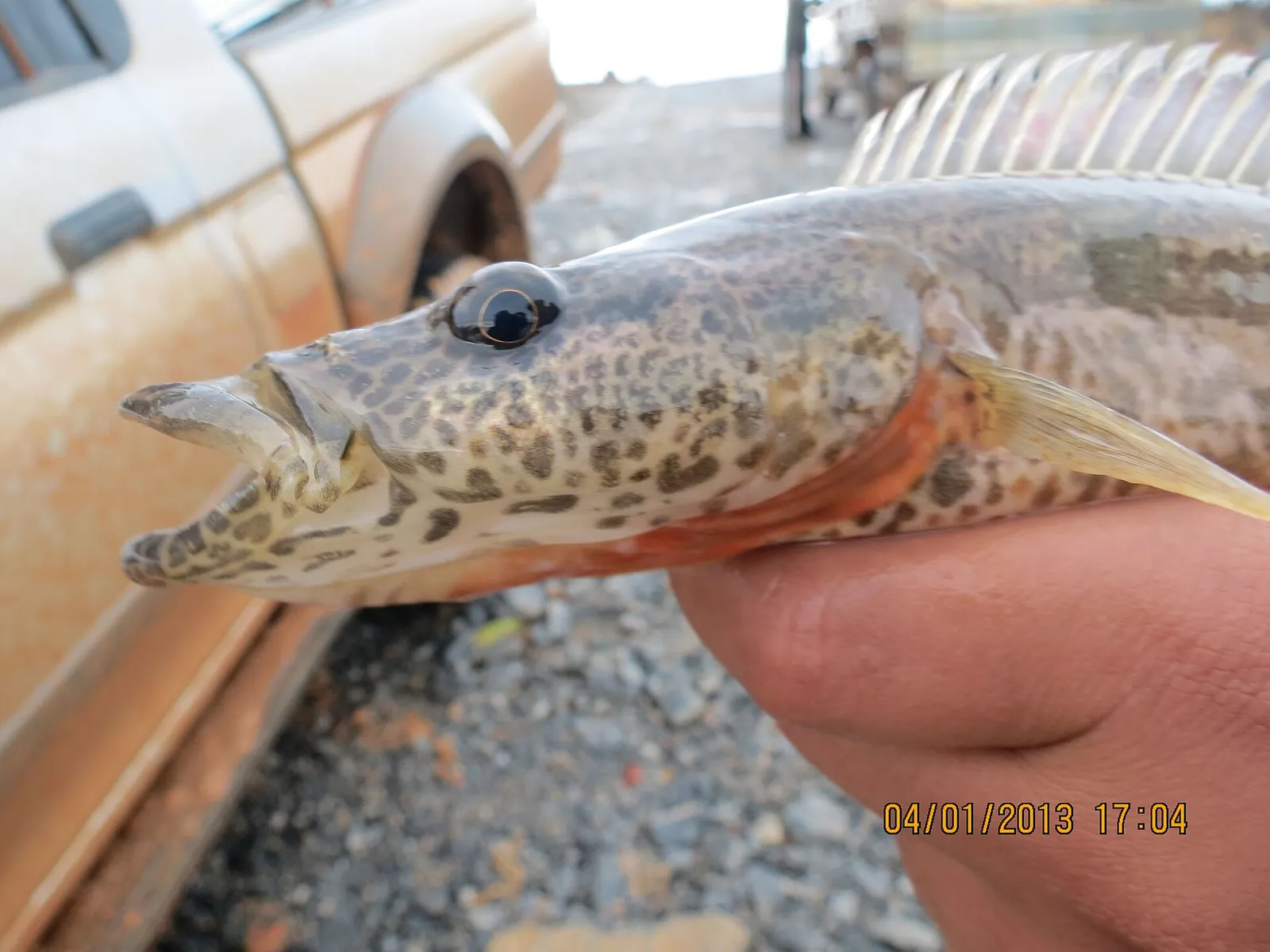
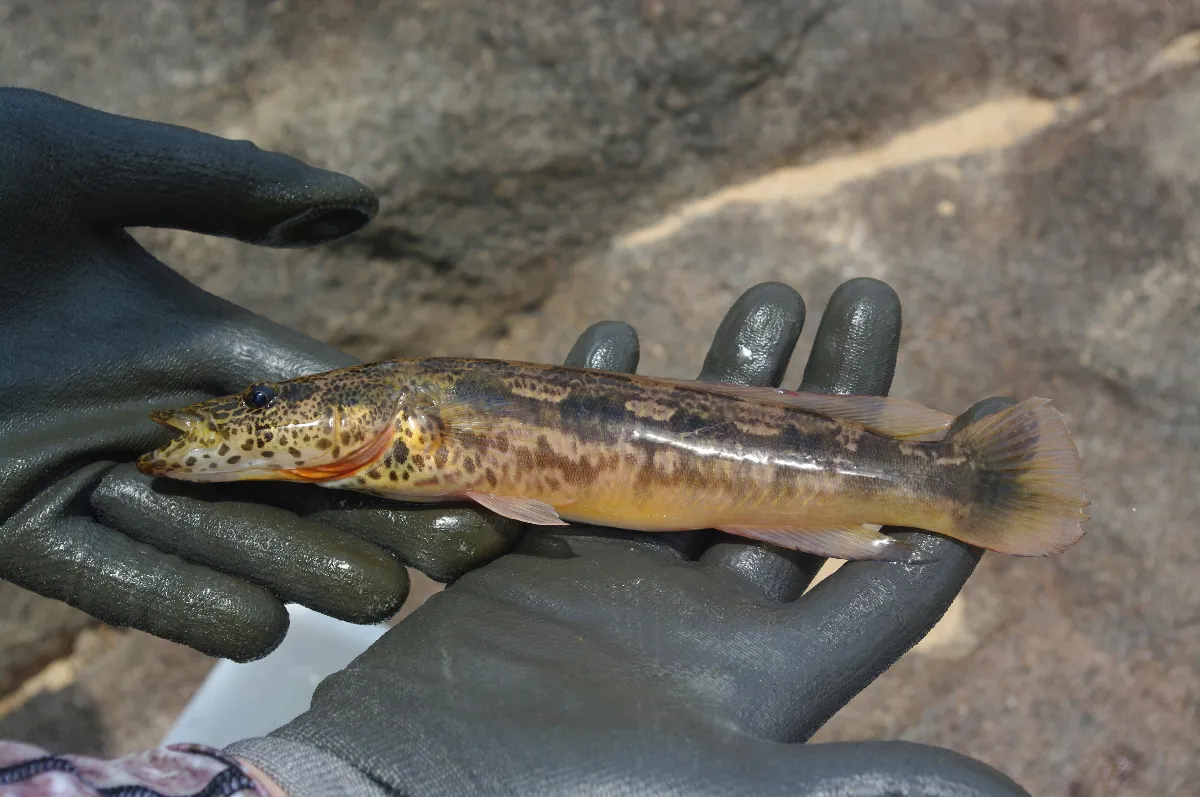
Lugubria percna is one of the larger Xingu pikes, though sources disagree on just how large. Kullander's type series reached about 9 in standard length (roughly 9 in SL, not counting the tail), and FishBase gives a maximum of about 8.5 in SL; Ad Konings' own tabulated figures in Enjoying Cichlids list a maximum of 14 in, comparable to its bigger Xingu relatives, even though he elsewhere describes percna as possibly the one exception among the group of large Xingu pikes that otherwise commonly exceed 12 in. Reconciling those two statements is not possible from the sources at hand, but taken together they indicate a substantial, heavy-bodied fish, very likely exceeding 10 in in total length at full growth and potentially reaching considerably more. The body is the elongate, cylindrical, torpedo shape shared by all pike cichlids, with the dorsal and anal fins set far back toward a powerful tail — the classic form of a lie-in-wait predator that launches in a single explosive lunge. The head is large and the snout pointed, with deeply cleft, protrusible jaws (the FishBase common name "longjaw pike cichlid" reflects this), set with bands of small recurved teeth for seizing and holding prey. The colour pattern, from which the fish takes its name, is dusky: the ground colour is a dark olive to brownish, marked by four dark blotches along the side and overlain by numerous small dark spots scattered across the head and flanks. There is no ocellated caudal blotch, and unlike most Crenicichla it also lacks the light-bordered spot normally present at the base of the caudal peduncle — a feature it shares with its close relatives L. phaiospilus and C. sp. 'Suiá Missú' but not with most other pike cichlids. The unpaired fins (dorsal, anal, caudal) are largely clear or unmarked — features Kullander used to separate it from congeners. Sexual dimorphism follows the typical Crenicichla pattern: males grow larger and more robust with age and develop more extended unpaired fins, while ripe females become noticeably deeper- and fuller-bodied and, as in many pikes, can flush a reddish or contrasting belly when in breeding condition. The species is not strongly sexually dichromatic, and confident sexing usually depends on body proportions and vent shape in mature fish.
Habitat
Lugubria percna is endemic to the Rio Xingu basin in Pará, Brazil, where it occurs through the Middle Xingu and the lower Rio Iriri, the Xingu's major left-bank tributary. Its entire documented range lies above the Belo Monte narrows — the constriction that marks the transition from the Middle to the Lower Xingu — and the type locality at Cachoeira do Espelho, together with collections near Altamira, sits within this rapids-rich stretch. The Xingu here is a clearwater river: comparatively transparent, nutrient-poor, warm and seasonally dynamic, draining the ancient crystalline shield of central Brazil. Lugubria percna is a rheophilic fish of the cataracts, found in and around the shallow rapids and braided channels where fast, well-oxygenated water runs over substrates of large rocks and bare bedrock with little fine sediment. This is the same demanding biotope occupied by a whole radiation of Xingu rheophiles — other large pikes of the lugubris group (the aquarium-trade "Xingu I" and "Xingu II"), the black jacundá Lugubria dandara, and small Teleocichla — fishes that shelter in the shadows between boulders and hunt in the broken water. FishBase characterises the species' preferred envelope as warm and near-neutral, with temperatures around 82–86 °F and pH roughly 6.5–7.0, consistent with the soft, warm clearwater of the shield rivers; documented occurrences are in shallow rapid habitat rather than deep channels, so its effective depth band is the shallow, fast water of the cataracts.
Feeding
Like the great majority of pike cichlids, Lugubria percna is a piscivorous ambush predator, and its large, long-jawed mouth and elongate, thrust-built body leave little doubt about its trophic role. FishBase places it at a high trophic level of about 3.8, near the top of the range for the genus. The lugubris-group pikes to which percna belongs are documented as swallowing fish whole — their pharyngeal plates carry conical and bicuspid (rather than crushing molariform) teeth, the dentition of a fish-eater rather than a snail-crusher. In the rapids it hunts as pike cichlids do everywhere: holding station among the rocks, relying on its dark, cryptic coloration to merge with the shaded stone, then striking with a sudden lunge at small fishes and any other prey that comes within reach. Aquarium observation adds a striking behavioural detail: Lugubria percna will rest motionless on a rock or the substrate, almost feigning death, while its normally light-brown flank spots darken into a much more conspicuous, contrasting pattern — a display Konings records as being triggered specifically when small fish come into view, suggesting it functions as part of the ambush itself rather than simple camouflage at rest. The same dusky camouflage that conceals it from predators also conceals it from prey, the classic double duty of an ambush hunter in a rocky, shadowed environment. As a mid-to-upper predator it helps structure the rheophilic fish community of the Xingu cataracts, exerting predation pressure on the small loricariid catfishes, characins and other rapids-dwellers that share its boulder fields.
Mating
The reproductive behaviour of Lugubria percna has not been documented in detail in the wild, and as with many recently described Xingu rheophiles, what can be said is largely inferred from the well-studied biology of the genus. Pike cichlids are biparental and form pairs; in the larger lugubris-group species, a pair establishes and jointly defends a territory, typically centred on a rock crevice or cavity that will serve as the spawning site. Courtship in Crenicichla involves the usual cichlid repertoire of lateral displays, fin-spreading, jaw-locking trials of strength and a reddening or intensified belly colour in the ripening female, who advertises her condition to the male. These are large, capable predators, and pair formation can be fraught — mismatched or unready fish may fight seriously — so in the wild the pair bond is presumably mediated by mutual display and the abundant cover of the rocky habitat, which lets a subordinate fish withdraw. Outside of breeding, percna is a solitary, territorial ambush hunter rather than a shoaling fish.
Breeding
No detailed account of spawning in Lugubria percna in nature or captivity has been published, and the species is rare enough in the aquarium hobby that reliable breeding reports are essentially absent. Its reproductive mode can nonetheless be stated with confidence from genus-wide biology: like all Crenicichla, it is a biparental cave or crevice spawner. The female attaches a clutch of adhesive eggs to the wall or ceiling of a sheltered cavity — among rapids fish, a crevice between boulders — and both parents guard the brood, the female tending and fanning the eggs while the male patrols and defends the wider territory. After hatching, the wrigglers are moved to pits and the free-swimming fry are guarded and led by the pair, retreating into cover at any threat. Clutch sizes are not documented for percna specifically; large lugubris-group pikes are moderately fecund cave spawners, and congeners of comparable size typically lay on the order of a few hundred eggs per spawning (a genus-typical estimate, not a measured figure for this species). Spawning in shield rivers is generally tied to the seasonal cycle, with reproduction concentrated as water levels and flow shift through the year, though the precise triggers for this species remain unstudied.
In the aquarium
Lugubria percna is a specialist's fish that reaches the aquarium trade only sporadically, usually as wild imports riding the same supply lines that bring out the better-known Xingu loricariids (plecos) and the orange "Xingu I" pikes. It is not a beginner's cichlid, and on its size and temperament alone it demands a large, well-equipped tank. As a heavy-bodied predator that exceeds 10 in in total length, a single adult needs a long aquarium on the order of 6 feet or more, and a serious attempt at a pair or a mixed predator community needs more again. The husbandry brief follows directly from the habitat: this is a fish of warm, clear, well-oxygenated rapids. Aim for a temperature around 82–86 °F, a pH near neutral and on the soft side (roughly 6.5–7.0), and — critically — strong current and high dissolved oxygen, supplied by powerful filtration and additional powerheads to mimic the broken water of the cataracts. Water quality must be kept high with generous, regular changes; rheophilic rapids fish tolerate organic pollution poorly. Aquascaping should provide what the wild fish relies on: a structure of large smooth rocks and stacked stone forming caves and shaded crevices into which the fish can retreat and from which it can ambush, over a substrate of sand or smooth gravel. Feeding is straightforward in that the fish is an enthusiastic predator — but it must be fed as a predator, on meaty foods such as earthworms, prawns, mussel, cut fish and suitably sized live or frozen items; many specimens can be weaned onto large carnivore pellets. Feeder fish are unnecessary and carry disease and nutritional risks. On compatibility, the usual pike-cichlid cautions apply with extra force given the size: anything small enough to be swallowed will be eaten, and conspecifics or other large cichlids may be attacked, especially in confined quarters or around a spawning pair. Robust, fast, similarly sized tankmates that occupy different parts of a big tank (large characins, armoured catfishes, other large rheophilic cichlids) are the realistic options. The most common mistakes keepers make are undersizing the tank, neglecting the flow and oxygen this rapids fish needs, and underestimating its predatory reach.
Conservation
Lugubria percna is assessed on the IUCN Red List as Near Threatened (NT). The assessment was carried out by Brazil's Instituto Chico Mendes de Conservação da Biodiversidade (ICMBio), dated 7 November 2018 and published in 2022. The reason for concern is geographic: the species is a narrow-range endemic confined to the Middle Xingu and lower Iriri, a distribution that overlaps the Volta Grande do Xingu and the reach most directly altered by the Belo Monte hydroelectric complex. Belo Monte diverts a large share of the Xingu's flow out of the Volta Grande and into an off-stream reservoir feeding the main powerhouse, dewatering and inundating stretches of exactly the shallow, fast, rocky rapids that rheophilic specialists like percna depend on — the same threat documented in detail for the syntopic, similarly rapids-restricted Lugubria dandara, whose describers flagged the loss of cataract habitat as the primary danger to the Xingu's rheophilic cichlids. Compounding the dam, the region faces additional pressure from the proposed Volta Grande gold-mining project, with its attendant risks to water quality. None of these pressures has been shown to have driven percna to a higher threat category yet, which is consistent with its Near Threatened rather than threatened listing, but they are the reason its status warrants attention: a fish tied to a single, heavily engineered stretch of one river has little margin if that habitat continues to degrade. (Note that some databases, including the Cichlid Room Companion, list the species as not evaluated; the live IUCN Red List entry under Crenicichla percna gives the Near Threatened assessment cited here.)