Taxonomy & naming
Warren E. Burgess described this fish in 1976 as Pseudotropheus aurora, in a Tropical Fish Hobbyist article series on the family Cichlidae, from material collected at Lake Malawi and probably originating at Likoma Island. The species name is Latin for "dawn" — the Roman goddess of the morning — a nod to the warm golden-yellow that floods the chest and lower head of breeding males where it meets the blue of the upper body.
The genus has been a moving target, and a buyer may encounter the same fish under three different labels. It was first placed in the old catch-all Pseudotropheus (the broad zebra group). When Stauffer and colleagues split that genus in 1997, this fish became Metriaclima aurora; many specialist writers, including Ad Konings, still use that combination today. Eschmeyer's Catalog of Fishes currently lists the valid name as Maylandia aurora (Burgess, 1976) — Maylandia honoring the German ichthyologist and aquarist Hans-Joachim Mayland — and FishBase follows suit. Maylandia and Metriaclima are widely treated as the same genus under different names, so all three combinations (Pseudotropheus, Metriaclima, Maylandia) point to one fish.
It is the type of the informal "aurora group" within the genus: a set of intermediate-habitat mbuna whose males lack a black submarginal band in the dorsal fin and whose females are light brown with yellow fin margins. A 2011 revision by Ciccotto, Konings and Stauffer carved five new species out of this group, tightening the definition of Maylandia aurora to its core populations.
Morphology
This is a modest-sized mbuna. Museum specimens top out around 3.4 in standard length, while in aquaria — measured to the tail tip and on richer food — males commonly reach about 4.5–5 in (4.5–5 in) and occasionally a little more. Reports of "4.5 in" or so reflect total length on well-fed tank fish rather than the wild standard-length figures, so the two numbers are not in conflict.
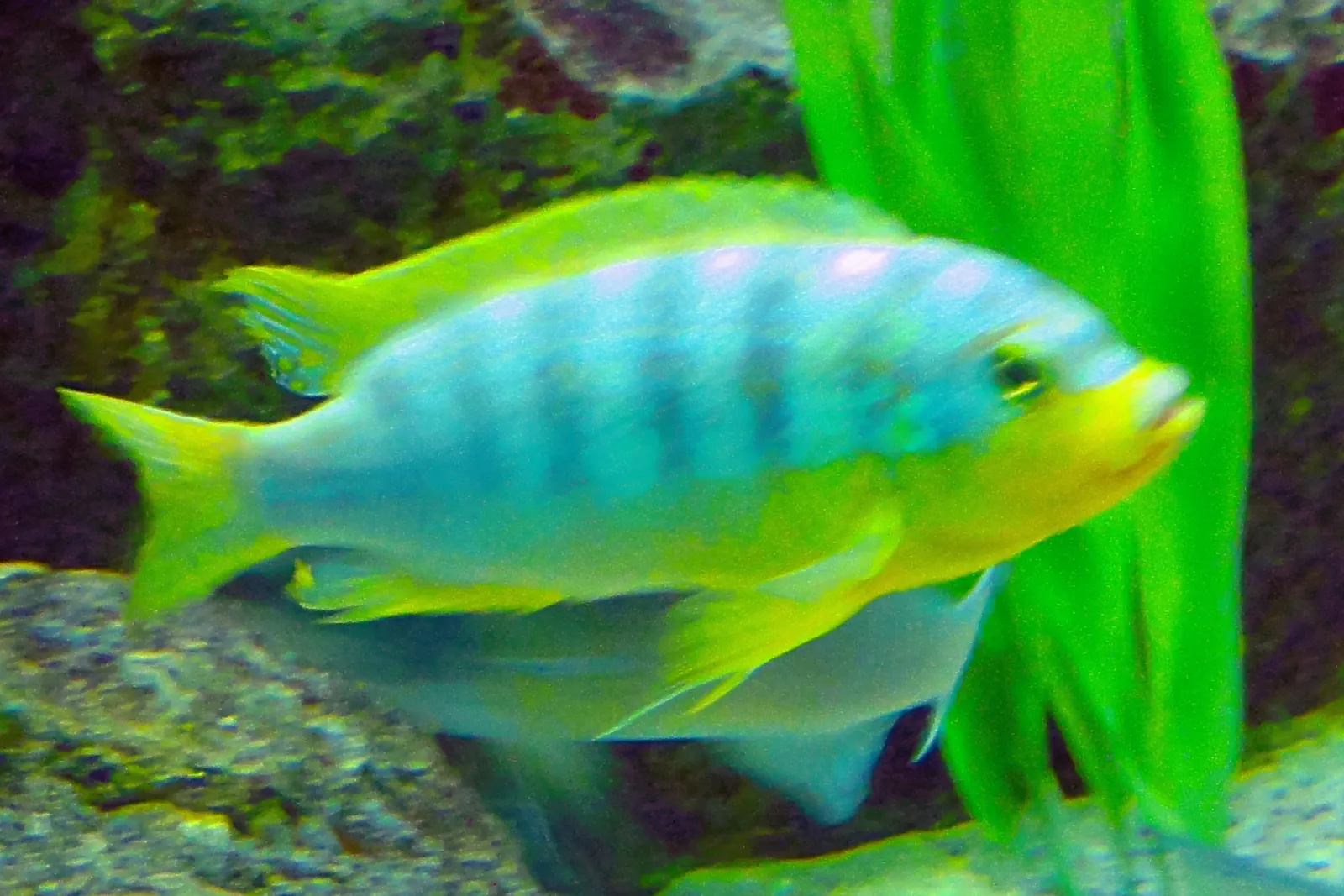
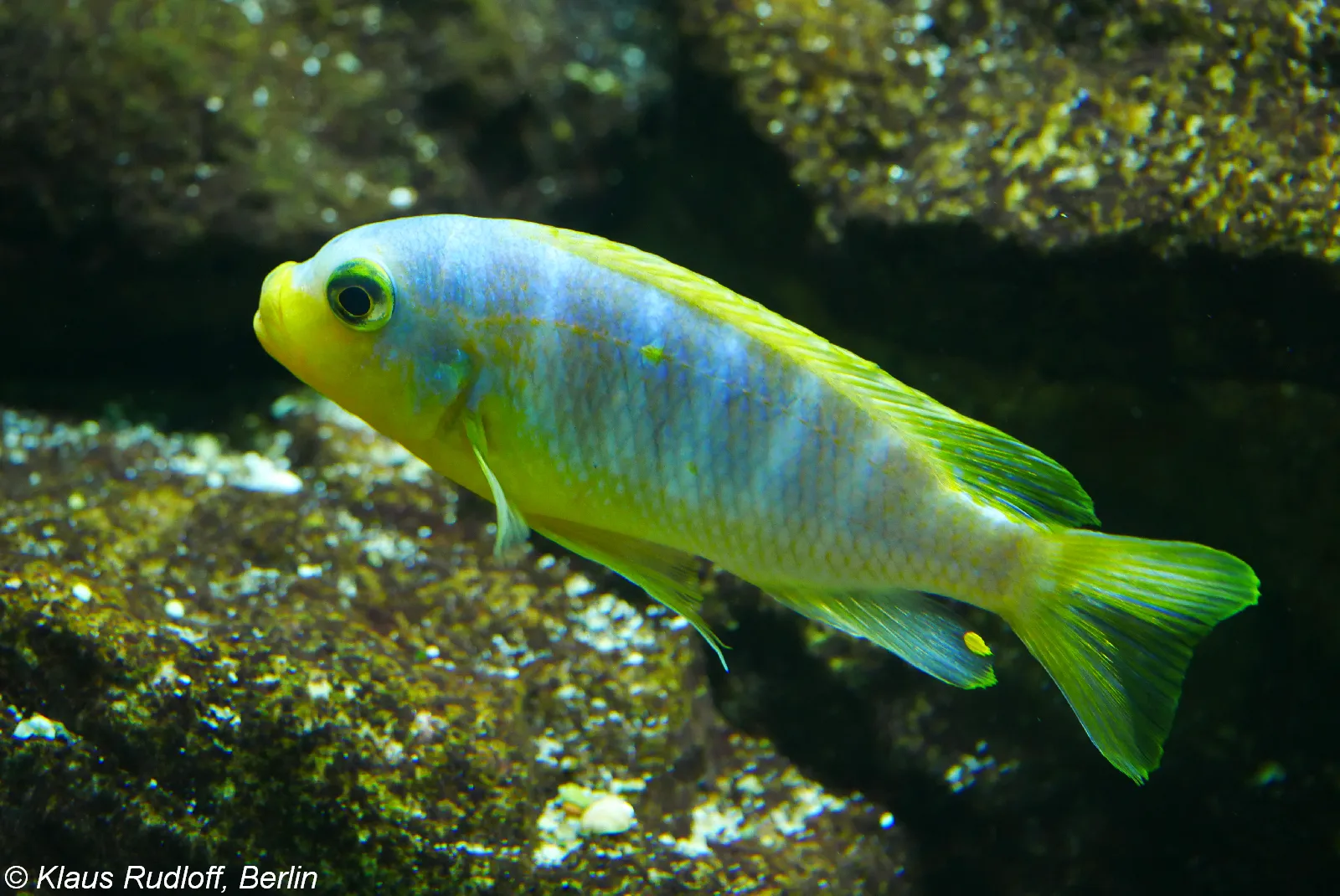
Sexual dimorphism is stark. Mature males from Likoma and the northern Mozambican coast are blue dorsally, the front of each scale sky-blue, with a dark blue caudal peduncle, a golden-yellow belly and breast, and a yellow-washed lower head; the dorsal fin is yellow with a sky-blue submarginal band, and six faint vertical bars show below it. Interestingly, males from Mbweca and Tumbi Point are brown rather than blue on the back — a documented within-species color variant rather than a separate fish. Females are altogether plainer: pale blue-grey to light brown, with orange-brown scale centers, a white belly and yellow-edged fins. That female drabness is a real identification trap — aurora-group females are nearly indistinguishable from one another, which is why the wild populations are usually told apart by male color and locality. The fish carries one telling oddity noted by aquarists: among mbuna, it has an unusually large eye relative to head length.
Habitat
Maylandia aurora is a Lake Malawi endemic with a naturally fragmented range in the lake's northern third. Its core is Likoma Island (the likely type locality) and neighboring Chizumulu Island, plus a string of Mozambican shore sites — Mara Point, Mbweca, Tumbi Point, and an isolated southern outpost near N'kolongwe. It is, in other words, a fish of the lake's eastern and island coastlines rather than a lake-wide species.
It lives in the "intermediate zone" — the transitional habitat where rocky reef gives way to open sand — and is most common right along the rock-sand interface, occasionally pushing onto purely rocky ground that abuts sand. Konings notes that aurora-group species typically favor this intermediate habitat at depths below about 15 feet. Most individuals occur shallow, between about 6.5 and 16 ft (7–16 ft), though the species ranges down to roughly 40 ft (39 ft). The water it inhabits is the alkaline, well-buffered, oxygen-rich condition typical of Malawi's upper layer: pH around 7.7–8.6 and temperatures near 75–79 °F (75–79 °F); a general hardness of roughly 6–10 °dH is a common keeping target. A point worth flagging for the site's purpose: the wild fish is genuinely a creature of this shallow, sunlit reef margin, not the deep open lake — which shapes both its biology and the pressures it faces.
Feeding
Like most mbuna, Maylandia aurora makes its living grazing aufwuchs — the dense felt of algae, diatoms, and the tiny invertebrates and detritus tangled within it that coats Malawi's rocks. FishBase places it at a trophic level of 2.0, effectively a primary consumer, with the diet rounded out by phytoplankton and suspended organic matter picked from the water near the rocks. Its dentition and feeding behavior are those of a rock-scraping grazer rather than a hunter, combing the algal mat for both plant matter and the micro-invertebrates living within it.
Ecologically it is one strand in Malawi's extraordinarily dense mbuna community, where dozens of algae-grazing species partition the same rocky shores by microhabitat, feeding angle, and depth. Maylandia aurora's particular niche is that rock-meets-sand seam, a zone less crowded than the pure rock face, which it shares with other intermediate-habitat specialists. It is not a fishery target of note — FishBase rates its vulnerability low — and its role in the system is as a grazer and, in turn, prey for the lake's larger predatory cichlids and birds.
Mating
Males are territorial and breed within a loose lek-like arrangement. A male typically claims the upper surface of a medium-to-large rock and defends it, though a minority take less prominent sites or dig sand-scrape nests at the base of rocks. Females, juveniles, and non-territorial males drift singly or in loose aggregations of up to about 30 fish. Aggression is directed most fiercely at rival males and at similar-looking species — a recurring theme that matters in captivity.
Courtship follows the classic Malawi egg-spot pattern. A ready male intensifies in color, cleans or excavates a spawning site, and courts passing females with quivering displays. The pair circles head-to-tail; the female lays one or two eggs at a time and immediately turns to take them into her mouth, snapping at the egg-shaped ocelli on the male's anal fin and drawing in milt as she does, so fertilization happens in the buccal cavity. The conspicuous yellow-orange egg-spots are central to this mechanism — work on this very species (as Pseudotropheus aurora) was used to probe how the number and arrangement of a male's egg-spots relate to his reproductive success on the lek.
Breeding
Reproduction is the classic Malawi pattern: maternal mouthbrooding. Once the eggs are fertilized in her mouth during the egg-spot exchange, the female carries the entire clutch alone, with no further role for the male beyond defending his territory and courting other females.
Wild and aquarium accounts converge on a brood of roughly 40–70 eggs, with the female incubating for around three weeks (commonly cited as 10–25 days across sources, the variation reflecting temperature and whether counting is from spawn or from hatch). She broods without feeding throughout, and may continue to shelter the free-swimming fry in her mouth for a few days after release, allowing them to dart back inside when threatened. There is no biparental care: brood-tending is wholly maternal, which is why a single male can fertilize the clutches of several females in succession.
In the aquarium
This is an established hobby fish — hardy, colorful, and not difficult to spawn — but it is honestly not a beginner's first cichlid. The consistent thread across keeper reports is aggression: males are pugnacious toward their own kind and toward similarly colored mbuna. The reliable setup is a single male with a harem of at least three to four females; keeping one male with one female tends to end in the female being harassed to death. Plan on a tank of at least 4 ft / ~55 gallons (a few sources will say a male-plus-two-females will scrape by in ~30 gallons, but the larger footprint genuinely reduces bloodshed), aquascaped as a rocky reef with stable, cave-rich structure built down to the glass, and a stretch of sand the fish can dig.
Water should be alkaline and well buffered (pH ~7.7–8.6) at 75–81 °F (75–81 °F), with strong filtration and regular water changes to handle a messy grazer's waste. Two mistakes recur. First, diet: this is a herbivore, and a protein-heavy menu invites "Malawi bloat" — feed a Spirulina-based staple with vegetable matter and only occasional meaty treats. The frequent care-sheet label "omnivore" overstates how much animal food it should get. Second, look-alikes: do not mix Maylandia aurora with other aurora-group or similarly patterned Maylandia/Metriaclima, both because males will fixate on them aggressively and because the genus hybridizes readily — cross-breeding with congeners is a real risk that muddies bloodlines, so keepers wanting pure stock should isolate it from its relatives. Tankmates are best chosen among robust, differently colored mbuna; a Synodontis catfish is a common bottom-dweller pairing.
Conservation
Maylandia aurora is assessed by the IUCN as Least Concern (2018 assessment, by Ad Konings), with a population trend listed as stable. The assessment notes its natural range across roughly five core sites and concludes there is no foreseeable major threat; the threats it does flag are collection for the ornamental aquarium trade and sedimentation, both rated as potential rather than acute. A translocated population introduced decades ago to Thumbi West Island has thrived and spread around Cape Maclear within Lake Malawi National Park — Konings, who has observed the island for over twenty years, records the Likoma-origin aurora establishing and spreading along its shores, an unusual case where a deliberate intra-lake transplant added a protected, self-sustaining subpopulation. So the species itself is, on current evidence, in reasonable shape.
That said, a Least-Concern species can still sit in a strained lake, and Malawi is under strain. The basin review by Chavula et al. (2023, Journal of Great Lakes Research 49(6):102241) documents lake-wide pressures: heavy over-fishing and the collapse of the chambo (Oreochromis) fishery, rising sediment and nutrient loading washing off deforested catchments, climate warming on the order of +33 °F in shallow waters that strengthens stratification and cuts the mixing that fuels productivity, and a growing invasive-species risk. For Maylandia aurora the most directly relevant of these is sedimentation — the very threat IUCN names. As a shallow, rock-sand-interface grazer dependent on clean, algae-covered rock in the lake's sunlit margin, it is precisely the habitat guild most exposed to silt smothering its substrate and to nearshore development; warming-driven deep-water productivity loss bears less on it than on pelagic species. The honest summary: this fish is not currently threatened, but its shallow reef-edge home is exactly where Malawi's catchment-erosion problems land hardest, so its status is better read as "secure for now, in a lake worth watching."