Taxonomy & naming
Maylandia emmiltos was described in 1997 by Jay R. Stauffer Jr., N.J. Bowers, K.A. Kellogg and K.R. McKaye, in their revision of the blue-black Pseudotropheus zebra complex published in the Proceedings of the Academy of Natural Sciences of Philadelphia (volume 148, pages 189–230) — the same paper that erected the genus Metriaclima and described ten new species within it. The type locality is Mpanga (Mphanga) Rocks near Chilumba, on the north-western shore of Lake Malawi.
The genus name is the subject of a well-known nomenclatural dispute. Stauffer et al. 1997 coined Metriaclima (Greek, 'moderately sloping,' for the head profile), but Maylandia — named in 1984 by Meyer, Riehl and Zetzsche for the German aquarist and author Hans-Joachim Mayland — is older and, under the priority rule of zoological nomenclature, is the senior synonym. Eschmeyer's Catalog of Fishes, this atlas's authority for valid names, lists the species as valid under Maylandia emmiltos and treats Metriaclima as a synonym; that is the usage here. The dispute persists in practice: Ad Konings and much of the European cichlid literature, along with the IUCN Red List, continue to use Metriaclima emmiltos, so readers will meet both names for the same fish.
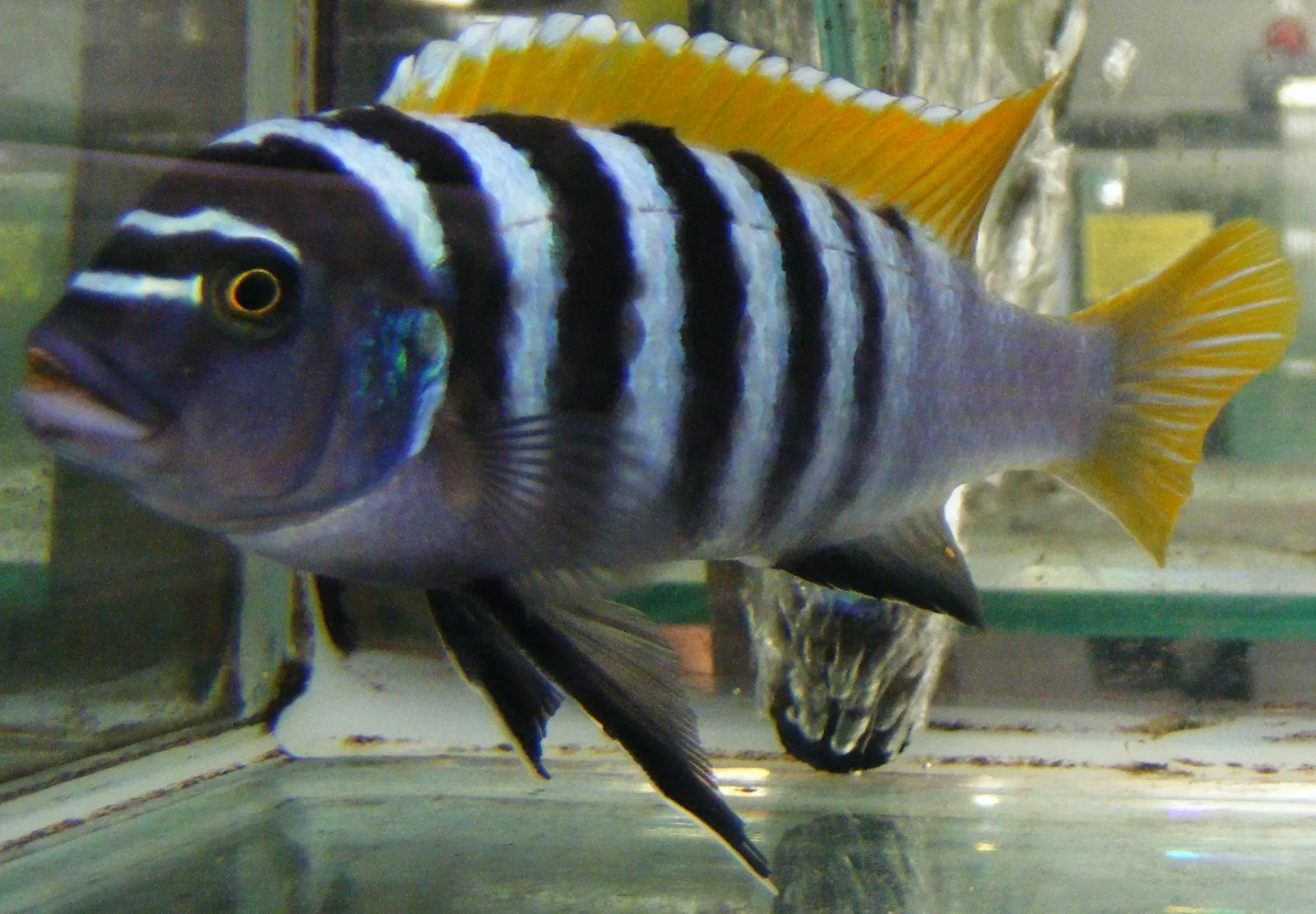
Within the genus, emmiltos sits in the zebra (blue-black) group and is treated as a distinct species rather than a colour form of the wide-ranging Maylandia zebra. Its diagnostic feature is the male's orange-to-red dorsal fin combined with black bars on a blue ground — a pattern it shares among congeners only with Maylandia pyrsonotos, from which Stauffer et al. separated it by a black submarginal band in the anal fin. In the hobby it is universally known as the Red Top Zebra.
Morphology
Maylandia emmiltos is a moderately sized mbuna. FishBase records a maximum of 3.5 in standard length (SL) from the original description; in the field, size differs strikingly between its two known sites. At Mphanga Rocks, males reach about 5 in total length and females about 4–4.5 in; at the deeper, more marginal Luwino Reef population, males rarely exceed 4 in and females about 3 in (malawi.si). The body is the fusiform, moderately compressed mbuna form, with the moderately sloped head that named the genus.
Colour is the species' defining trait. Territorial males carry a blue ground crossed by clean black vertical bars and topped by an orange-to-red dorsal fin — the 'red top.' This bar-plus-red-dorsal combination is, among the many zebra-group mbuna, shared only with Maylandia pyrsonotos; the reliable separator is the black submarginal band in the anal fin of emmiltos. Females and non-territorial males are far plainer, lacking the strong blue and the red dorsal, in the usual zebra-group pattern of moderate sexual dichromatism. Egg-spots on the anal fin mark mature males.
Habitat
Maylandia emmiltos is a Lake Malawi endemic with a genuinely tiny range: it is known only from Mphanga Rocks and the nearby Luwino Reef, on the north-western shore near Chilumba in Malawian waters. This is one of the most restricted distributions among the zebra-group mbuna.
The species is strictly rock-bound, favouring clear-water rocky coasts and shelter-rich rock structures used both for retreat and for spawning. It is common on the large rocks at Mphanga Rocks and much scarcer at Luwino Reef, where it occurs mainly deeper than about seven metres and is uncommon where rocks are scattered thinly over sand (malawi.si). The chemical setting is the standard Lake Malawi envelope: an ancient, strongly buffered rift lake with surface waters around 75–82 °F, alkaline pH of roughly 7.7–8.6, and moderate hardness, stable across the species' small range.
Feeding
Maylandia emmiltos is fundamentally an aufwuchs grazer, like the rest of its guild, but field observation adds an important nuance: it is also a frequent and active plankton feeder. It combs loose material from the algal matrix on rock surfaces at roughly right angles to the substrate using its bicuspid outer teeth, and it is regularly seen in large foraging schools taking plankton from the open water column above the rocks (malawi.si). The mainstay of the diet is still the algal-biofilm matrix of diatoms, filamentous algae and associated micro-organisms.
The practical consequence for aquarists is the familiar one for aufwuchs specialists: a long, plant-adapted gut that copes poorly with rich, high-protein animal foods and a corresponding susceptibility to 'Malawi bloat.' A spirulina- and vegetable-based diet, supplemented sparingly, suits the species far better than meaty fare.
Mating
Breeding males of emmiltos defend territories centred on caves among the rocks, with neighbouring males sometimes spaced as little as about 29.5 in apart (malawi.si) — a dense territorial mosaic typical of a productive rocky reef. The male advertises from his cave in full blue-and-red breeding colour, displaying to females that move through the area. Aggression is intense toward conspecific males but, as the field accounts note, the species is generally tolerant of other species sharing the reef.
No formal courtship study is published, but the behaviour is the standard haplochromine-mbuna sequence: the territorial male leads a receptive female into his cave with lateral displays and shimmying movements, and spawning takes place inside the shelter. Because males are colourful and site-attached while females are cryptic and mobile, mate choice is visual and territory-based.
Breeding
Maylandia emmiltos is a maternal mouthbrooder. Spawning occurs inside the male's cave: in the classic mbuna sequence the female lays eggs a few at a time and immediately takes them into her mouth, nosing at the egg-spots on the male's anal fin so that fertilisation happens at the mouth, repeating until the clutch is complete. Field accounts describe brooding females hiding among the rocks and releasing their young there after incubation, with no observed fry-guarding — the female abandons the fry once they are released (malawi.si).
Incubation runs roughly three weeks, during which the female feeds little, and the male plays no role after fertilisation. Clutch size has not been published as a precise figure for emmiltos; by the pattern of similarly sized zebra-group mbuna it is modest, on the order of a couple of dozen eggs. In the aquarium the cycle replicates easily once a settled male and conditioned females are present, and the comparatively large fry accept crushed flake immediately; moving a brooding female to a quiet rearing tank improves fry survival in a busy community.
In the aquarium
As the 'Red Top Zebra,' Maylandia emmiltos is one of the more recognisable and sought-after zebra-group mbuna in the hobby — the orange-red dorsal over a black-barred blue body is a genuinely showy combination, and the fish is regularly bred and traded, usually by its Mphanga Rocks origin. It is a good mbuna for a keeper who already knows the genre: hardy, colourful and not difficult, but assertive.
A tank of around 80 US gal is the recommended size for a harem of one male with three or four females, with larger groups possible in correspondingly larger aquaria (malawi.si). Water should be alkaline and well-buffered in the Lake Malawi mould — pH roughly 7.8–8.6, temperature 75–82 °F — kept stable with a crushed-coral or aragonite substrate, strong filtration and regular generous water changes. Soft, acidic water is unsuitable.
Provide extensive rockwork with caves and hiding places: this both mimics the clear-water rocky coast the fish inhabits and disperses aggression by breaking sightlines and multiplying territory edges. A sand base lets females forage and shelter. On temperament, emmiltos is aggressive within the species but generally tolerant toward other species, so the usual rule applies — keep a single male, and choose tankmates that are robust mbuna of different colour so the male does not mistake them for rivals. Diet should be spirulina- and vegetable-based to respect the aufwuchs-grazing gut and avoid bloat; this is the most common keeping mistake across the guild. Breeding requires no special trigger beyond a comfortable, well-fed group.
Conservation
The IUCN Red List assessed the species (as Metriaclima emmiltos) as Least Concern, with the assessment dated 20 June 2018. Least Concern here reflects a stable, locally common population rather than a wide one — the listing acknowledges that the species is doing well at its sites, but the sites themselves are very few. There is no CITES or CMS listing.
The honest caveat is that emmiltos has one of the smallest ranges of any zebra-group mbuna, essentially two adjacent reefs near Chilumba, with the Luwino Reef population already thinner and deeper than the Mphanga Rocks stronghold. A single-locality fish, even a common one, is intrinsically exposed: localised sedimentation from catchment deforestation, or a surge of collection for the showy aquarium trade it supplies, could affect a large share of the world population at once. These concerns sit within Lake Malawi's broader trajectory — basin-scale reviews such as Chavula et al. (2023) in the Journal of Great Lakes Research document growing fishing pressure, sediment and nutrient loading, and climate-driven warming that weakens the lake's seasonal mixing. None is recorded as an active decline in emmiltos, but they frame the long-term outlook for a narrowly endemic rock-dweller like this one.