Taxonomy & naming
The Kenyi was described in 1977 by the American aquarist and ichthyologist Warren E. Burgess, in the magazine Tropical Fish Hobbyist, as Pseudotropheus lombardoi — the eighth instalment of his 'Studies on the family Cichlidae' and pointedly subtitled 'a new species of Lake Malawi Mbuna with reversed sexual coloration.' The type locality is Mbenji Island in central Lake Malawi; the holotype was supplied to Burgess by John Lombardo of African Fish Imports, the exporter who first brought the fish to his attention and after whom the species is named. The genus assignment has been unstable ever since. Burgess placed it in the catch-all Pseudotropheus; subsequent workers moved it into Maylandia (Meyer & Foerster, 1984) and into the competing name Metriaclima (Stauffer, Bowers, Kellogg & McKaye, 1997). The two genus names are near-synonyms erected for the same group of Malawi 'zebra' mbuna, and which one is 'correct' remains a matter of nomenclatural dispute — Scharpf and others have argued the priority and validity questions at length. FishBase and Ad Konings' malawi.si database currently file the fish as Maylandia lombardoi, while the IUCN Red List lists it under Metriaclima following Konings (2016) and Stauffer et al. (2016); Pseudotropheus lombardoi persists as the original combination and an older synonym. In the hobby it has also circulated under the trade tags 'golden zebra,' 'Pseudotropheus lilancinius,' and simply 'kenyi.' Within Lake Malawi's enormous mbuna flock it belongs to the rock-grazing zebra group, alongside congeners such as Maylandia zebra, Maylandia callainos and the other Mbenji-Island endemics Maylandia barlowi and Maylandia mbenjii.
Morphology
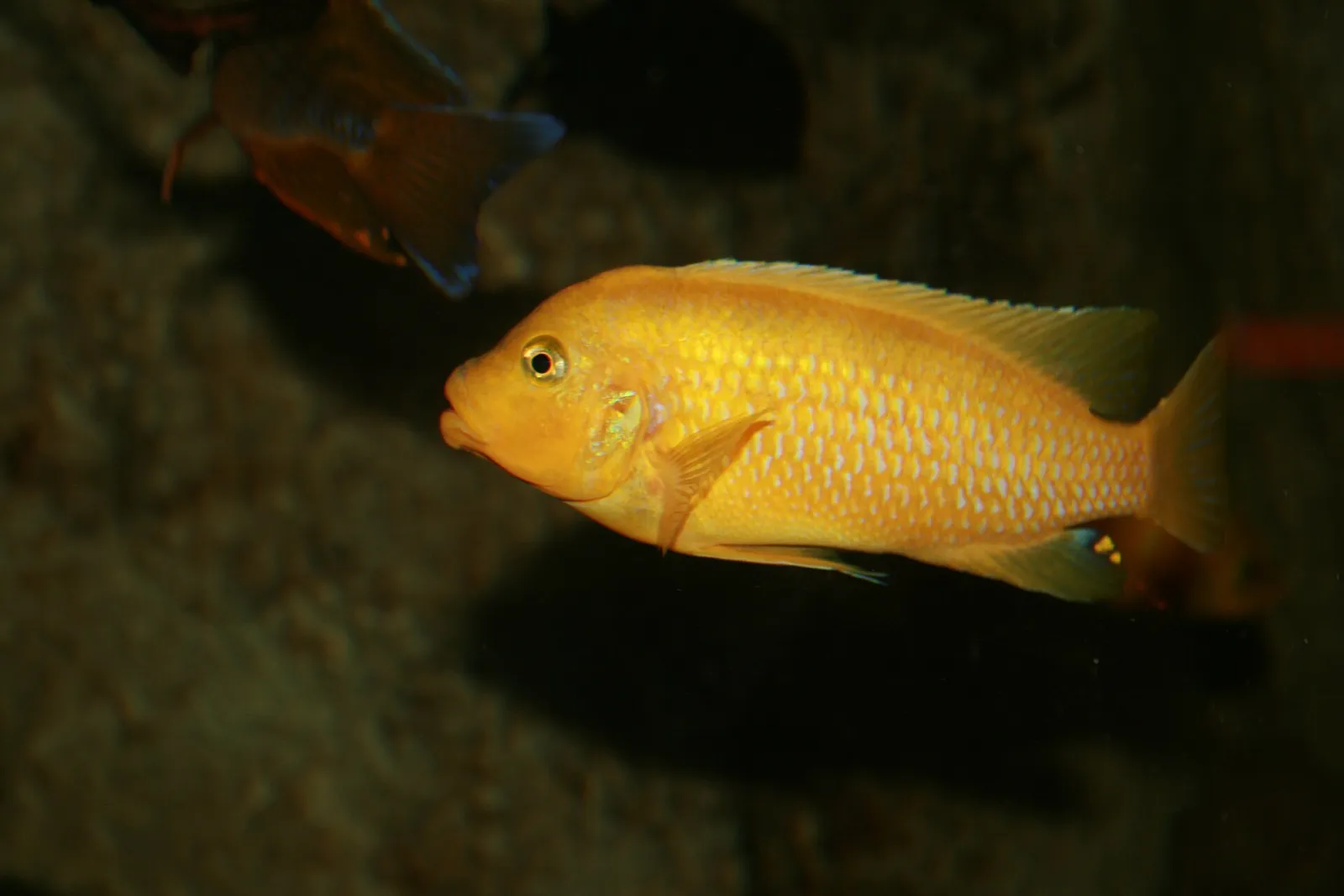
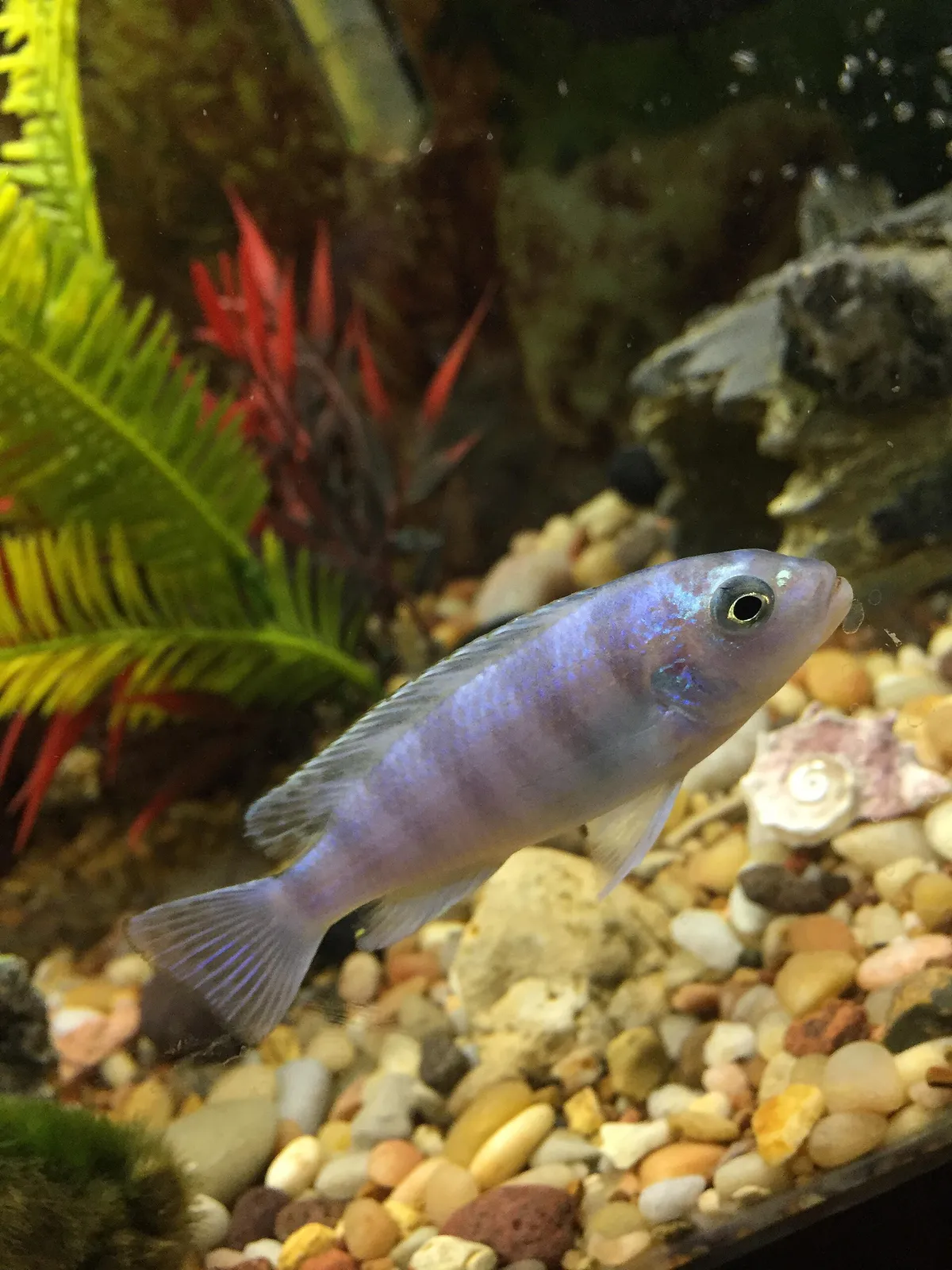
This is a moderately small mbuna with the typical fusiform, slightly compressed body of the rock-zebras. Size reports vary with how the fish is measured and where: FishBase records a maximum of about 3.5 in standard length, the IUCN assessment and several field sources give roughly 4.5 in total length for wild males, and aquarium specimens, fed heavily and free of competition, are commonly reported at 5 in and occasionally up to about 6.5 in. Females stay roughly 10 percent smaller than males. The species' signature is its reversed sexual dichromatism, unusual within the subfamily Pseudocrenilabrinae: adult males are an almost uniform golden to canary yellow — head, body and fins — often showing faint darker vertical bars that fade in and out with mood, a bluish wash on the dorsal, and pale blue streaking in the tail. Females and immatures wear the 'normal' zebra livery: a light to pale blue ground crossed by about five dark vertical bars that begin in the dorsal fin and taper out before reaching the belly. Males make the switch at around 2 in and do not revert; brooding females may temporarily flush yellowish but usually keep their barring. Every male carries a single conspicuous egg-spot (egg-dummy) on the anal fin, and experimental work shows females prefer males displaying one large egg-spot over those with many small ones. Because juveniles and females are blue while only mature males are yellow, a tankful of young Kenyi gives no hint of the colour split to come — a frequent source of confusion for keepers who buy a group of 'blue' fish and watch several turn yellow and turn on each other.
Habitat
Maylandia lombardoi is a lacustrine endemic with one of the smaller ranges in the lake: it is native only to the Mbenji Islands, where it is very common, and to nearby Nkhomo Reef, with underwater observation showing no consistent differences between the two populations. The IUCN puts its area of occupancy below 7.7 mi² (an estimated 3.1 mi²). It is a fish of the intermediate, sediment-rich habitat rather than the clean boulder zone — it is most numerous at the rock–sand interface, over sandy and muddy patches between rocks and over large flat rocks. Depth records run from about 20–98 ft, with the fish notably abundant in water deeper than 33 ft and most numerous around 33 ft; malawi.si gives a typical band of roughly 23–82 ft. Lake Malawi's chemistry frames its requirements: the water is warm, decidedly alkaline and well buffered. In situ and aquarium-reference figures place temperatures around 75–82 °F, pH from about 7.7 to 8.6 (FishBase lists 8.0 and up; Konings' broader lake figures bracket the mid-to-high 7s through the mid-8s), with a general hardness of 10–20 °dH as a common keeping target — stable, well-oxygenated, alkaline water quite unlike the soft blackwaters that many tropical cichlids inhabit. A population has been introduced (by collectors moving fish within the lake) at Namalenje Island, where it is not native.
Feeding
Like most mbuna the Kenyi is fundamentally an aufwuchs grazer — its trophic role is scraping the felt-like mat of algae, diatoms and associated micro-invertebrates that coats the lake's rocks. FishBase estimates a trophic level near 2.7, consistent with a herbivore-leaning omnivore. It feeds by brushing loose algae from rock surfaces, the diet dominated by diatoms and filamentous and blue-green (cyanobacterial) algae, and it is more opportunistic than the most specialised rock-scrapers: it also takes plankton from the open water above the reef. That willingness to feed in the water column, together with its preference for sediment-rich intermediate ground rather than sheer rock, sets it slightly apart from the strict epilithic grazers it shares the reef with. In the aquarium this herbivorous gut has a practical consequence keepers ignore at their peril: a vegetable-based, low-protein diet is essential, because the high-protein, meaty foods that suit many cichlids predispose mbuna like this one to the fatal intestinal inflammation known as 'Malawi bloat.'
Mating
Social structure in the wild centres on aggressively held male territories. Mature males excavate and defend nests — pits dug beneath rocks over sand in the intermediate zone — and are strongly aggressive toward conspecific (same-species) males, while, in the field, showing comparatively little aggression toward other species. Females, juveniles and non-territorial males live singly or in small loose groups away from the nests. This is a polygynous, maternal mouthbrooding cichlid with no pair bond: a territory-holding male courts any ripe female that enters his patch, displaying his yellow flank and quivering to lead her to the nest. Female mate choice is visual and specific — they favour fully yellow males bearing a single large anal-fin egg-spot, the lure that figures in the spawning sequence itself. Once spawning is done the male's involvement ends; he returns to displaying and defending, and the female carries the brood away. The same intrasexual aggression that organises the wild population is what makes the species notorious in tanks, where the lake's natural escape routes and space do not exist.
Breeding
Maylandia lombardoi is a maternal mouthbrooder. Spawning takes place inside the male's cave or nest: the female lays a small clutch — typically about 15–40 eggs — and the classic mbuna egg-spot mechanism comes into play. As she circles to take her own eggs into her mouth, she is drawn to the bright egg-dummies on the male's anal fin and mouths at them, and it is at that moment the male releases milt, so fertilisation occurs in or near her mouth. She then broods the developing eggs and larvae orally for roughly three to three-and-a-half weeks, taking no food, before releasing free-swimming fry and abandoning them immediately — there is no extended parental care once the young are spat out. Generation length is short, about a year, and the species breeds readily; its 'reproductive performance' is one reason it is a trade staple. In captivity it spawns easily and often, and the fry are straightforward to raise on crushed flake and fine vegetable foods — the difficulty with Kenyi is never getting them to breed but managing the violence that breeding condition unleashes among the adults.
In the aquarium
The Kenyi is one of the more demanding mbuna in common trade, not because its water requirements are unusual but because its aggression is exceptional even by Lake Malawi standards. A minimum tank of 59–71 in (roughly 80–105 US gal) is the practical floor for keeping it at all, and larger is better — the male's claim to the whole tank is essentially absolute, and without sufficient horizontal run there is nowhere for subordinates to flee. The water column should follow standard Malawi practice: alkaline, well-buffered, well-oxygenated and warm. Target pH 7.8–8.6, total hardness in the range of 10–20 °dH (roughly 180–360 mg/L as CaCO₃), and temperature 75–82 °F. These are straightforward to achieve by buffering with crushed coral or aragonite substrate, which does double duty as a visual match for the lake's sediment-rich intermediate zone. Rockwork is non-negotiable: stacked rocks creating multiple caves, overhangs and sight-breaks define what the tank is. Smooth stones rather than sharp lava rock are more appropriate for a fish that lives partly over sand and flat rock, and the layout should ensure that no individual fish can claim line-of-sight to the entire tank floor.
The feeding regime is as important as the decor. Maylandia lombardoi is a herbivore-leaning aufwuchs grazer, and its digestive tract is adapted for a diet high in plant matter and low in animal protein. Spirulina-based flake or pellet, blanched greens (courgette, spinach, peas), and algae wafers should form the backbone of the diet. Meaty foods — bloodworm, brine shrimp, beef heart — are the single most common cause of Malawi bloat in this species: a fatal bacterial-inflammatory intestinal condition that progresses from belly distension and loss of colour to rapid death within days. Occasional insect larvae in small amounts are acceptable (the species does take invertebrates opportunistically in the wild), but high-protein staple feeding is a genuine keeper error. Feed small amounts two to three times daily rather than one large meal, and never let uneaten food accumulate.
Tankmate selection requires care and honesty about the fish's personality. Maylandia lombardoi males are among the most intolerant mbuna toward conspecifics: a second male in any tank short of a species-specific public-aquarium setup will almost certainly be killed or chronically harassed. The practical arrangement is one male to three or more females — and even then the male will harass females relentlessly during spawning condition, so females must be able to break line-of-sight easily. With other species, the rule of thumb is to pair the Kenyi only with fish of similar or greater robustness and similar water requirements. Medium-to-large Melanochromis, Labeotropheus, Chindongo elongatus or other aggressive mbuna are the traditional companions, never docile species, and never fish that share its exact yellow-and-blue colour pattern (conspecific colour triggers are real and cross into interspecific aggression). The standard overcrowding strategy for mbuna — stocking the tank densely so that no single fish bears the full weight of one dominant's attention — works here, but overcrowding itself demands excellent biological filtration and regular water changes of 20–30 percent weekly.
Breeding happens readily and usually without coaxing. A healthy, well-fed female in good water will come into spawn condition every four to six weeks, and once a male is in residence and the tank is settled, spawning follows naturally. The brooding female holds for approximately three to three-and-a-half weeks, visibly slack-jawed and refusing food; the experienced keeper learns to recognise this and may move her to a holding tank with a mesh divider — or simply let her brood in situ and catch fry at the point of release. Fry released at 0.5 in are large enough to take crushed Spirulina flake immediately. The main risk to the brood in a mixed tank is the male forcing a premature release by harassing the female; adequate retreat space and the option of separating the brooding female are the standard mitigations.
The Kenyi is a moderately difficult mbuna, rated so principally because of its aggression management requirements rather than any delicacy in its water chemistry or feeding. Keepers familiar with the general mbuna template — alkaline water, rocks, vegetable diet, high filtration — will recognise the framework, but should approach this species with eyes open to the fact that it sits at the aggressive end of an already-aggressive group. It rewards the hobbyist willing to design the tank around its behaviour with a visually striking, active and hardy fish: the reversed colour scheme, with females staying barred blue while males bloom into solid yellow, is genuinely unlike any other cichlid in the standard trade. Generalising from broader mbuna husbandry is reasonable where species-specific detail is thin, but the aggression, the dietary caution around protein, and the male-to-female ratio are points where the Kenyi specifically diverges from a generic mbuna profile.
Conservation
The IUCN Red List assesses the species (as Metriaclima lombardoi) as Least Concern, last assessed on 8 June 2018 by Ad Konings, with a stable population trend. That rating is a deliberate judgement call rather than a sign of a wide range: the fish is endemic to just two restricted locations with an area of occupancy under 7.7 mi², which on area criteria alone would flag it as threatened — but four decades of regular extraction for the ornamental trade have not measurably dented the population, so it is rated Least Concern. Earlier assessments (2006 and 2017) had in fact listed it as Vulnerable, underscoring how narrow-range its distribution is. The threats the assessment names are collection for the aquarium trade (where it is sold as 'golden zebra' and 'kenyi') and sedimentation. That second pressure is the one to watch, because it bears directly on a fish of the sediment-rich rock–sand interface. Lake Malawi as a whole faces mounting basin-level strain — catchment deforestation and soil erosion driving sediment and nutrient loading into the inshore zone, a warming surface layer and strengthened stratification reducing the deep mixing that renews oxygen and nutrients, and heavy fishing pressure across the littoral. For a shallow-to-mid-depth rocky endemic confined to a single island group, increased sedimentation smothering the algal-mat habitat is a more plausible long-term risk than the aquarium fishery, which has so far proved sustainable. None of these lake-wide pressures is yet documented as harming this particular species, but they are the backdrop against which a two-reef endemic's 'Least Concern' status should be read.